Health · Running Safety · U.S. · November 2026
What Runners Need to Know About Rhabdomyolysis After Rachel Apa’s NYC Marathon Death
Rachel Apa, 24, collapsed near Mile 24 of her first New York City Marathon on Nov. 1 and died hours later. Her father says rhabdomyolysis was the cause; the city’s medical examiner has not issued a final ruling.
By the Health & Fitness DeskFact-checked against peer-reviewed studies, hospital patient guidance and named news reportsUpdated November 8, 2026Scope: United States, 2026 NYC Marathon
Rachel Apa knew how to compete. A former Division I field hockey forward at Bucknell University, the 24-year-old from Lewisberry, Pennsylvania, lined up on Sunday, Nov. 1, for her first marathon, running for the Parkinson’s Foundation in memory of her grandfather. Somewhere after the halfway point, the day began to turn. She messaged her father around Miles 18 and 19 that she was hurting. Near Mile 24, inside Central Park and a little more than two miles from the finish, she went down.
She died that night at a Mount Sinai hospital after roughly six hours of treatment. Her father, Steve Apa, has told reporters the cause was rhabdomyolysis, a rapid breakdown of skeletal muscle that most recreational runners have never heard of. The New York City Office of Chief Medical Examiner has not announced a final cause of death. Even so, the family’s account has sent runners across the country searching for the same answers: what rhabdo is, how a fit young athlete could develop it, and how to tell ordinary race-day pain from a medical emergency.
This guide separates what is confirmed from what remains open, then lays out what the research says, including a study of New York City Marathon runners themselves.
What We Know
- Rachel Apa, 24, collapsed near Mile 24 of the TCS New York City Marathon on Sunday, Nov. 1, 2026. It was her first marathon.
- Spectators started CPR, race medical staff used a defibrillator, and an ambulance took her to Mount Sinai, where she was pronounced dead at about 9:40 p.m.
- Her father has publicly said the cause was rhabdomyolysis.
- New York Road Runners expressed condolences and said the previous runner death after a medical incident at the race came in 2024.
- She had raised more than $5,400 for the Parkinson’s Foundation, above her $4,000 goal.
What Is Still Unclear
- The medical examiner had not issued a final cause-of-death determination in the latest reporting.
- Whether heat, hydration, medication, illness or an underlying condition played a role has not been made public.
- It is not known whether rhabdo acted alone or alongside another event, such as heat stroke or a cardiac arrest.
- Lab values such as her creatine kinase and potassium levels have not been released.
Inside the Final Miles: How Race Day Unfolded
Pieced together from her family’s accounts and statements reported by CBS News, The New York Times, NBC News and others, the sequence on Nov. 1 looked like this. Mile markers are confirmed; clock times other than the time of death were not published.
- StartApa begins her first marathon, a 26.2-mile course through all five boroughs, running on the Parkinson’s Foundation charity team.
- Mile 13.1She passes the halfway point. Her father is tracking her progress through the race app and sending messages.
- Miles 18 to 19She replies only twice after halfway, both times saying she is in pain.
- Mile 23Her father sends encouragement as she enters the closing stretch. Her mother waits farther up the course near Mile 25.
- Mile 24She collapses in Central Park near 85th Street. Spectators, two of whom said they were doctors, take turns giving CPR.
- Minutes laterRace medical staff take over and use a defibrillator before an ambulance transports her to Mount Sinai.
- About 6 hoursDoctors continue life-saving treatment. She is pronounced dead at about 9:40 p.m.
- Nov. 3 to 4The medical examiner’s office says it is still investigating. Her father tells reporters the cause was rhabdomyolysis.
Muscle Under Siege: What Rhabdomyolysis Does Inside the Body
Every hard run causes microscopic damage to muscle fibers. That is how training works: the body repairs the damage and rebuilds stronger. Rhabdomyolysis is what happens when the damage outruns the repair. Muscle cell membranes fail on a large scale, and the contents of those cells pour into the bloodstream faster than the body can clear them.
Three of those contents matter most. Myoglobin, the protein that stores oxygen in muscle, is filtered by the kidneys and can clog and injure them, especially when a runner is low on fluids. Potassium, normally locked inside cells, can surge in the blood and disrupt the heart’s electrical rhythm. Creatine kinase, or CK, is harmless in itself but is the main lab marker doctors use to confirm the diagnosis and track its severity.
Why the Heart, Not Only the Kidneys, Can Be the Danger Point
Kidney injury from rhabdo usually develops over hours to days, which is why many runners with exertional cases recover once IV fluids start. A sudden potassium spike moves faster. High blood potassium, known as hyperkalemia, can provoke arrhythmias and cardiac arrest. It is one reason a collapse during a race can involve several overlapping processes, including heat illness, electrolyte shifts and muscle breakdown, that may be hard to untangle until a full medical review is complete.
Rare but Real: The Numbers Behind Exercise-Related Rhabdo
In absolute terms, rhabdomyolysis is uncommon. A 2016 review in BMJ Open Sport & Exercise Medicine cited an estimate of about 26,000 U.S. cases a year from all causes, with exertional cases making up 47% in one report, though other studies found smaller shares. Many milder cases in distance runners are never diagnosed. Emory cardiologist Jonathan Kim, who has co-authored large studies of 23 years of U.S. marathon and half-marathon death data, told CNN that race deaths are extremely rare and deaths from rhabdo rarer still.
The gap between those figures is the point. Across every cause, including crush injuries, drug toxicity and infections, kidney injury is common. Among otherwise healthy people hospitalized for exercise-related rhabdo in a Kaiser Permanente Northern California study published in JAMA Network Open in 2024, the rate was far lower: 17 of 200 patients, and none died. That is why doctors describe a fatal case in a young runner as exceptional, not typical.
The Heat Signal Hidden in Six New York City Marathons
The most relevant research comes from New York itself. Physicians at Mount Sinai and Lenox Hill, including nephrologist Douglas Farrell, reviewed hospital charts for rhabdomyolysis after the 2017, 2018, 2019, 2021, 2022 and 2023 marathons. The 2020 race was canceled because of COVID-19. Their findings appeared this year in the journal Nephron.
One year dominated. The 2022 race, the warmest since the event moved to November in 1986, reached a peak heat index of 24.5°C, about 76°F, and produced 24 cases of post-marathon rhabdo. The other five races combined produced about 15. Heat index and case counts moved almost in lockstep, with a correlation of 0.93, and race day in 2022 was 5.6°C, about 10°F, warmer than the previous two weeks, the biggest jump of the period.
Who Came Into the ER After the 2022 NYC Marathon
The authors pointed to acclimatization. Runners who had trained through a cool autumn met sudden warmth on race day before their bodies had adapted to shed heat efficiently. They described the link as a correlation rather than proof, and the sample was small. It also matters that the 2026 race was not a 2022-style heat outlier: forecasts called for the 50s to around 60°F, though some outlets described temperatures reaching the mid-60s. Heat is one piece of the puzzle, not a full explanation.
What the Bloodwork Revealed
CK readings in the Nephron group were striking. The average on arrival was 5,515 units per liter and the average peak was 21,426, with one runner reaching 88,430. Runners who arrived feverish peaked far higher than those who did not. Nearly all had some kidney injury, yet almost every case was short-lived and responded to IV fluids. One runner needed dialysis for about two weeks and then recovered.
Creatine Kinase Levels in NYC Marathon Rhabdo Patients
The Painkiller Habit That Kept Showing Up in the Data
If one practical lesson stands out, it concerns over-the-counter anti-inflammatory drugs such as ibuprofen and naproxen, known as NSAIDs. In the Kaiser study, 64.7% of patients who developed kidney injury had used NSAIDs before admission, compared with 21.9% of those who did not. The researchers estimated that eliminating NSAID use and dehydration could have prevented 92.6% of the kidney injury cases.
The New York data echo that at small scale. The only runner in the Nephron study who needed dialysis was also the only one documented to have taken naproxen, and he reached the hospital later than the others. NSAIDs reduce blood flow to the kidneys exactly when they most need to flush out myoglobin. The Kaiser authors favored acetaminophen for exercise-related aches. Nothing has been reported about whether Apa took any medication.
How NSAIDs and Dehydration Tracked With Kidney Injury
Who Faces Higher Odds, Beyond the Distance Itself
Anyone can develop exertional rhabdomyolysis, regardless of age or fitness. Cleveland Clinic sports medicine physician Jessica Tomazic and other experts quoted in recent coverage name a consistent set of risk factors. The table below organizes them alongside the data behind each.
| Risk factor | Why it raises risk | Evidence or figure | Practical step |
|---|---|---|---|
| Unaccustomed heat | Body has not adapted to shed heat; muscle and core temperature climb | 24 cases in 2022 vs about 15 in five other races | Watch forecasts; slow pace on warm days |
| Dehydration | Less fluid to flush myoglobin through the kidneys | Paired with NSAIDs, linked to 92.6% of AKI | Drink to thirst; use electrolytes on long runs |
| NSAID painkillers | Cut kidney blood flow when it is most needed | 64.7% vs 21.9% use, AKI vs no AKI | Skip ibuprofen and naproxen before and during races |
| Running while sick | Fever adds heat load; infection stresses muscle | Febrile peak CK 27,123 vs 12,176 | Defer the race if you have a fever |
| New or sudden intensity | Untrained muscle breaks down faster | Cases tied to spin, HIIT and CrossFit | Build mileage and intensity gradually |
| Prior rhabdo or family history | May signal an inherited muscle disorder | Repeat episodes flagged in 2016 review | Ask a doctor about genetic testing |
| Sickle cell disease | Abnormal red cells impair oxygen delivery to muscle | Listed by Cleveland Clinic experts | Get personalized clearance before racing |
| Statins, alcohol, drugs | Can make muscle more vulnerable to injury | Case report: CK 2,631 on a statin vs 650 off it | Review medications with a physician |
Two cautions keep this in proportion. Most people with several of these risk factors never develop rhabdo, and a first marathon is not inherently dangerous for a healthy, trained runner. At the same time, fitness lowers risk without erasing it. Apa was a lifelong athlete who exercised regularly, according to her father. Earlier in 2026, a 21-year-old Navy SEAL candidate, Austin Stallman, died of rhabdomyolysis after collapsing during a 9-mile training run in Texas.
Sore Legs or Something Worse? Reading the Warning Signs
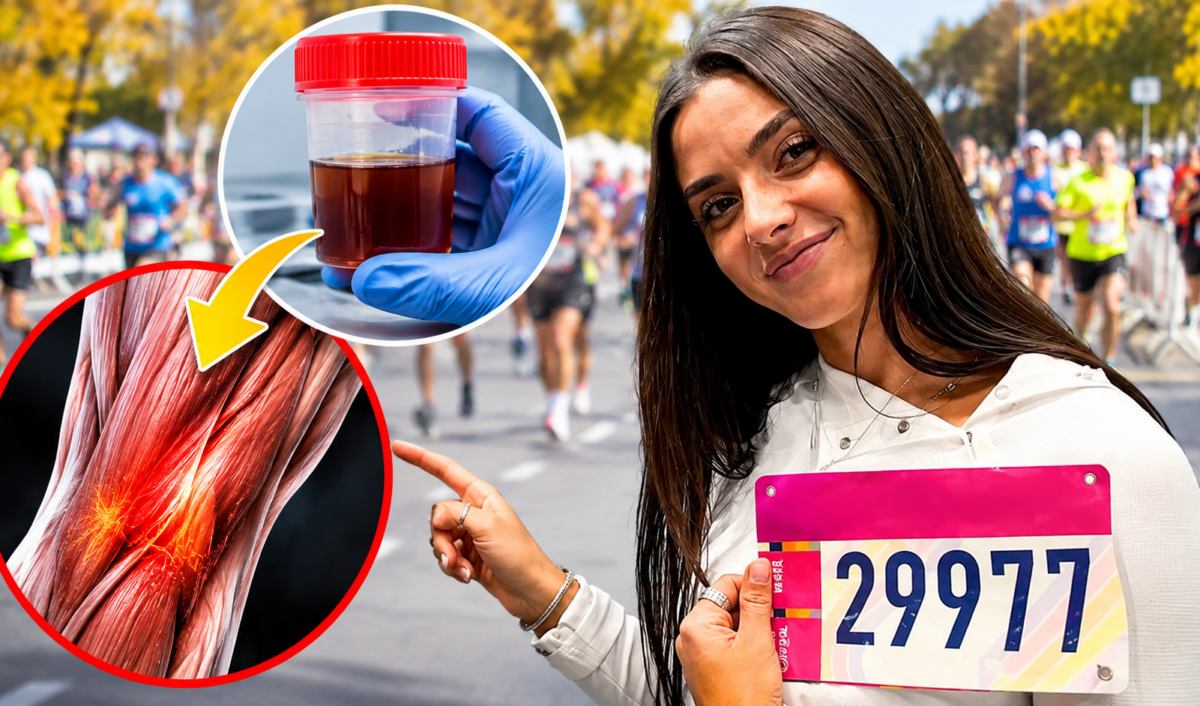
The difficulty is that early rhabdo can look like ordinary marathon misery. Every finisher hurts. Clinicians describe the red flags as pain out of proportion to the effort, muscles that swell or feel rock-hard, weakness that keeps getting worse instead of better, and urine the color of tea or cola.
Why Dark Urine Is the Signal Not to Ignore
Cleveland Clinic notes that the classic trio of muscle pain, weakness and dark urine appears in fewer than 10% of patients, so missing one piece of the set is not reassuring. Myoglobin tints urine brown. If dark urine follows a long or intense effort, especially with little urine at all, the right move is an emergency department, not a recovery shake. Confusion, fainting or repeated vomiting during a race are emergency signs on their own.
| What you notice | Usually normal | Possible rhabdo | What to do |
|---|---|---|---|
| Muscle soreness | Peaks 24 to 72 hours, slowly fades | Severe, worsening, out of proportion | Seek care if pain keeps rising after 24 hours |
| Urine color | Pale to light yellow | Tea, cola or brown | Emergency department now |
| Urine output | Returns within a few hours of fluids | Very little or none for hours | Emergency department now |
| Swelling | Mild puffiness | Tight, hard, very tender muscle | Urgent evaluation |
| Strength | Tired legs that improve with rest | Weakness that keeps worsening | Urgent evaluation |
| Body temperature | Normal after cooling down | 100.4°F or higher | Cool down and get medical help |
| Mental state | Clear, if exhausted | Confusion, fainting, collapse | Call 911 immediately |
Inside the ER: How Doctors Treat Rhabdomyolysis
Diagnosis rests on a blood test for creatine kinase. Rhabdo is commonly defined as CK above about five times the upper limit of normal, though some definitions use ten times. Doctors also check kidney function, potassium and a urine sample. Treatment centers on generous IV fluids to flush myoglobin through the kidneys, along with close monitoring of electrolytes and heart rhythm. Dialysis is reserved for severe kidney failure or dangerous potassium levels.
Timing is the variable patients control. In the New York study, every patient received IV fluids, and the one runner who needed dialysis had arrived late. Most people with exertional rhabdo recover fully, often within days to a few weeks, but they are usually told to return to training slowly and only after their bloodwork normalizes.
A Race-Week Playbook That Lowers the Odds
None of these steps guarantees safety, and none says anything about what happened to Apa. They reflect the patterns that keep appearing in the research and in sports medicine guidance.
- Build graduallyA common coaching rule is to raise weekly mileage by no more than about 10%.
- Respect the forecastHeat adaptation usually takes 10 to 14 days; adjust goals if race day runs warm.
- Leave the ibuprofen homeAvoid NSAIDs for 24 hours before and during long efforts; acetaminophen is a gentler option.
- Hydrate to thirstSteady sips plus electrolytes beat chugging; overdrinking carries its own risk.
- Skip the race if sickA fever of 100.4°F or higher is a clear reason to defer.
- Listen past mile 18Pain that sharpens in the final 8 miles is a reason to walk or stop.
- Check your urine within 6 hoursDark color or little output after a race means go to the ER.
- Review your medicationsAsk about statins and other drugs that affect muscle before race season.
If You Are Cheering, Pacing or Running Beside Someone
Spectators often see trouble first. Stumbling, confusion or a runner who suddenly stops responding should prompt a call to the nearest medical tent or 911. If someone collapses and is not breathing normally, start CPR and ask for an automated external defibrillator, exactly what bystanders did for Apa. And if a friend texts mid-race that they are hurting, it is fair to ask whether they should stop.
Frequently Asked Questions
What is rhabdomyolysis in simple terms?
It is a condition in which damaged skeletal muscle breaks down and releases proteins and electrolytes into the blood. Myoglobin can injure the kidneys and potassium can disturb the heart’s rhythm. It can follow extreme exercise, heat, crush injuries, infections, drugs or certain medications.
What did Rachel Apa die from?
Her father has said she died of rhabdomyolysis after collapsing near Mile 24 of the Nov. 1, 2026 New York City Marathon. The New York City Office of Chief Medical Examiner had not issued a final cause-of-death determination in the latest reporting, and race organizers have not confirmed a cause.
Can running a marathon cause rhabdomyolysis?
Yes. Endurance events can trigger exertional rhabdomyolysis, especially in heat, with dehydration, while sick or after NSAID use. Mild muscle breakdown is common in distance runners, but serious cases needing hospital care are uncommon and deaths are rare.
What are the early warning signs of rhabdo?
Muscle pain far worse than the effort explains, swelling or very firm muscles, weakness that keeps getting worse, and dark urine. Nausea, vomiting, confusion and fainting are more serious signs. The classic full set of symptoms appears in fewer than 10% of patients, so do not wait for all of them.
What color is urine with rhabdomyolysis?
Often tea-colored, cola-colored or reddish-brown, caused by myoglobin. Dark urine after a long or intense workout, particularly if you are passing very little, is a reason to go to an emergency department.
How long after exercise does rhabdomyolysis show up?
Symptoms can begin during an extreme effort or develop over the following 24 to 72 hours. Soreness that peaks and fades is typical of normal recovery; pain, swelling and weakness that keep worsening are not.
Can ibuprofen cause rhabdomyolysis or make it worse?
NSAIDs such as ibuprofen and naproxen are not considered a main cause, but research links them to kidney injury in people who develop rhabdo. In a 2024 study, 64.7% of patients with kidney injury had used NSAIDs versus 21.9% without it. Researchers favored acetaminophen for exercise-related pain.
Can you fully recover from rhabdomyolysis?
Most people with exercise-related rhabdo recover completely with prompt IV fluids, and many return to running after a gradual, doctor-guided restart. Severe or delayed cases can require dialysis, and in rare cases the condition is fatal.
The Short Version
Rachel Apa, 24, collapsed near Mile 24 of her first New York City Marathon and died hours later; her father says rhabdomyolysis was the cause, while the medical examiner’s ruling is still pending. Rhabdo occurs when muscle breaks down faster than the body can cope, flooding the blood with myoglobin, potassium and CK. Serious exertional cases are uncommon and usually treatable, but heat, dehydration, illness, sudden intensity and NSAIDs push risk higher. Dark urine, worsening weakness or confusion after a hard effort warrant emergency care. For runners, the practical takeaway is simple: train gradually, respect the weather, skip the ibuprofen and treat unusual pain as information.

Omisha is a health writer passionate about turning complex medical research into clear, actionable content readers can trust. She covers everything from nutrition and mental wellness to chronic disease management, always grounding her work in credible science and real-world relevance. When she's not writing, she's usually reading up on the latest health studies or exploring new wellness trends to write about next.