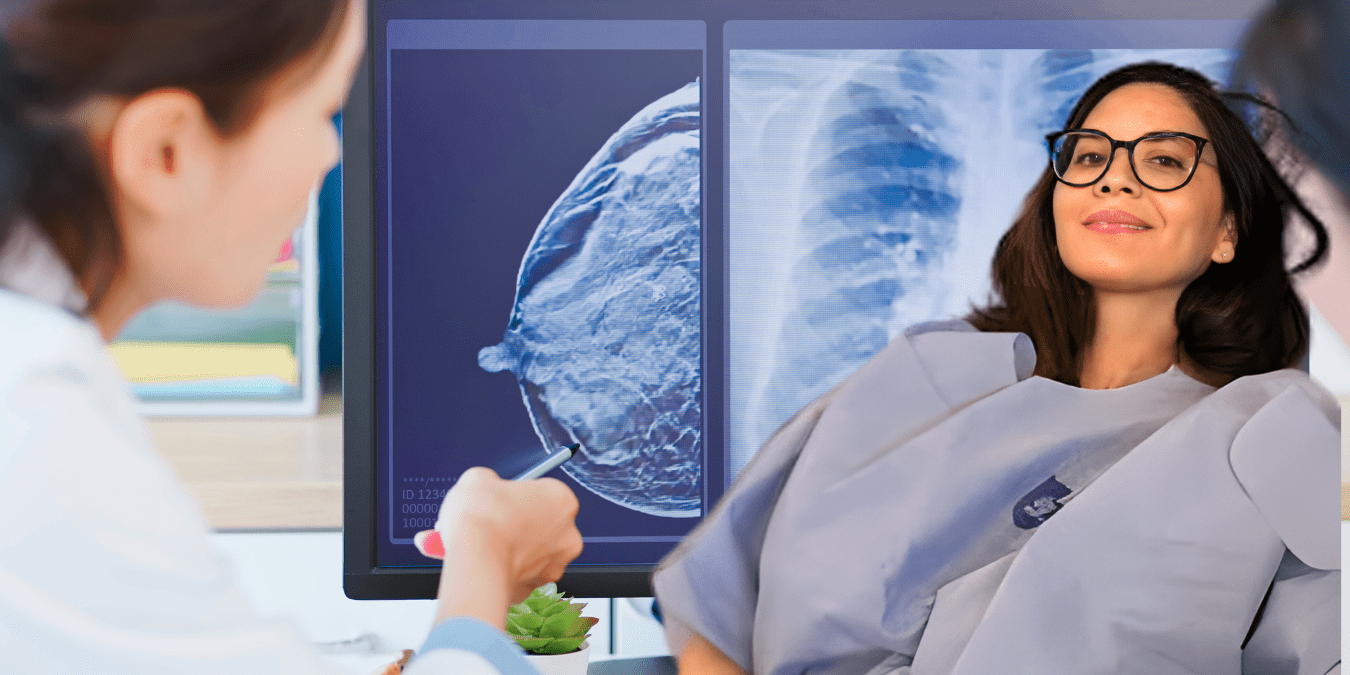
Her mammogram was clear. Her ultrasound was clean. She had zero symptoms. Yet Olivia Munn had breast cancer in both breasts — and a free, 5-minute online quiz caught what every doctor missed. Now 4,000% more women are taking it. Do you know your number?
Olivia Munn had done everything right. She had gone to her annual appointments, gotten her mammogram, and received a clean bill of health. Her ultrasound was clear. There were no lumps, no pain, no warning signs — absolutely zero symptoms. And yet, in April 2023, the actress and mother was diagnosed with Stage 1 Luminal B breast cancer in both breasts.
The twist that makes her story unlike most cancer stories you have ever read? A single, free, five-minute online quiz caught what every other medical screening missed — and it is now saving women’s lives across the United States at a rate no one could have predicted.
A Routine Appointment That Changed Everything
It did not start in a radiology lab or an oncologist’s office. It started at an annual Pap smear appointment, the kind of check-up most American women schedule on autopilot and often rush through. During that appointment, Olivia Munn’s gynecologist paused and asked a deceptively simple question: “Do you know your lifetime breast cancer risk score?”
Munn did not. Most women do not — and that is exactly the problem.
Her doctor pulled up an online tool called the Tyrer-Cuzick Risk Assessment, also known as the IBIS model, right there in the exam room. Together, they spent less than five minutes answering a series of questions. The result stopped them both. Munn’s lifetime breast cancer risk score came back at 37.3 percent.
For context, the average woman in the United States carries roughly a 12 to 13 percent lifetime risk of developing breast cancer — about a 1 in 8 chance. Any score above 20 percent is medically classified as high risk. Munn’s score was nearly three times the national average, and she had no idea until that moment.
That score unlocked a chain of follow-up screenings that a clean mammogram had not triggered. Her doctor ordered a breast MRI — a far more sensitive imaging tool than a standard mammogram — and the MRI found what everything else had missed: early-stage cancer in both breasts.
“No symptoms,” Munn later told CBS Sunday Morning in March 2026. “And I had a clear mammogram and a clear ultrasound.”
What Exactly Is This Test — and Where Can You Take It?
The tool at the center of Olivia Munn’s story is the Tyrer-Cuzick (IBIS) Risk Assessment Tool, a scientifically validated online questionnaire that estimates a woman’s probability of developing breast cancer over her lifetime. It is completely free to use, available to anyone with internet access, and takes approximately five minutes to complete.
Unlike a standard mammogram, which looks for physical evidence of cancer that already exists, the Tyrer-Cuzick model is predictive. It asks a comprehensive set of questions to build a full picture of your individual risk profile, including:
- Your current age and race/ethnicity
- Whether you have ever been pregnant, and at what age
- Your age at first menstrual period
- Your body mass index (BMI)
- Whether you have dense breast tissue
- Your personal history of breast biopsies or ovarian cancer
- Your family history of breast cancer, including first and second-degree relatives
- Whether you carry the BRCA1 or BRCA2 gene mutations
- Whether you have used hormone replacement therapy
The model then runs all of those data points through a statistical algorithm built from decades of population-level cancer research and returns a percentage score representing your lifetime breast cancer risk. A score above 20 percent qualifies a woman for enhanced screening protocols, including annual breast MRIs in addition to mammograms — the very protocol that caught Munn’s cancer.
The National Cancer Institute (NCI) also offers its own free tool at bcrisktool.cancer.gov, based on the Gail Model, which asks about age, race, reproductive history, biopsy history, and family history. Both tools are legitimate, evidence-based, and available right now to every woman in America at no cost.
- Louisiana Vibrio Vulnificus Outbreak 2026 Explained: Who Faces the Greatest Risk in Gulf Coast Waters and How to Stay Safe

- 3 Midlife Habits Linked to Almost 13 More Dementia-Free Years, According to a 26-Year Study of 12,409 Adults

- Your Blood Pressure Reading Has a “Hidden Number” Doctors Say Most People Ignore
- AI Is Now Diagnosing Your Skin Before You Even Visit a Dermatologist — Here’s How the Beauty Industry Is Changing Everything in 2026

- The Side-Part Is Making the Most Unexpected Comeback in American Beauty History — And This Time, It’s Not Going Anywhere

- This Heat Protectant Spray From LolaVie Is Going Viral in the US — Stylists Say It Cuts Drying Time and Saves Your Blowout for Days
Why a Clean Mammogram Is Not Always Enough
One of the most important — and most unsettling — takeaways from Olivia Munn’s story is that mammograms, long considered the gold standard of breast cancer screening, do not catch every cancer.
Research indicates that standard mammograms detect approximately 80 percent of breast cancers. For women with dense breast tissue — a condition that affects nearly half of all women in the United States — that detection rate can be significantly lower, because dense tissue and tumors both appear white on a mammogram, making it harder to distinguish between the two.
Munn had a clean mammogram. She had a clean ultrasound. Both gave her a false sense of security, not because she or her doctors did anything wrong, but because those tools were never designed to catch every cancer in every woman. The Tyrer-Cuzick risk score did not detect her cancer directly — but it correctly flagged her as someone who needed deeper investigation, which ultimately led to the MRI that found it.
This is the medical gap that the risk assessment tool fills: it does not replace mammograms, it supplements them by identifying which women need more aggressive, more sensitive screening protocols.
The 4,000 Percent Surge — and Why It Matters
When Olivia Munn went public about her diagnosis on Instagram in March 2024, she did not post a vague message asking for privacy. She posted a detailed, educational explainer about the Tyrer-Cuzick risk tool, urged every woman who read it to ask her doctor about getting a risk score, and spoke about her journey on television, in magazines, and at medical conferences.
The response was staggering.
In the years since Munn began sharing her story, the number of women taking the breast cancer risk assessment test has increased by 4,000 percent. To put that in human terms: that is not a modest uptick in awareness. That is a national behavioral shift. Thousands upon thousands of women who would never have known to ask their doctors about a risk score are now sitting in exam rooms, taking a five-minute quiz, and — in many cases — discovering that they are at high risk and need enhanced screening.
At the Women’s Cancer Research Fund’s Unforgettable Evening gala in 2025, where Munn was honored with the Courage Award, organizers noted directly that her public advocacy led to that 4,000 percent increase in test usage — and emphasized that the cascading effect of early detections from those tests “alone saves so many lives.”
Munn’s reaction to those numbers, in her own words to CBS Sunday Morning, was one of deep and genuine awe: “Knowing that it’s really changed so many people’s lives. It’s been the most amazing thing. There’s no way I could have ever predicted it.”
Her Treatment — and What “Zero Risk” Looks Like Now
After her diagnosis, Munn made aggressive, calculated decisions about her treatment. She underwent a double mastectomy, removing both breasts, followed by an ovariectomy (removal of the ovaries) and a partial hysterectomy — a series of four surgeries that placed her body into medically induced menopause.
These were not impulsive decisions. Luminal B breast cancer, the type Munn was diagnosed with, is a more aggressive subtype than the more common Luminal A, characterized by faster cell growth and a higher likelihood of recurrence without decisive intervention. Munn’s surgical choices were guided by her oncological team’s assessment of her specific cancer biology.
The outcome? Munn’s current lifetime risk score is effectively zero.
Throughout her treatment and recovery, her husband — comedian John Mulaney, whom she married in 2024 — stood by her side through every step. The couple had begun dating in 2021, and Mulaney was instrumental in helping break the news to family members when Munn initially struggled to find the words.
Rather than retreating from the public eye during recovery, Munn leaned in. She became a face of the SKIMS breast cancer awareness campaign in partnership with the Susan G. Komen Foundation, proudly displaying her mastectomy scars in the campaign imagery and donating 10 percent of bra sales to breast cancer research.
The Story Didn’t End With Her Own Recovery
In July 2025, Munn revealed another gut-punch chapter: her own mother had been diagnosed with breast cancer. Rather than keep it private, Munn used even that painful moment as a teaching opportunity — noting that her mother had taken the same Lifetime Risk Assessment test that Munn had publicized, which led to her mother’s early Stage 1 detection as well.
Two generations. Two early-stage diagnoses. One free, five-minute online test.
The power of that narrative arc cannot be overstated in the context of public health advocacy. Munn did not just speak about a test — she lived its consequences in real time, publicly, and let the world watch.
What Every American Woman Should Do Right Now
The medical community’s consensus, reinforced by Munn’s story, points to a clear and actionable set of steps for every woman in the US:
- Ask your OB-GYN or primary care physician to calculate your lifetime breast cancer risk score at your next appointment — it takes five minutes and should be a routine part of women’s healthcare.
- Take the free online Tyrer-Cuzick (IBIS) tool or the NCI’s Gail Model at bcrisktool.cancer.gov if you want to check your score before your appointment.
- Know whether you have dense breast tissue — ask your doctor after your next mammogram, as this affects your mammogram’s reliability.
- If your score is above 20 percent, discuss enhanced screening with your provider, which may include annual breast MRIs in addition to standard mammograms.
- Do not assume a clean mammogram means you are in the clear — especially if you have risk factors that have never been formally evaluated.
Cleveland Clinic experts note that a five-year risk score of just 1.67 percent or higher on the Gail Model is enough to warrant a conversation with your provider about preventive medications such as Tamoxifen or Raloxifene. The point is not to create fear — it is to create informed action.
The Bigger Conversation America Needs to Have
Olivia Munn’s story exposes a structural gap in how breast cancer screening is currently administered across the United States. For decades, the standard protocol has been: get a mammogram once a year starting at 40 (or earlier if you have a family history), and wait for symptoms. But as Munn’s case demonstrates so vividly, that protocol is not sufficient for every woman.
Breast cancer risk assessment tools like Tyrer-Cuzick have existed for years. They are validated, free, and recommended by leading institutions including the American Cancer Society, the National Cancer Institute, and Cleveland Clinic. And yet, before Olivia Munn told her story to the world, the vast majority of American women had never heard of them — and many doctors were not routinely offering them.
The 4,000 percent increase in test usage is not just a feel-good statistic. It represents a fundamental shift in how American women are approaching their own breast health — moving from passive recipients of annual screenings to active participants who understand their individual risk profiles and advocate for the screenings they actually need.
That shift has a name. It is Olivia Munn.
The Bottom Line
In April 2023, a five-minute online questionnaire and one proactive gynecologist gave Olivia Munn the information that her mammogram, her ultrasound, and her clean bill of health could not. That information led to a breast MRI, which led to a diagnosis, which led to treatment, which led to a cancer-free life.
She could have kept it private. She could have recovered quietly, returned to work, and let the world move on. Instead, she turned one of the most frightening moments of her life into a public health mission — and in doing so, she drove a 4,000 percent surge in risk assessment test usage that is, without question, saving lives right now across the United States.
The test is free. It takes five minutes. It is available to every woman in America today.
The only question left is: do you know your number?
Sources: CBS News, CNN, Time, NPR, Cleveland Clinic, Prevent Cancer Foundation, Cape Cod Health, Orlando Health, Women’s Cancer Research Fund, Oncodaily.

Omisha is a health writer passionate about turning complex medical research into clear, actionable content readers can trust. She covers everything from nutrition and mental wellness to chronic disease management, always grounding her work in credible science and real-world relevance. When she's not writing, she's usually reading up on the latest health studies or exploring new wellness trends to write about next.