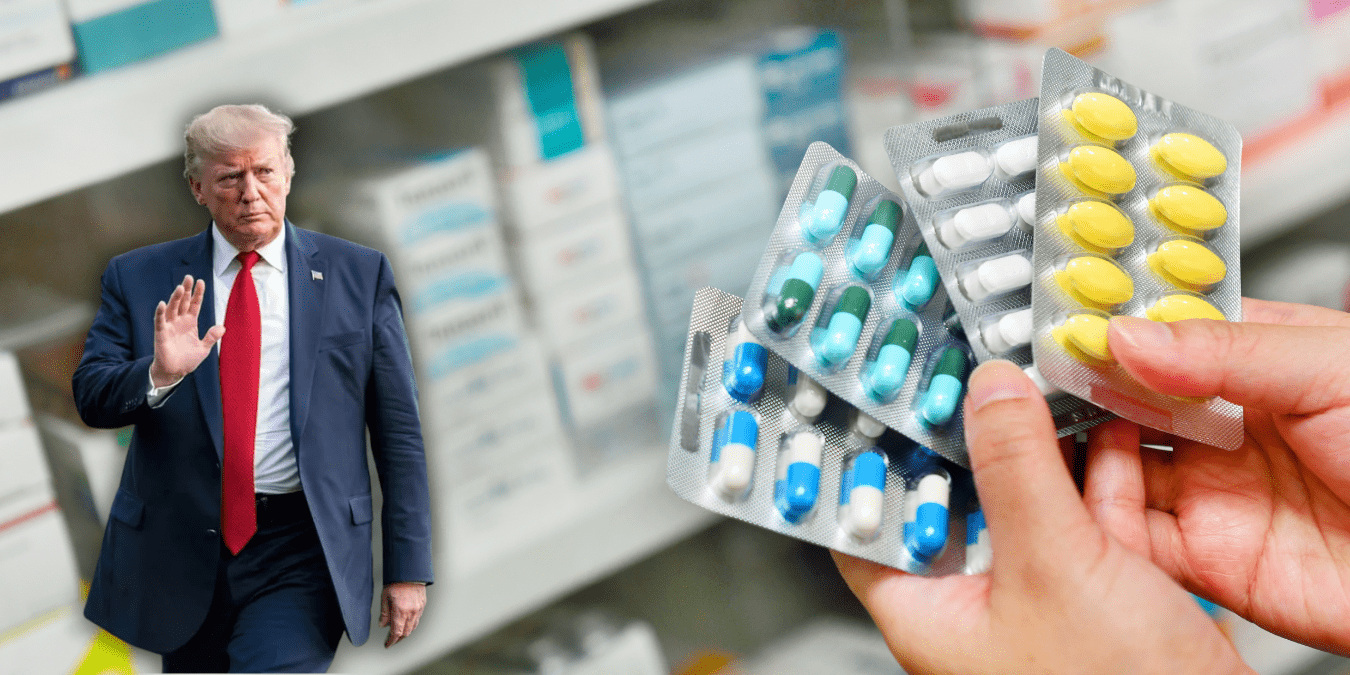
If you’ve ever stood at a pharmacy counter and winced at the price of a branded medication, brace yourself. The drug pricing landscape in the United States is about to undergo one of its most seismic shifts in decades. On April 2, 2026, President Donald Trump signed an executive order imposing tariffs of up to 100% on certain imported pharmaceutical products — a move that has rattled Wall Street, unnerved global drugmakers, and left millions of American patients wondering: What does this mean for my medicine cabinet?
This is not a hypothetical policy debate. The tariffs are real, the timeline is set, and the downstream effects on what Americans pay for their prescriptions will be profound — at least for certain categories of drugs. Understanding exactly what is in this order, what gets hit first, and what you can realistically expect to pay more for is no longer optional for anyone managing a chronic condition, caring for a family member, or simply watching their health costs.
Here’s a complete, honest, expert breakdown.
What the Executive Order Actually Says
President Trump’s April 2026 executive order was built on the foundation of Section 232 of the Trade Expansion Act of 1962, the same national security provision he previously used to justify steel and aluminum tariffs. The White House framed America’s heavy dependence on foreign drug manufacturing as a national security vulnerability — and the data backs that framing up in stark terms.
U.S. pharmaceutical imports reached approximately $213 billion in 2024, a threefold increase from just a decade prior. The executive order targets patented and branded drugs as well as their active pharmaceutical ingredients (APIs) — the chemical building blocks that make medicines work. These are the high-value, high-margin medications that dominate television commercials: biologics, specialty drugs, oncology treatments, and branded name-brand versions of common therapies.
The structure of the tariff is tiered and deliberate:
- 0% tariff — Companies that have signed a “Most Favored Nation” (MFN) pricing agreement with the U.S. government and are actively building domestic manufacturing facilities
- 20% tariff — Companies with a plan to build in the U.S. but no formal MFN pricing deal; this rate escalates to 100% over four years
- 100% tariff — Companies that have neither negotiated pricing arrangements with the Department of Health and Human Services (HHS) nor committed to domestic manufacturing
Critically, the tariffs are set to take effect in 120 to 180 days from the signing — meaning the first real-world price impacts are expected to arrive between late July and early September 2026.
What Is Exempt — And Why It Matters
Before panic sets in, it’s essential to understand what is not covered by these tariffs, because the exemptions are wide and strategically important.
Generic drugs are exempt — for now. This is the single most important carve-out in the entire order. Generic medications account for over 90% of all prescriptions filled in the United States. That means the vast majority of what Americans pick up at the pharmacy — metformin for diabetes, lisinopril for blood pressure, generic statins for cholesterol — falls outside the scope of these tariffs, at least for approximately one year.
Orphan drugs, veterinary medications, and specialty drugs that address urgent public health emergencies or originate from countries with existing U.S. trade agreements are also exempt from certain provisions. Additionally, pharmaceutical companies that have already struck drug pricing agreements with Trump’s administration — including Pfizer, Johnson & Johnson, AstraZeneca, Novo Nordisk, and Eli Lilly — have secured exemptions or reduced tariff exposure by committing to lower U.S. prices.
The one-year reprieve on generics is not guaranteed to be permanent. Industry analysts and healthcare economists warn that if supply chains for APIs remain heavily concentrated in China and India, a future executive action could pull generics into the tariff net. As EY’s Americas Life Sciences Leader Arda Ural noted, generic drug manufacturers already operate on razor-thin margins, and even modest tariff exposure could push some producers entirely out of the U.S. market.
What Gets Hit First: The Drug Categories at Greatest Risk
So if you’re a patient trying to figure out whether your prescriptions are about to get more expensive, here is a clear-eyed look at the categories facing the steepest exposure right now.
Specialty and Branded Biologics
This is ground zero. Biologics — medications derived from living cells rather than chemical synthesis — are some of the most complex and expensive drugs on the market. They treat conditions like rheumatoid arthritis, psoriasis, Crohn’s disease, multiple sclerosis, and certain cancers. Many of these drugs are manufactured in Europe, particularly in Ireland, Germany, Switzerland, Denmark, and Belgium.
These countries are among the biggest exporters of patented, high-value drugs and biologics to the United States, and the executive order does not automatically exempt EU or Japanese manufacturers based on country status alone. Relief is tied to company-level compliance — meaning each individual pharmaceutical firm must negotiate its own deal or face the full tariff.
For American patients on biologics who are not covered by a company-specific MFN deal, costs could escalate significantly once the tariff kicks in. Insurers and pharmacy benefit managers may absorb some of this cost initially, but those expenses will eventually filter into higher premiums, larger co-pays, or tiered formulary changes that push patients toward alternatives.
Cancer Drugs and Chemotherapy
This is the category that health policy experts are most alarmed about. Research published in a peer-reviewed analysis found that certain cancer treatments could increase by $8,000 to $10,000 for a 24-week course under Trump’s tariff policies. A separate study noted that chemotherapy drugs — including generic sterile injectables used in hospitals — have been prone to supply disruptions for years, and tariff pressure on their active ingredients could worsen an already fragile situation.
An article in a major oncology publication put it plainly: the proposed tariffs on pharmaceuticals “threaten to worsen already high drug costs and disrupt access to essential cancer treatments”. For patients undergoing active treatment, even a modest out-of-pocket increase can mean choosing between medicine and rent.
Weight Loss and Diabetes Drugs (GLP-1s)
Drugs like Ozempic and Wegovy — manufactured by Denmark’s Novo Nordisk — represent perhaps the most visible flashpoint in this tariff battle. These GLP-1 receptor agonists have exploded in U.S. demand over the past two years. Denmark’s pharmaceutical sector is so significant that analysts noted its entire national economy could be impacted by these tariffs.
Novo Nordisk has reportedly entered into pricing discussions with the Trump administration, which could qualify it for a tariff exemption. However, until those deals are fully executed and verified, the uncertainty alone creates pricing pressure. Americans who pay out of pocket for these medications — and there are millions who do, since insurance coverage remains inconsistent — are the most exposed.
HIV and Autoimmune Medications
Some HIV medications have already demonstrated vulnerability in this environment. According to NPR’s reporting, pharmaceutical companies that struck deals with the White House did achieve meaningful price reductions in some categories — Fiasp insulin saw a 75% price reduction, and drugs like Farxiga, Jardiance, and Eliquis also experienced price drops. However, other companies simultaneously raised prices on drugs like Isentress (for HIV) and Belsomra, illustrating the uneven and often contradictory nature of deal-by-deal negotiations as the framework for pharmaceutical pricing.
Which Countries’ Exports Are Most at Risk
Understanding the geography of drug manufacturing helps explain which supply chains face the most disruption.
The countries most exposed to the 100% tariff scenario are:
- Ireland — pharmaceutical exports to the U.S. represent roughly 12% of Ireland’s entire GDP
- Germany and Switzerland — home to major innovator companies like Roche, Novartis, Bayer, and numerous others
- Denmark — headquarters of Novo Nordisk, maker of Ozempic and Wegovy
- Belgium and the United Kingdom — significant exporters of biologics and specialty drugs
- Japan — a major manufacturer of branded and high-value pharmaceutical compounds
India, by contrast, is largely insulated from the immediate impact because its pharmaceutical exports to the U.S. are overwhelmingly in the generic drug category, which is exempt. Generic-focused Indian companies like Dr. Reddy’s and Cipla face minimal direct tariff exposure, though they play a critical role as API suppliers to multinational innovator companies, which creates indirect vulnerability in the supply chain.
The Bigger Strategic Play: Forcing Drug Prices Down
It would be a mistake to view these tariffs in isolation as simply a protectionist trade measure. The architecture of the executive order makes clear that the 100% tariff is a negotiating weapon, not necessarily the intended end state.
The mechanism works like this: pharmaceutical companies that want to avoid the tariff must either build manufacturing plants in the United States or negotiate “Most Favored Nation” pricing deals with HHS — meaning they agree to sell their drugs to American consumers at prices no higher than what they charge in other developed countries. This is an approach Trump has championed for years, arguing that Americans subsidize cheap drug prices in Europe and Canada while paying multiples of what citizens in other countries pay for the same medications.
That argument has genuine merit. Americans already pay 3 to 4 times more for branded drugs than people in other developed countries. The MFN pricing model, if successfully enforced, could theoretically bring those prices down dramatically. Pfizer became a high-profile early mover, pledging $70 billion in U.S. manufacturing investment in exchange for favorable tariff treatment.
Sixteen drug companies had already struck deals with the Trump administration by January 2026, and those negotiations did produce some measurable price reductions in the commercial market. The tariff is designed to accelerate that dealmaking.
How Physicians and Healthcare Providers Are Reacting
The medical community is watching this development with a mixture of cautious optimism and genuine alarm. A survey conducted on Sermo, a major physician network, found that 72% of surveyed physicians are concerned about the impact of pharmaceutical tariffs on access to affordable medications. Only 6% believed the tariffs would have little to no impact.
Doctors on the front lines are already seeing the early signals of what protectionist pharmaceutical policy looks like in practice. As one physician surveyed by Sermo described: “Patients ration insulin injections or cut pills in half. That’s the real cost of protectionist policies”. That observation, while anecdotal, reflects a very real pattern in American healthcare — one where price shocks at the pharmacy translate directly into reduced medication adherence and worse health outcomes.
Clinics and hospitals are also projecting cost increases of 15% or more for products heavily reliant on global supply chains, including pharmaceuticals, PPE, and medical devices. These institutional cost increases do not stay absorbed by healthcare systems indefinitely; they inevitably flow into billing, insurance premiums, and patient cost-sharing.
What Smart Patients Should Do Right Now
The tariffs take effect between late July and September 2026. That gives American patients a window to take proactive steps.
- Talk to your doctor now. If you are on a branded specialty medication, ask whether a generic equivalent or biosimilar is available and whether it might be equally effective for your condition.
- Check whether your drug company has signed an MFN deal. Companies like Pfizer, AstraZeneca, Novo Nordisk, and others have entered into pricing agreements that exempt them or reduce their tariff exposure. A deal from your drug’s manufacturer may mean prices stay stable.
- Contact your pharmacy benefit manager (PBM) or insurance provider. Ask specifically whether your plan’s formulary will change in response to the tariffs and what your cost-sharing exposure might look like going forward.
- Monitor the 120-180 day transition period. The implementation window gives patients and providers time to adjust. Watch for official updates from HHS and the FDA about how the tariff schedule is being enforced.
- Advocate through patient organizations. Groups like Patients for Affordable Drugs have been vocal about the risks to cancer patients and others. Patient advocacy has historically influenced the scope and application of pharmaceutical regulation in Washington.
The Long Game: Domestic Manufacturing and Supply Chain Resilience
Whatever one’s view on tariffs as economic policy, the underlying concern driving this executive order is legitimate: the United States has allowed its domestic pharmaceutical manufacturing capacity to erode dangerously over several decades. Today, the U.S. depends on foreign nations — including geopolitical rivals — for the active ingredients in many essential medications.
The Section 232 national security rationale is not rhetorical window dressing. A pandemic, a geopolitical conflict, or a major trade disruption could cut off American access to essential medicines that are manufactured entirely abroad. Building redundant domestic capacity for critical medications is a genuine national security imperative that enjoys bipartisan support in principle, even if the tariff mechanism used to achieve it remains deeply controversial.
The real question is whether the 100% tariff threat is credible enough to accelerate domestic investment — or whether it triggers supply disruptions, litigation, and WTO challenges that ultimately undermine the goal. Pfizer’s $70 billion domestic investment pledge suggests that at least some major players are treating the tariff as a real forcing mechanism rather than political theater. Whether smaller and mid-sized pharmaceutical companies can afford to follow suit is a far more uncertain proposition.
The Bottom Line for American Patients
The April 2026 pharmaceutical tariff order is a watershed moment for U.S. drug pricing — but its effects will not be immediate, universal, or uniform. Generic drugs, which fill the overwhelming majority of American prescriptions, are exempt for now. The companies that have already struck deals with the Trump administration face reduced or zero tariff exposure.
What is getting hit first, hardest, and most directly are branded specialty drugs, biologics, cancer therapies, and high-value patented medications manufactured primarily in Europe — especially in Ireland, Switzerland, Denmark, Germany, and the United Kingdom. American patients who rely on those medications, particularly those without comprehensive insurance coverage, face real and near-term risk of higher out-of-pocket costs.
The 100% tariff is a blunt instrument wielded in service of two goals that are not inherently incompatible: lower drug prices for Americans and greater domestic manufacturing resilience. Whether those goals are achievable through this mechanism — without triggering supply shortages, insurance premium spikes, and deteriorating access for the most vulnerable patients — is the defining healthcare policy question of 2026. The answer will unfold at pharmacy counters across America over the next several months.

Omisha is a health writer passionate about turning complex medical research into clear, actionable content readers can trust. She covers everything from nutrition and mental wellness to chronic disease management, always grounding her work in credible science and real-world relevance. When she's not writing, she's usually reading up on the latest health studies or exploring new wellness trends to write about next.