Skin HealthStress & SleepU.S. Winter 2026
Can a Relaxing Nighttime Skincare Routine Calm Stress and Help Your Skin? What the Research Shows
Studies link stress and poor sleep to slower skin barrier repair. A short, gentle evening routine built on dermatologist guidance can support both your skin and your wind-down, as long as you skip the irritants.
ByThe Skin & Wellness DeskFact-checkedAgainst AAD guidance, peer-reviewed studies and APA and Circana dataUpdatedNovember 9, 2026ScopeU.S. adults with healthy or mildly sensitive skin
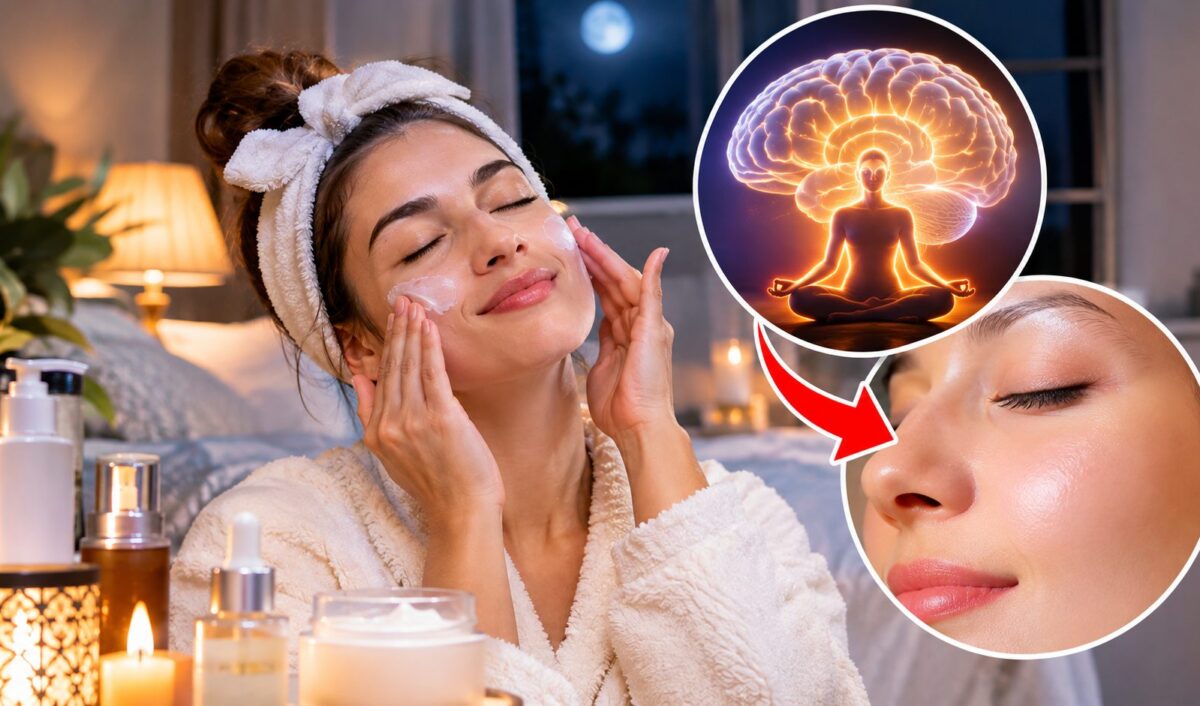
It is 10:40 p.m. Your phone says you should already be asleep, your shoulders say the day is not over, and your face feels tight from a week of indoor heat. A 12-step routine is the last thing you want. Yet the few minutes you spend at the bathroom sink may be one of the more useful parts of your evening, if you treat them as a wind-down and not a chore.
The idea is not just a wellness slogan. Researchers have measured that stress and short or poor sleep slow the skin’s ability to repair its protective outer layer. Separate studies suggest slow, gentle touch, such as facial massage, can lower self-reported anxiety. And as winter air dries skin across much of the country, the basics dermatologists recommend, lukewarm water, a mild cleanser and a moisturizer applied to damp skin, matter more than any new product.
What We Know
- The American Academy of Dermatology recommends washing your face twice a day with lukewarm water, using fingertips and a gentle, non-abrasive cleanser.
- A 2015 study found skin barrier function worsened in students during exam periods and after a long vacation.
- A study of 60 women found poor sleepers had higher intrinsic aging scores and slower barrier recovery.
- A 2008 study of 32 women found a 45-minute facial massage reduced anxiety and negative mood scores.
- The APA’s 2025 survey found 75% of U.S. adults are more stressed about the country’s future than before.
What Is Still Unclear
- Most skin-and-stress studies are small, and some are funded by cosmetic companies.
- No large trial has shown that a nightly skincare ritual by itself improves sleep or lowers cortisol.
- Short self-massage of 1 to 3 minutes has not been tested as rigorously as longer professional massage.
- Tools such as gua sha stones and rollers lack strong evidence for lasting skin changes.
The stress backdrop
A Tired, Wired Country Is Reaching for Small Rituals
The American Psychological Association’s Stress in America 2025 survey, conducted by The Harris Poll among 3,199 adults in August 2025, painted a picture of a lonely and anxious public. Three-quarters said they were more stressed about the nation’s future than they used to be, and 69% said they needed more emotional support than they received in the past year, up from 65% in 2024.
How U.S. Adults Described Their Stress in 2025
Spending patterns hint at how people respond. Circana, which tracks U.S. beauty sales, reported that in the first half of 2025 prestige facial skincare dipped 1% while mass-market skincare grew 4%, prestige body care grew, and scalp care jumped 19%. Only 14% of beauty buyers told Circana that a higher price signals better quality. The takeaway for a calming routine is reassuring: it does not need to be expensive.
Where U.S. Beauty Dollars Moved in the First Half of 2025
The science
What Stress and Short Nights Do to Your Skin’s Outer Shield
Your skin’s outermost layer, the stratum corneum, works like a brick wall: skin cells are the bricks and fats such as ceramides are the mortar. When that barrier is healthy, it holds water in and keeps irritants out. Scientists test it by gently stripping the surface with tape and measuring how quickly water loss returns to normal, a reading called transepidermal water loss.
In a 2015 study in the International Journal of Cosmetic Science, Japanese researchers tracked 16 female students. Barrier function deteriorated significantly during final exams and again after a long vacation, compared with a calmer control period. The sample was small, but the finding fits a broader body of research showing stress hormones can slow barrier repair.
The Sleep Study Behind the “Beauty Sleep” Headlines
A study led by Dr. Elma Baron at University Hospitals Case Medical Center, commissioned by Estée Lauder and later published in Clinical and Experimental Dermatology in 2015, compared 60 women aged 30 to 49. Poor sleepers scored twice as high on a standard intrinsic aging scale, recovered more slowly from a mild sunburn and showed weaker barrier recovery after 72 hours. The results show an association, not proof that sleep alone caused the difference.
Good Sleepers vs Poor Sleepers: Four Measurements
Intrinsic aging score (SCINEXA)
Barrier recovery at 72 hours
Self-rated attractiveness score
Share with obesity
That last row is a reminder to read sleep studies carefully: poor sleepers were nearly twice as likely to have obesity, which could also influence skin. Still, the direction of the evidence is consistent. The Centers for Disease Control and Prevention says adults need 7 or more hours of sleep, and about 1 in 3 U.S. adults report getting less. Anything that makes it easier to get to bed on time is working in your skin’s favor.
The routine
The 10-Minute Wind-Down, Minute by Minute
This sequence follows AAD advice on washing and moisturizing, with a short massage-and-breathing pause added. The timings are indicative; the point is a predictable order your brain begins to associate with bedtime.
- 0:00Dim the lightsLower overhead lighting and set your phone to silent for the next 10 minutes.
- 0:30Lukewarm cleanseAbout 60 seconds with fingertips and a gentle, alcohol-free cleanser.
- 1:30Pat, do not rubUse a soft towel and leave skin slightly damp.
- 2:00Treatment, if anyOne pea-sized active, such as a retinoid, 2 to 3 nights a week to start.
- 3:00MoisturizeApply a ceramide or glycerin cream while skin is still damp.
- 4:00Massage and breathe2 to 3 minutes of light upward strokes with 4-second inhales and 6-second exhales.
- 7:00Lips and handsA thin layer of petrolatum or balm where skin cracks first in winter.
- 8:00 to 10:00Screens awaySet out tomorrow’s SPF 30 and head to bed.
Why Lukewarm Beats Hot
A steaming shower feels relaxing, but hot water dissolves the skin’s natural oils faster. The AAD advises lukewarm water for face washing and, for dry skin, limiting showers and baths to 5 to 10 minutes and applying moisturizer right after patting dry. The warmth you want can come from the room instead: a warm bathroom, a soft robe and a calm light do the relaxing without stripping your barrier.
Product choices
Soothing or Secretly Irritating? An Ingredient Decoder
“Relaxing” products are often scented, and that is where many routines go wrong. Fragrance, including natural essential oils, is one of the most common causes of allergic contact dermatitis. The calming feeling comes from the ritual; the skin benefit comes from plain, barrier-friendly ingredients.
| Ingredient | What it does | Bedtime-friendly? | Watch for |
|---|---|---|---|
| Ceramides | Replace barrier fats that hold water in | Yes, nightly | Few issues for most skin |
| Glycerin | Draws water into the outer layer | Yes, nightly | Rarely irritating |
| Hyaluronic acid | Holds water; best on damp skin | Yes, nightly | Follow with cream in dry air |
| Petrolatum | Seals in moisture overnight | Yes, thin layer | Can feel heavy on oily skin |
| Colloidal oatmeal | Soothes itch and dryness | Yes, nightly | Rare oat allergy |
| Niacinamide | Supports barrier, evens tone | Yes, 2% to 5% | Mild flushing in some people |
| Retinoids | Speed cell turnover, smooth lines | 2 to 3 nights a week | Dryness, peeling; not in pregnancy without advice |
| AHAs or BHAs | Exfoliate dead skin | 1 to 2 nights a week | Do not stack with retinoid at first |
| Fragrance and essential oils | Pleasant scent | Use sparingly | Common contact allergens |
| Grainy scrubs | Physical exfoliation | Avoid on face | AAD advises against scrubbing |
Put the Scent Somewhere Else
If aroma is part of what relaxes you, keep it off your face. A scented candle across the room, a diffuser in the hallway or a scented hand soap gives the sensory cue without leaving potential allergens on facial skin for eight hours. People with eczema-prone or sensitive skin benefit most from this swap.
Personalize it
Matching the Wind-Down to Your Skin Type
The structure stays the same; the products shift. Use this as a starting point and adjust after two to four weeks.
| Skin type | Cleanser | Night treatment | Moisturizer | Massage step |
|---|---|---|---|---|
| Dry | Cream or lotion cleanser | Skip most nights | Rich ceramide cream plus petrolatum on dry patches | 2 to 3 minutes with a drop of plain oil |
| Oily | Gentle gel, once at night | BHA 1 to 2 nights a week | Lightweight, oil-free lotion | 1 to 2 minutes, very light |
| Combination | Gentle gel or low-foam | Retinoid 2 to 3 nights a week | Lotion; cream on cheeks only | 2 minutes |
| Sensitive | Fragrance-free, soap-free | None until stable 4 weeks | Fragrance-free barrier cream | 1 minute, fingertips only |
| Acne-prone | Mild cleanser, no scrubbing | As directed by your dermatologist | Noncomedogenic lotion | Skip over active breakouts |
| Mature | Cream cleanser | Retinoid 2 to 3 nights, building up | Cream with ceramides or peptides | 2 to 3 minutes, upward strokes |
Make it stick
Six Rules That Keep the Ritual Calm, Not Complicated
- Anchor it to a timeStart at the same clock time most nights so it becomes a bedtime cue.
- Cap it at 10 minutesA routine you finish beats one you skip because it feels long.
- Change one product at a timeWait 2 to 4 weeks before judging results or adding another.
- Keep the bathroom comfortableWarm room, lukewarm water, soft towel, low light.
- Mind indoor airA humidifier set to keep rooms at 30% to 50% humidity helps in winter; clean it regularly.
- Save the morning for sunscreenBroad-spectrum SPF 30 or higher is the step that protects what the night routine repairs.
Your Pre-Bed Checklist
- Water lukewarmNot hot; keep any shower to 5 to 10 minutes.
- 60-second cleanseFingertips only, no washcloth or brush.
- Moisturize within minutesWhile skin is still slightly damp.
- Fragrance off the faceScent goes in the room, not the cream.
- 2 to 3 minutes of slow breathingLonger exhales than inhales.
- Phone down by minute 8Protect the 7 or more hours of sleep adults need.
- Pillowcase changed weeklyClean fabric for the face that rests on it.
- SPF 30 set out for morningSo the first step tomorrow is already ready.
Your questions
Frequently Asked Questions
What is a good relaxing nighttime skincare routine?
Cleanse with lukewarm water and a gentle cleanser using your fingertips, pat dry, apply any single treatment product, moisturize while skin is damp, then spend 2 to 3 minutes on light facial massage with slow breathing. Keep the whole routine to about 10 minutes.
Can stress really affect your skin?
Yes. Studies have found that psychological stress, such as exam periods, is associated with weaker skin barrier function and slower recovery. Stress can also worsen conditions such as eczema, psoriasis and acne.
Does lack of sleep make your skin age faster?
A study of 60 women found poor sleepers had higher intrinsic aging scores and slower barrier recovery than good sleepers. The study shows an association and was commissioned by a cosmetics company, so more research is needed.
Is facial massage good for your skin?
Gentle facial massage can help you relax; a small study found a 45-minute session reduced anxiety and negative mood. Evidence for lasting skin changes is limited. Use light pressure and avoid massaging over active breakouts or irritated skin.
Should I wash my face with hot or cold water?
Lukewarm. The American Academy of Dermatology recommends lukewarm water because hot water can strip natural oils and dry the skin, while very cold water is uncomfortable and offers no proven benefit.
Are essential oils safe to use on my face?
Many essential oils contain fragrance compounds that can cause allergic reactions or irritation, especially on sensitive skin. If scent helps you relax, consider using it in the room rather than in products that stay on your face overnight.
How many skincare steps do I really need at night?
Most people need two or three: a gentle cleanser, a moisturizer and, optionally, one treatment such as a retinoid. Adding more steps raises the risk of irritation without guaranteed extra benefit.
How long before I see results from a new skincare routine?
Moisturizing can improve dryness within days. Products such as retinoids often take several weeks to a few months to show visible change. Change one product at a time and give each 2 to 4 weeks before judging it.
The Short Version
Stress and poor sleep are linked in studies to weaker skin barrier repair, and with 75% of Americans reporting more stress about the nation’s future, a calming evening ritual makes sense. Keep it to about 10 minutes: lukewarm cleanse with fingertips, one treatment at most, moisturizer on damp skin, a few minutes of light massage and slow breathing, then screens away. Keep fragrance off your face, change one product at a time, and protect your progress with SPF 30 each morning. See a dermatologist if irritation, itching or breakouts persist.

Omisha is a health writer passionate about turning complex medical research into clear, actionable content readers can trust. She covers everything from nutrition and mental wellness to chronic disease management, always grounding her work in credible science and real-world relevance. When she's not writing, she's usually reading up on the latest health studies or exploring new wellness trends to write about next.