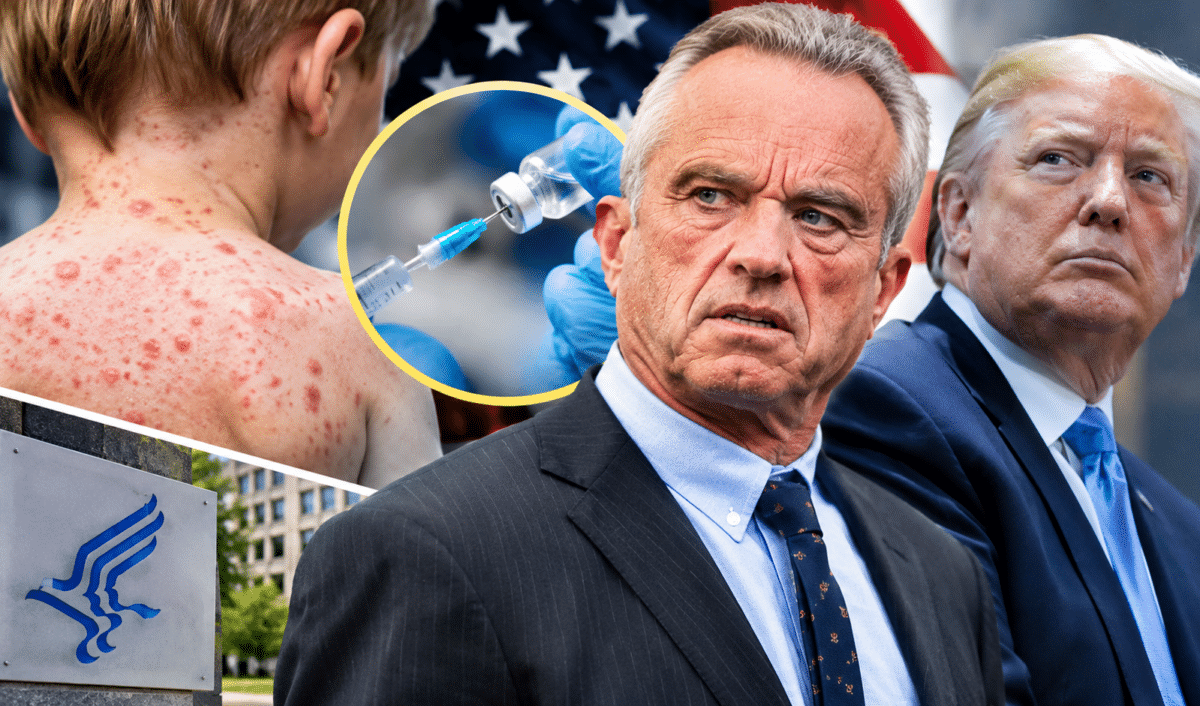
U.S. Loses Measles Elimination Status After 26 Years as Critics Blame RFK Jr. and HHS Defends Its Response
The Pan American Health Organization withdrew the designation on November 17, 2026, finding measles had spread continuously for more than a year. Here is what that means, who is being blamed, and what the administration says.
For a quarter of a century, measles in the United States behaved like a visitor. Travelers brought it in, local health departments chased down every contact, and the outbreaks burned out. That is what “elimination” meant. On November 17, 2026, the Pan American Health Organization concluded that measles is no longer just visiting. It has stayed long enough, spreading from person to person for more than 12 months, to be considered endemic again. Within hours, the debate shifted from the virus to the person running the nation’s health department.
The Worst Measles Year Since 1991, in Numbers
The Centers for Disease Control and Prevention reported 5,412 confirmed measles cases in 2026 as of November 12, according to Contagion Live’s summary of CDC data. The Associated Press reported that this is already more than double the 2025 tally and that 10 measles-associated deaths have been recorded this year, at least five of them children. More than 10% of people infected over the past two years were hospitalized.
ABC News counted 48 outbreaks in 2026, with large ongoing case numbers in Pennsylvania, Wisconsin, Minnesota and Indiana, and New York State has declared a state of emergency. Pennsylvania alone has more than 1,500 cases, according to the Atlanta Journal-Constitution. In 2024, by contrast, the CDC recorded 285 cases for the entire year.
Confirmed cases. Sources: CDC; 2025 full-year figure is CDC’s preliminary total; 2026 is as of November 12. 1991 shown for comparison.
What “Elimination” Meant, and Why Losing It Is More Than a Label
Elimination never meant zero cases. It meant no single chain of measles transmission lasting 12 months or more inside a country. Under PAHO’s verification framework, the status can be withdrawn when epidemiological and laboratory evidence shows the same virus lineage has circulated continuously for a year. The decision came from PAHO’s Measles and Rubella Elimination Regional Monitoring and Re-Verification Commission, which met November 10 to 13, 2026. PAHO Director Jarbas Barbosa said the commission recommended withdrawal, “a recommendation which I have accepted.”
“Measles elimination is not a trophy that is won once and placed on a shelf,” Barbosa said. He added that losing the status “means the virus has circulated for a prolonged period of time.” Susan Kansagra of the Association of State and Territorial Health Officials called measles “the canary in the coal mine” for other vaccine-preventable diseases, because it is so contagious that it finds gaps in immunity first.
Where the clock started
The current wave began with an outbreak first reported on January 20, 2025, in an undervaccinated community in Gaines County, West Texas. That outbreak, which Texas declared over in August 2025 after 762 cases, was followed by large outbreaks along the Utah-Arizona border and in South Carolina. Federal officials argued for months that these were separate introductions. PAHO’s spokesperson said in January that scientists had confirmed the same measles strain in Texas, New Mexico, Utah, Arizona, South Carolina, Canada, Mexico and several other countries.
What We Know and What Is Still Unclear
What We Know
- PAHO formally withdrew U.S. elimination status on November 17, 2026.
- Mexico and Bolivia also lost status; Canada lost it in November 2025.
- The U.S. has more than 5,400 confirmed cases in 2026, the most since 1991.
- Kindergarten MMR coverage was 92.4% in 2025-26, below the 95% target.
- Each country must submit a corrective plan to PAHO in the coming weeks.
What Is Still Unclear
- Exactly which transmission chain PAHO judged to have crossed 12 months.
- What the U.S. corrective action plan will contain and when it will be public.
- How much of the vaccination decline any one policy or official caused.
- How long it will take for the U.S. to regain elimination status.
The Case Critics Make Against Kennedy
Criticism came quickly from Democratic lawmakers, physicians and public health researchers. Sen. Ron Wyden of Oregon called the decision the result of a campaign by “grifters, quacks and charlatans.” Noel Brewer, a University of North Carolina professor who chairs the independent committee that presented U.S. measles data to PAHO, said “the federal government has had such a ho-hum response.” Josh Michaud of KFF said, “What we’re not seeing from the administration is strong communications about the need for vaccinations.”
Critics point to a list of actions. Kennedy, who led a prominent vaccine-skeptical organization before taking office, fired all 17 members of the CDC’s vaccine advisory committee in 2025 and appointed vaccine critics among the replacements. In January 2026, HHS downsized the childhood immunization schedule, a move a judge later temporarily halted. Kennedy also directed the CDC to change website language to contradict its longstanding guidance that vaccines do not cause autism, and promoted vitamin A during an outbreak.
Other actions cited by critics include HHS layoffs of more than 10,000 workers, which experts say may have weakened state and local outbreak response, and an executive order signed by President Trump calling for splitting the MMR vaccine into separate shots, which are not available in the United States. After Pennsylvania reported two measles-related infant deaths in August, Kennedy said they “may even have been altogether fabricated,” before later acknowledging that one was caused by measles.
Percent. Kindergarten MMR coverage from CDC by school year; recommendation figure is the share very or somewhat likely to recommend MMR for an eligible child, Annenberg Public Policy Center surveys. Target line is 95%.
Kennedy took office in February 2025. Most of the decline in kindergarten coverage predates his tenure; the drop in stated confidence came during it.
How Kennedy and HHS Answer the Criticism
Kennedy has rejected the idea that he caused the outbreaks. “We will stop measles outbreaks, protect American families, and work to regain U.S. measles elimination status,” he said in a statement on November 17, adding, “I continue to recommend MMR vaccination as the most effective way to prevent measles.” He wrote that the administration is “working to close vaccination gaps and rebuild public trust” and blamed COVID-era disruptions for gaps in protection.
In congressional testimony earlier this year, reported by CIDRAP, Kennedy said, “I have nothing to do with the measles outbreak. A lot of nations have lost their elimination status.” He argued that most unvaccinated Americans who caught measles were older than 5, meaning their parents made vaccination decisions before he took office. Administration leaders have also argued that vaccination rates were falling before President Trump’s second term and that the U.S. is handling measles better than other countries.
CDC Director Erica Schwartz said, “The measles elimination designation is not what protects Americans. Vaccination does,” and that losing it will not change the federal response. HHS has said the CDC invested $100 million, awarded in two tranches in August and September, to help state and local health departments reach outbreak communities, and sent specialists to assist states. HHS also said the CDC, not Kennedy, decided how to count the disputed deaths.
- Messaging: years of vaccine skepticism eroded trust; confidence fell from 90% to 82%.
- Policy: 17 advisers fired, schedule downsized, autism guidance changed.
- Capacity: 10,000+ HHS layoffs weakened outbreak response.
- Funding: $100 million “wasn’t a lot of money,” said Chrissie Juliano of the Big Cities Health Coalition.
- Position: Kennedy says he recommends MMR as the most effective protection.
- Timing: coverage fell from 95.2% to 92.7% before he took office.
- Global trend: Canada, Mexico, Bolivia and the UK also lost status.
- Action: $100 million to states, specialists deployed, a pledge to regain status.
From Texas to the PAHO Ruling: A Two-Year Timeline
- Jan 20, 2025Outbreak reported in Gaines County, Texas; the 12-month clock effectively begins.
- Feb 2025Kennedy is confirmed as Health and Human Services Secretary.
- Aug 2025Texas declares its outbreak over at 762 cases; Utah-Arizona outbreak grows.
- Oct 2025First case of the South Carolina outbreak, which tops 847 cases by late January.
- Nov 2025Canada loses the elimination status it had held since 1998.
- Jan 2026HHS downsizes the childhood schedule; CDC reports 2025 as the worst year since 1991.
- Aug to Sep 2026CDC awards $100 million; Pennsylvania reports two infant deaths.
- Nov 10 to 13, 2026PAHO re-verification commission holds its sixth annual meeting.
- Nov 17, 2026PAHO announces the U.S., Mexico and Bolivia have lost elimination status.
Measles-associated deaths. Sources: CDC (2025), AP (2026 U.S.), PAHO (Americas, as of November 13, 2026).
The Arguments Side by Side
Much of the dispute turns on timing and causation, which the data can inform but not fully settle. The table pairs each major claim with the evidence offered for it and the strongest response from the other side.
| Claim | Who makes it | Evidence offered | Counterpoint |
|---|---|---|---|
| Vaccination fell before Kennedy | Kennedy, HHS | Kindergarten MMR dropped from 95.2% to 92.7% by 2023-24 | Critics say confidence fell further during 2025, from 90% to 82% |
| This is a global problem | Kennedy | Canada, Mexico, Bolivia and the UK lost status | Experts quoted by AP say the U.S. outcome was not inevitable |
| Policy changes fueled doubt | Critics, Democrats | ACIP firings, schedule cuts, autism page change | HHS says Kennedy recommends MMR and wants to restore trust |
| Response was underfunded | Health coalitions | $100 million against 5,400+ cases and 48 outbreaks | CDC says funds and specialists went to outbreak areas |
| The label does not matter | CDC director | “Vaccination” protects, not the designation | PAHO says loss means prolonged spread and more risk |
Compiled from statements reported by AP, ABC News, the Atlanta Journal-Constitution, CIDRAP and Fox News, November 2026.
CDC says two doses of MMR are about 97% effective at preventing measles, and one dose is about 93% effective. Children typically get the first dose at 12 to 15 months and the second at 4 to 6 years. PAHO estimates the measles vaccine prevented 6.2 million deaths in the Americas from 2000 to 2023.
The Math Behind a 95% Target
Measles is one of the most contagious diseases known, which is why public health agencies aim for 95% vaccination coverage. Small percentage drops translate into large numbers of children. The calculation below is indicative and uses the CDC’s own estimate as a starting point.
How many kindergartners a few points represent
- Kindergartners unprotected at 92.7% coverage, 2023-24 (CDC)about 280,000
- Implied kindergarten class size (280,000 divided by 7.3%)about 3.8 million
- Unprotected at 92.4% coverage (7.6% of 3.8 million)about 290,000
- Each 1-point drop in coverageabout 38,000 children
- Gap between 92.4% and the 95% targetabout 100,000 children
Indicative calculation derived from CDC’s published estimate for 2023-24; actual class size and exemptions vary by year and state. National averages also hide local pockets far below 92%, where outbreaks start.
- Thinking elimination meant no measles at all; it meant no chain lasting 12 months.
- Assuming the label change alone changes anyone’s personal risk.
- Believing national averages tell the story; outbreaks start in local low-coverage pockets.
- Treating the decline as starting in 2025; coverage was slipping from 2019-20.
- Assuming status cannot be regained; Brazil and others have done it.
What It Takes to Win the Status Back
Countries that lose elimination status must submit a corrective action plan to PAHO, which said it would send its recommendations within days. PAHO’s Daniel Salas said the U.S. had begun intensifying vaccination in low-coverage areas with active transmission. Each plan must show how a country will interrupt transmission for at least a year. Brazil lost and later regained its status, and the United Kingdom lost its status for a second time this year, illustrating that the designation can move in both directions.
- Stop every active outbreak and document the end of each chain with genetic sequencing.
- Raise MMR coverage in the communities where coverage is lowest.
- Show at least 12 months with no continuous transmission of any single lineage.
- Submit surveillance and laboratory evidence to PAHO’s re-verification commission.
- Pass the commission’s review at a future annual meeting.
Your personal risk depends on your vaccination status and your community, not on a designation. Check that children have two MMR doses, that adults born in 1957 or later have documented immunity, and that infants traveling internationally get an early dose if their doctor advises it. Measles symptoms usually start with high fever, cough, runny nose and red eyes, followed by a rash.
Frequently Asked Questions
Why did the U.S. lose its measles elimination status?
The Pan American Health Organization determined that measles had circulated continuously in the United States for more than 12 months, which ends elimination status under its criteria. The announcement came on November 17, 2026, amid more than 5,400 confirmed cases this year.
When did the U.S. first eliminate measles?
The United States was declared to have eliminated measles in 2000, meaning there was no continuous transmission for 12 months or more. It held that status for 26 years.
Why are critics blaming RFK Jr. for measles?
Critics, including Democratic lawmakers and many public health experts, point to Kennedy’s history of vaccine skepticism, his replacement of the CDC’s vaccine advisory committee, changes to the childhood schedule and autism guidance, and HHS staff cuts. They argue these weakened trust and response capacity.
What has Kennedy said about losing measles elimination status?
Kennedy said the administration will stop outbreaks and work to regain the status, and that he recommends the MMR vaccine as the most effective way to prevent measles. He has also argued that vaccination rates fell before he took office and that many countries have lost their status.
How many measles cases are there in the U.S. in 2026?
The CDC reported 5,412 confirmed cases as of November 12, 2026, the most since 1991, when there were 9,643. The AP reported 10 measles-associated deaths this year.
Can the U.S. get its measles elimination status back?
Yes. The U.S. must submit a corrective plan to PAHO and show at least 12 months without continuous transmission of any measles lineage, supported by surveillance and lab evidence. Other countries, such as Brazil, have regained the status.
Which other countries lost measles elimination status?
Mexico and Bolivia lost their status in the same PAHO decision. Canada lost its status in November 2025, and the United Kingdom lost its status for a second time this year.
Does losing elimination status change my risk of measles?
Not directly. Risk depends on whether you are vaccinated and how many people around you are. Two MMR doses are about 97% effective, according to the CDC.
The Short Version
On November 17, 2026, PAHO ruled that measles had spread continuously in the U.S. for more than a year, ending the elimination status held since 2000. The country has more than 5,400 cases and 10 deaths this year, the most cases since 1991. Critics blame Health Secretary Robert F. Kennedy Jr.’s vaccine policies, messaging and staff cuts. Kennedy says he recommends the MMR vaccine, notes that vaccination rates were falling before he took office, and has pledged to stop outbreaks and regain the status. Winning it back will require at least 12 months without sustained transmission.

Omisha is a health writer passionate about turning complex medical research into clear, actionable content readers can trust. She covers everything from nutrition and mental wellness to chronic disease management, always grounding her work in credible science and real-world relevance. When she's not writing, she's usually reading up on the latest health studies or exploring new wellness trends to write about next.