NutritionLiver HealthNew Research
Late-Night Eating Linked to Up to 30% Higher Liver Disease Risk — What Scientists Found and How Late Is Too Late
A study of nearly 200,000 Americans tied eating after dinner or near bedtime to more fatty liver disease and cirrhosis. It joins earlier research on late eating, hunger hormones, reflux and gut health.
ByThe Nutrition Science DeskFact-checkedAgainst peer-reviewed journals, university releases and conference abstractsUpdatedNovember 9, 2026ScopeU.S. adults, research through 2026
The dishes are done, the kids are asleep, and the house finally goes quiet. For millions of Americans, that is when the real snacking starts: a bowl of cereal at 10 p.m., leftovers standing at the open fridge, chips during the last episode of a show. It feels harmless because the calories seem small and the day is over.
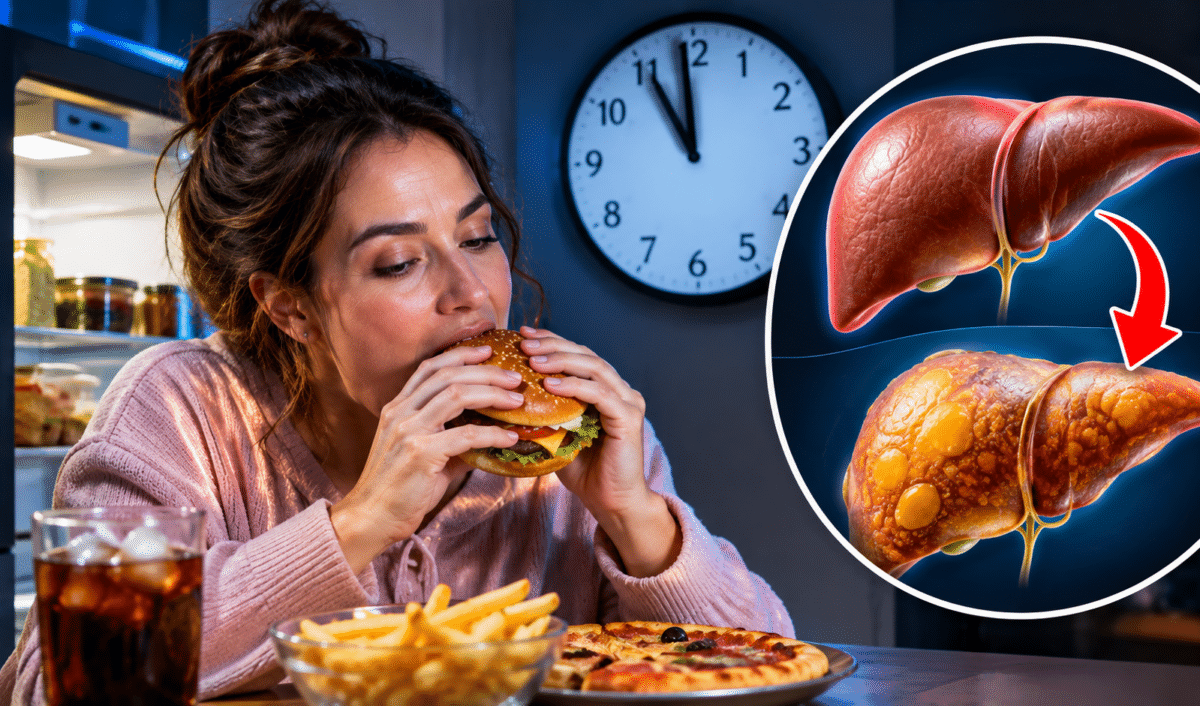
Scientists are increasingly interested in that timing. In October 2026, researchers at Oregon Health & Science University and Massachusetts General Hospital reported that people who regularly ate after dinner or near bedtime had a 20% to 30% higher risk of fatty liver disease and cirrhosis. The finding does not prove late snacks damage the liver. But it adds to a growing body of research suggesting that when you eat may matter alongside what you eat.
What We Know
- The OHSU-led study used data from the Nurses’ Health Study, Nurses’ Health Study II and Health Professionals Follow-up Study.
- Late eaters had a 20% to 30% higher risk of MASLD and cirrhosis than those who did not eat late.
- Fatty liver disease affects as much as 30% of the U.S. population, OHSU says.
- A 2022 Harvard-affiliated lab trial found eating four hours later lowered leptin and slowed calorie burning.
What Is Still Unclear
- Public summaries of the liver study do not define an exact clock time for “late-night” eating.
- Whether weight, diet quality or sleep explain part of the link is not settled.
- Whether eating earlier improves liver health is being tested in a new OHSU trial.
- Separate risk figures for fatty liver disease and cirrhosis were not given in public reports.
The Liver Study Behind the Headlines
The new research was led by Dr. Robert Wilechansky, a hepatologist at Oregon Health & Science University who specializes in liver transplantation, with sleep and circadian scientist Andrew McHill of OHSU and colleagues at Massachusetts General Hospital. They analyzed self-reported diet and lifestyle data from almost 200,000 people in three nationwide U.S. studies. Participants were grouped by eating habits, and the team compared rates of fatty liver disease and cirrhosis.
People who reported late-night eating, meaning eating after dinner or after bedtime, had a 20% to 30% increase in liver disease compared with those who did not. Wilechansky called it “among the first long-term analyses to explicitly draw the connection to fatty liver disease.” The paper, titled “Late-Night Eating is Associated with MASLD and Cirrhosis,” appeared in Clinical Gastroenterology and Hepatology in October 2026.
How Big Is a 20% to 30% Higher Risk?
No added risk+25%+50%
A Relative Risk, Not a Diagnosis
A 20% to 30% higher relative risk sounds alarming, but it applies to your starting risk. Wilechansky stressed that only a small fraction of people with fatty liver disease go on to develop serious forms such as cirrhosis. The findings also come from people’s own reports of their eating habits, which can be imprecise. ScienceDaily noted that overall diet quality, weight and sleep patterns may also play a role.
Why the Liver Cares What Time It Is
Your body runs on a roughly 24-hour internal clock, and the liver is one of the organs most tied to it. During the day, it is set up to process food, store fuel and manage fat. At night, as the body prepares for sleep, those systems shift. McHill said eating at night, when the internal clock promotes sleep, reduces the body’s ability to metabolize food efficiently, which can contribute over time to obesity, diabetes and poor liver health. Animal studies show the liver is among the organs most vulnerable when eating and sleep timing fall out of sync.
That is part of why researchers pay attention to night-shift workers, whose day-night cycles are misaligned and who have elevated rates of obesity and heart disease, OHSU notes. The new study suggests something similar may happen, on a smaller scale, to people with regular schedules who eat their last food close to bedtime.
What a Lab Experiment Showed About Hunger
The clearest controlled evidence comes from a 2022 study in Cell Metabolism led by Nina Vujović and Frank Scheer at Brigham and Women’s Hospital. Sixteen adults with overweight or obesity completed two laboratory schedules with identical meals: one early, one shifted about four hours later. When meals came later, levels of leptin, a hormone that signals fullness, were lower across 24 hours. Participants burned calories more slowly, felt hungrier, and fat tissue showed gene changes favoring fat storage over fat breakdown.
How Large Were the Key Meal-Timing Studies?
Late Eating, Your Weight, Your Gut and Your Sleep
The liver finding fits a pattern. A 2013 study in the International Journal of Obesity followed 420 people in Spain through a 20-week weight-loss program. Those who ate their main meal, lunch, after 3 p.m. lost less weight and lost it more slowly than earlier eaters, even though calorie intake was similar between the groups. Spain’s main meal is lunch, so the findings do not translate directly to American dinners, but they point the same way.
The “Double Hit” to Gut Health
Research presented at Digestive Disease Week in May 2026 looked at stress and late eating together. Dr. Harika Dadigiri of New York Medical College and colleagues analyzed data from more than 11,000 people in the federal NHANES survey and more than 4,000 in the American Gut Project. People with high physiological stress who ate more than 25% of their daily calories after 9 p.m. were 1.7 times as likely to report constipation or diarrhea as lower-stress people who did not eat late. In the American Gut data, the combination was linked to 2.5 times the odds of bowel problems and lower gut microbiome diversity. It was a conference abstract, not yet a peer-reviewed paper, and showed associations only.
Heartburn Is the Fastest Payback
Reflux is where meal timing shows its effect most directly. A 2021 systematic review in Therapeutics and Clinical Risk Management reported that an interval of less than three hours between dinner and bed was associated with sharply higher odds of gastroesophageal reflux disease. When you lie down with a full stomach, acid can flow back into the esophagus more easily.
Eating Habits Linked to Reflux Disease
Comparing the Evidence, Study by Study
Not all of this research carries the same weight. Large observational studies can spot patterns in real life, but they cannot rule out other explanations. Small lab trials can show cause and effect under controlled conditions, but only for short periods. The table puts the main studies side by side.
| Study | Year | Participants | Design | Main finding | Evidence type |
|---|---|---|---|---|---|
| OHSU and Mass General, liver | 2026 | About 200,000 | Long-term cohorts, self-reported | 20% to 30% higher MASLD and cirrhosis risk | Association |
| Dadigiri et al., gut | 2026 | 11,000+ and 4,000+ | Survey data, conference abstract | 1.7x and 2.5x bowel symptom risk with stress | Preliminary |
| Vujović et al., Brigham | 2022 | 16 | Randomized crossover lab trial | Lower leptin, slower calorie burning, more hunger | Controlled |
| GERD systematic review | 2021 | Multiple studies | Review of observational studies | Dinner under 3 hours before bed: 7.45x odds | Association |
| Garaulet et al., Spain | 2013 | 420 | 20-week weight-loss program | Late main meal, after 3 p.m., linked to less weight loss | Association |
How Late Is Too Late? A Practical Evening Plan
There is no official cutoff time. Wilechansky’s advice is general: “confining your calorie intake to several hours before bedtime might be beneficial.” The reflux research points to at least three hours between dinner and lying down. A sensible plan works backward from your bedtime, not from a fixed clock.
- 4 hours beforeMain dinnerLargest evening meal, with protein and fiber
- 3 hours beforeKitchen closesReflux research supports this gap
- 2 hours beforeWater or tea onlySkip alcohol and large drinks
- 1 hour beforeWind downScreens off, lights low
- BedtimeSleepAim for 7 or more hours
- Set a kitchen-closing timePick a time about three hours before your usual bedtime and stick to it on weeknights.
- Eat enough earlier in the daySkipping breakfast or lunch often drives evening hunger; the reflux review linked skipped breakfast to 2.7 times the odds of GERD.
- Move calories, not just cut themShift part of your evening snack to an afternoon snack.
- If you need a late snack, keep it smallChoose something light rather than a full meal, and avoid lying down right after.
- Watch the companionsAlcohol, screens and short sleep tend to come with late eating.
- Ask your doctor about liver testsEspecially if you have obesity, type 2 diabetes or high cholesterol, which raise fatty liver risk.
- 3-hour gap before bedDinner finished early enough
- Under 25% of calories after 9 p.m.Gut study threshold
- Breakfast or lunch eatenReduces nighttime hunger
- Small late snack onlyIf you eat late at all
- 7+ hours of sleepAdult recommendation
- Liver checkup if at riskDiscuss with your doctor
Frequently Asked Questions
Is eating late at night bad for your liver?
A 2026 study of nearly 200,000 Americans linked eating after dinner or near bedtime to a 20% to 30% higher risk of fatty liver disease and cirrhosis. It shows an association, not proof.
What time should you stop eating at night?
There is no official cutoff. Researchers suggest finishing your eating several hours before bed, and reflux research supports at least three hours between dinner and lying down.
Does eating late at night cause weight gain?
A 2022 lab study found eating four hours later lowered the fullness hormone leptin, increased hunger and slowed calorie burning, which could make weight gain more likely over time.
Why does eating before bed cause heartburn?
Lying down with a full stomach makes it easier for acid to flow into the esophagus. A dinner-to-bed gap under three hours was linked to 7.45 times the odds of reflux disease.
Is late-night snacking bad for gut health?
Research presented in 2026 linked eating more than 25% of calories after 9 p.m., combined with high stress, to more bowel problems and lower gut microbiome diversity.
What is MASLD?
MASLD, metabolic dysfunction-associated steatotic liver disease, is the current name for fatty liver disease linked to metabolic factors. It affects as much as 30% of the U.S. population.
Is a small snack before bed OK?
A small, light snack is unlikely to matter much for most people, and some people with diabetes are advised to have one. The research concerns regular late eating, not occasional snacks.
Does it matter what I eat late at night or just when?
Both matter. Late eating often comes with larger portions, processed snacks and alcohol. The liver study’s lead author suggested changing meal timing without changing what you eat.
The Short Version
A 2026 study of nearly 200,000 Americans found that people who regularly ate after dinner or near bedtime had a 20% to 30% higher risk of fatty liver disease and cirrhosis. It is observational, so it shows a link, not proof. Lab research shows later meals lower fullness hormones and slow calorie burning, while other studies tie late eating to reflux and gut problems. The practical takeaway: finish eating about three hours before bed, eat enough earlier in the day and keep any late snack small.

Omisha is a health writer passionate about turning complex medical research into clear, actionable content readers can trust. She covers everything from nutrition and mental wellness to chronic disease management, always grounding her work in credible science and real-world relevance. When she's not writing, she's usually reading up on the latest health studies or exploring new wellness trends to write about next.