Health · Menopause · Hair Care · U.S. Readers
The Best Hair-Loss Shampoos for Menopausal Women: Which Ingredients Have Evidence, and Where Shampoo Stops Working
Ketoconazole, piroctone olamine and caffeine have the strongest research behind them, but no shampoo is FDA-approved to regrow hair. Here is what the studies found and how to build a routine that works.
- By the Health and Beauty Desk
- Checked against clinical trials, FDA-approved labels and menopause research
- Updated November 28, 2026
- Scope: U.S. women in perimenopause and after menopause
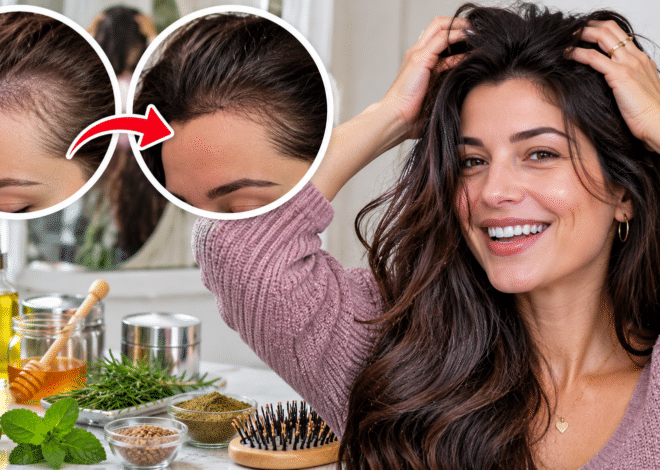
The shampoo aisle has a new section, and it is aimed squarely at women over 45. Bottles promise “menopause hair,” “DHT blocking” and “thicker in weeks.” Meanwhile the drain fills a little faster and the part looks a little wider. If you are in perimenopause or past it, the question is practical: which of these bottles is worth the money, and which is just a nice smell?
The honest answer starts with a time limit. A shampoo usually sits on the scalp for a couple of minutes before you rinse it away. A handful of ingredients have shown measurable effects in clinical studies even with that short contact, and a few have shown nothing beyond marketing. Knowing the difference is the most useful thing you can bring to the store.
What We Know
- Thinning is common after menopause. A 2022 study in Menopause of 178 women at a menopause clinic found 52.2% had female pattern hair loss, and prevalence rose with age.
- Hormones are part of the picture. The Menopause Society notes that menopause-related hormone changes can reduce hair diameter and limit hair growth.
- Only one topical is FDA-approved for women. Minoxidil is the approved topical for female pattern hair loss, and the 5% foam was approved for once-daily use in women in 2014.
- Ketoconazole has early evidence. A 1998 study found 2% ketoconazole shampoo improved hair density and follicle size almost as much as 2% minoxidil, though the authors called for larger trials.
- Caffeine reaches the follicle quickly. A 2007 study found caffeine from a shampoo penetrated hair follicles after just 2 minutes of contact.
What Is Still Unclear
- Large trials in menopausal womenMost shampoo studies are small, short or done in men; few enrolled postmenopausal women specifically.
- Real-world regrowthLab penetration and shedding reductions do not prove visible regrowth over years.
- Botanical “DHT blockers”Saw palmetto, biotin and similar shampoo additives lack strong clinical evidence at shampoo doses.
- Best combinationNo trial has compared full shampoo-plus-treatment routines head to head in menopausal women.
Why So Many Women Notice Thinning After 45
Menopause is not a rare event. The Society for Women’s Health Research says about 1.3 million U.S. women transition into menopause each year, at an average age of 51, and that the transition usually lasts 4 to 8 years. Hair changes ride along with it. In a 2026 industry survey of more than 4,000 women reported by Cosmetics and Toiletries, 80% named hair loss or shedding and 77% named thinning as negative hair changes since perimenopause or menopause.
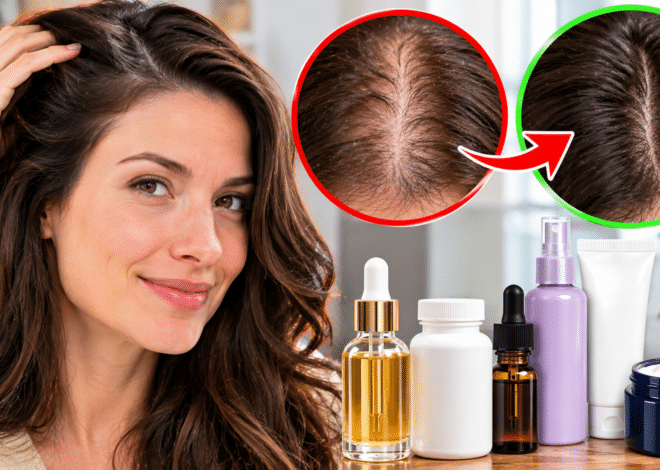
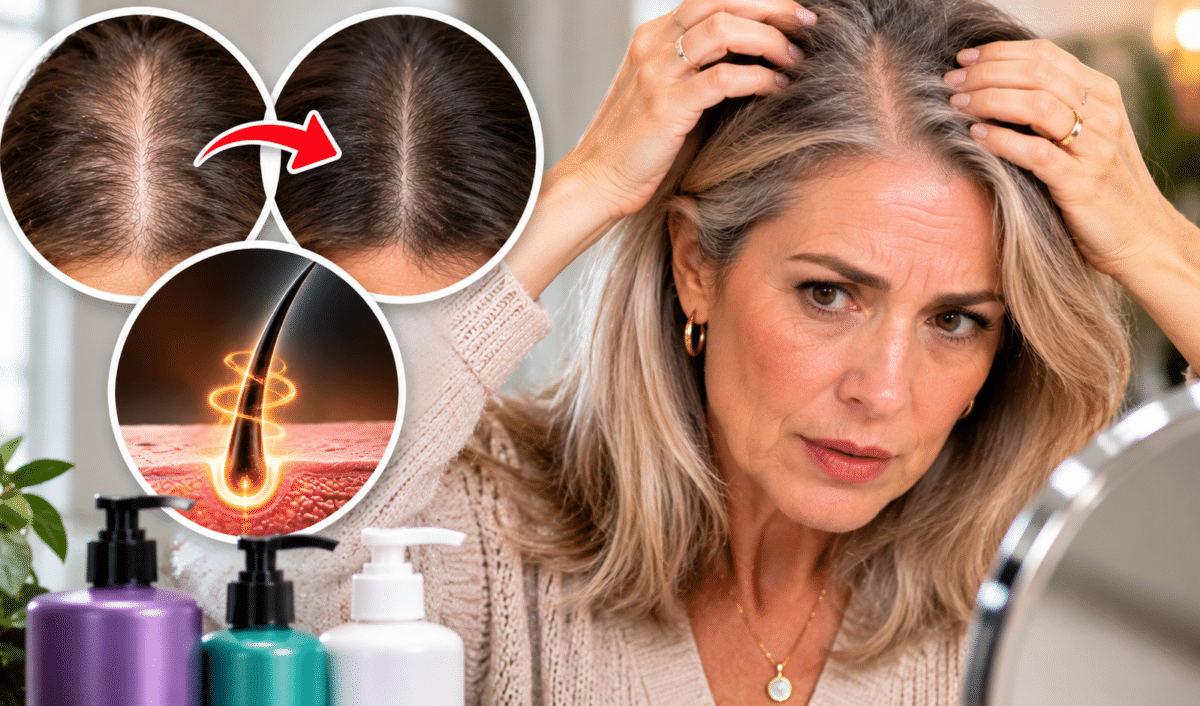
The hair loss most women see is female pattern hair loss: thinning at the part that spreads over the top of the head, with the front hairline intact. The Menopause Society describes it as the most common hair loss disorder in women and notes that women spend, on average, about a third of their lives after menopause. Among women in the 2022 study who had it, 73.2% had mild loss, 22.6% moderate and 4.3% severe. That matters for shampoo shoppers. Mild loss is exactly where scalp care and early treatment have the most room to help.
Hair changes women report since perimenopause or menopause
Percent of respondents naming each change. 2026 survey of more than 4,000 U.S. women, reported by Cosmetics and Toiletries. Bars scaled to 80%.
- 178Women examined in the 2022 Menopause study
- 73.2%Of those with pattern loss had mild loss
- 60%Of participants had low self-esteem
- 4–8 yearsTypical length of the menopause transition
The Two-Minute Problem Every Shampoo Faces
A shampoo’s job is to clean, then leave. That short visit limits what any active ingredient can do. Some ingredients get around it. In a study in Skin Pharmacology and Physiology, caffeine applied in a shampoo for just 2 minutes penetrated the hair follicles, and the follicles were the fastest route in. A follow-up laser microscopy study found the caffeine was still detectable in the follicles 24 hours later.
Other ingredients work on the scalp surface rather than the follicle. Antifungals such as ketoconazole and piroctone olamine calm yeast, flaking and inflammation, and researchers suspect a calmer scalp helps hair stay anchored longer. What no shampoo has shown is the reliable, measured regrowth that earned minoxidil its FDA approval.
Worked example: how little time shampoo spends on your scalp
- Contact time per wash2 minutes
- Washes per week3
- Total contact per week2 x 3 = 6 minutes
- Minutes in a week7 x 24 x 60 = 10,080
- Share of the week on the scalp6 ÷ 10,080 = 0.06%
Our arithmetic, assuming a 2-minute lather three times a week. Leave-on treatments stay on the scalp for hours. That gap is why dermatologists treat shampoo as support and a leave-on as the main treatment.
Ingredient by Ingredient: The Evidence Scorecard
Instead of ranking brands, which change formulas often, we graded the ingredients that matter. The letter grade is our editorial summary of the published evidence, not an official rating.
Minoxidil 5% foam (the partner to any shampoo)
Minoxidil is not a shampoo, but no article on menopausal hair loss should skip it. A Skin Therapy Letter review notes the FDA approved 5% minoxidil foam for female pattern hair loss in 2014. In a phase III trial in the Journal of Drugs in Dermatology, 322 women used either once-daily 5% foam or twice-daily 2% solution for 52 weeks, and the foam was found noninferior. The label says results may occur at 3 months, and some women need at least 6 months.
Ketoconazole (1% over the counter, 2% prescription)
Ketoconazole is the active ingredient in medicated dandruff shampoos. The 1% strength is sold over the counter, and the 2% strength requires a prescription. A 1998 study in Dermatology found 2% ketoconazole shampoo improved hair density, follicle size and the share of growing follicles almost as much as a 2% minoxidil regimen. A 2019 trial in Biomedical Dermatology tested a 2% ketoconazole preparation in 40 women with female pattern hair loss over 6 months. Both groups improved, and side effects hit 10% of the ketoconazole group versus 55% of the minoxidil group, though the two groups started at different severity levels.
Piroctone olamine
This anti-dandruff ingredient has one of the few placebo-controlled trials done in women with thinning. In an 8-week, double-blind study published in the International Journal of Cosmetic Science in 2021, women with self-perceived thinning used a piroctone olamine shampoo or leave-on, and the authors reported reduced shedding and better scalp condition. A larger 24-week Cleveland Clinic study of 360 men and women aged 25 to 65 tested a shampoo and leave-on combining piroctone olamine, zinc pyrithione, niacinamide, panthenol and caffeine, and found significant improvement in thinning hair. Both tested specific formulations, so results may not carry over to every product that lists the ingredient.
Caffeine
Caffeine’s lab evidence is strong and its clinical evidence is thinner. In a 2017 randomized trial of 210 men, a leave-on 0.2% caffeine liquid was found noninferior to 5% minoxidil solution: growing-phase hairs improved by 10.59% with caffeine and 11.68% with minoxidil after 6 months. That was a leave-on liquid in men, not a shampoo in women. The same paper notes lab research suggesting female hair follicles may be more sensitive to caffeine than male follicles, which is encouraging but not proof.
Rosemary
Rosemary is everywhere on social media. The evidence is a single 2015 trial in Skinmed in which 100 men used rosemary oil or 2% minoxidil for 6 months. Both groups gained hair at 6 months, neither did at 3 months, and the difference between them was not significant. It used concentrated oil, not shampoo, had no placebo group, and compared rosemary with the weaker 2% minoxidil. Dermatologists generally treat it as a pleasant add-on rather than a treatment.
How many people were in the key studies
Participants in the main published trial for each ingredient. Bigger is not everything, but small trials are easier to overturn. Bars scaled to 360.
Patience Is the Hidden Ingredient
Hair grows slowly, and the follicles that thin during menopause respond slowly too. The 2015 rosemary trial is a useful warning: neither rosemary nor minoxidil showed a significant hair-count change at 3 months, and both did at 6. Women who quit at 10 weeks often quit right before anything could have happened.
When studies first measured results
Months of use at the first reported endpoint or label guidance. Bars scaled to 12 months.
- Weeks 1 to 8: Scalp feels calmer; flaking and itch ease. Shedding reductions were measured at 8 weeks in the piroctone olamine trial.
- Months 2 to 3: Minoxidil can cause temporary extra shedding as old hairs make way. The foam label says results may start at 3 months.
- Month 6: The checkpoint most trials used. Rosemary, ketoconazole and caffeine studies measured results here.
- Month 12: The minoxidil foam phase III study ran for 52 weeks. Fair time to judge a full routine.
- Ongoing: Stopping minoxidil generally means losing the gains. Shampoo routines also only help while you keep using them.
How to Read a “Menopause Shampoo” Label
Use the table below as a decoder. If an ingredient is not on the list, it is not necessarily harmful; it simply has less published evidence behind it at shampoo strength.
| Label ingredient | What it does | Best evidence | Studied in | Our take |
|---|---|---|---|---|
| Ketoconazole 1% or 2% | Antifungal; reduces inflammation and oil | 1998 and 2019 trials, 6 months | Men; 40 women | Strong pick if you have flakes or oiliness |
| Piroctone olamine | Antifungal antioxidant | 8-week placebo trial | Women with thinning | Strong pick for shedding |
| Caffeine | Stimulates follicles in lab tests | Follicle penetration in 2 minutes | Men (clinical); lab | Reasonable add-on |
| Zinc pyrithione | Antifungal for dandruff | Part of 360-person combo trial | Men and women | Good for flaky scalps |
| Niacinamide, panthenol | Scalp barrier and conditioning | Part of 360-person combo trial | Men and women | Supportive |
| Rosemary | Botanical; circulation claims | One 100-man oil trial | Men | Optional extra |
| Biotin, saw palmetto | Marketed as strengthening or DHT-blocking | No strong shampoo trials | Limited | Do not pay extra for it |
Dry scalp? Rotate, do not double up
Medicated shampoos can be drying, and many women notice drier hair after menopause. One practical approach is to use the medicated shampoo two or three times a week and a gentle, moisturizing shampoo on other wash days, always followed by conditioner on the lengths.
Matching the Shampoo to Your Situation
| Your situation | Shampoo to look for | Add-on treatment | Check after | See a doctor if |
|---|---|---|---|---|
| Widening part, no flaking | Caffeine or piroctone olamine | Minoxidil 5% foam once daily | 6 months | No change at 12 months |
| Thinning plus dandruff or oiliness | Ketoconazole 1%, 2 to 3 times a week | Minoxidil 5% foam | 6 months | Itch or redness persists |
| Sudden heavy shedding | Gentle shampoo; avoid new actives | Blood tests for iron, thyroid | 3 months | Shedding lasts over 6 months |
| Dry, brittle, limp hair | Moisturizing shampoo plus conditioner | Reduce heat styling | 2 months | Breakage keeps worsening |
| Patches, pain or burning | None until diagnosed | Dermatologist exam | Now | Always; scarring loss needs fast care |
Myths Sold in the Shampoo Aisle
What people get wrong
- “This shampoo regrows hair.” No shampoo is FDA-approved to regrow hair; minoxidil is the approved topical for women.
- “Rosemary works as well as Rogaine.” The one trial used oil, enrolled 100 men and compared it with the weaker 2% minoxidil.
- “If I don’t see results in a month, it’s not working.” Most trials measured results at 6 months; minoxidil may take 3 to 6.
- “Sulfate-free shampoo prevents hair loss.” Gentle cleansers help dry hair feel better but are not a hair loss treatment.
- “Menopause hair loss is just hormones, so nothing helps.” Pattern hair loss is treatable, and mild cases have the most to gain.
Your Shampoo Routine Checklist
- Massage shampoo into the scalp for a full 2 minutes.
- Use a medicated shampoo 2 to 3 times a week.
- Condition the lengths after every wash.
- Apply minoxidil 5% foam once daily if advised.
- Photograph your part every 3 months in the same light.
- Give any routine at least 6 months.
- Ask about iron and thyroid tests if shedding is sudden.
- See a dermatologist for patches, pain or burning.
Frequently Asked Questions
What is the best shampoo for menopausal hair loss?
Look for ketoconazole, piroctone olamine or caffeine, which have the most research behind them. Shampoo works best alongside 5% minoxidil foam, the FDA-approved topical for female pattern hair loss.
Does ketoconazole shampoo help women’s hair loss?
Small studies suggest it can. A 2019 trial in 40 women found a 2% ketoconazole preparation improved pattern hair loss over 6 months with fewer side effects than 2% minoxidil. Larger trials are still needed.
Is caffeine shampoo effective for thinning hair?
Caffeine reaches hair follicles after 2 minutes of shampoo contact and stays detectable for 24 hours. Its main clinical trial used a leave-on liquid in men, so evidence for women is still limited.
Can menopause hair thinning be reversed?
Often partly. Pattern hair loss is common after menopause, and treatments such as minoxidil can slow it and regrow some hair, usually over 3 to 12 months.
How often should I use a hair loss shampoo?
Medicated shampoos such as ketoconazole are typically used 2 to 3 times a week, alternating with a gentle shampoo if your scalp gets dry. Follow the product label.
Does rosemary shampoo help hair growth?
Evidence is limited. The only well-known trial used rosemary oil in 100 men and found results similar to 2% minoxidil after 6 months, without a placebo group.
How long does it take for hair loss shampoo to work?
Shedding may improve within about 8 weeks, but most studies measured hair changes at 6 months. Judge a full routine after 6 to 12 months.
Should I see a doctor about menopausal hair loss?
Yes, if shedding is sudden, lasts more than 6 months, comes with patches, itching, pain or burning, or does not improve after a year of treatment.
The Short Version
About half of postmenopausal women develop pattern hair loss, and the shampoo aisle has noticed. The ingredients with the most evidence are ketoconazole, piroctone olamine and caffeine, which can calm the scalp and reduce shedding. Rosemary, biotin and saw palmetto have far less support. No shampoo is approved to regrow hair, so for real thinning, pair a good shampoo with once-daily 5% minoxidil foam and give it 6 to 12 months.

Omisha is a health writer passionate about turning complex medical research into clear, actionable content readers can trust. She covers everything from nutrition and mental wellness to chronic disease management, always grounding her work in credible science and real-world relevance. When she's not writing, she's usually reading up on the latest health studies or exploring new wellness trends to write about next.