Beauty Science · Hair Care · Product Evidence
Hair Oil vs Hair Growth Serum: Which One Actually Does What It Promises?
Oils protect and smooth the hair you already have. Only a drug, such as minoxidil, is approved by the FDA to regrow hair. Most “growth serums” sit somewhere in between, and the label tells you which side they are on.
- By the Beauty Science Desk
- Checked against FDA rules and peer-reviewed trials
- Updated November 27, 2026
- Scope: U.S. over-the-counter hair products
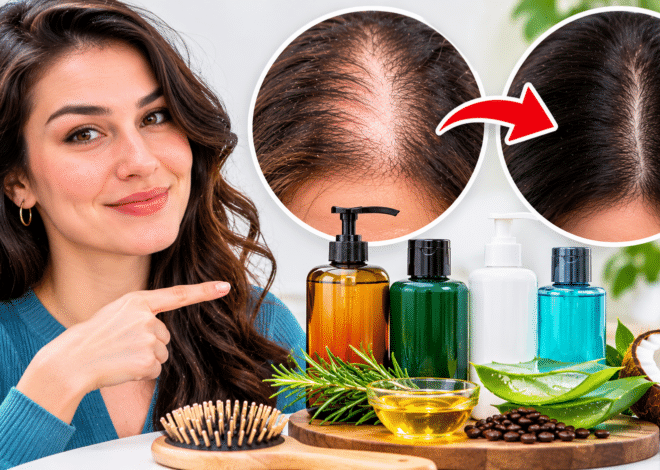
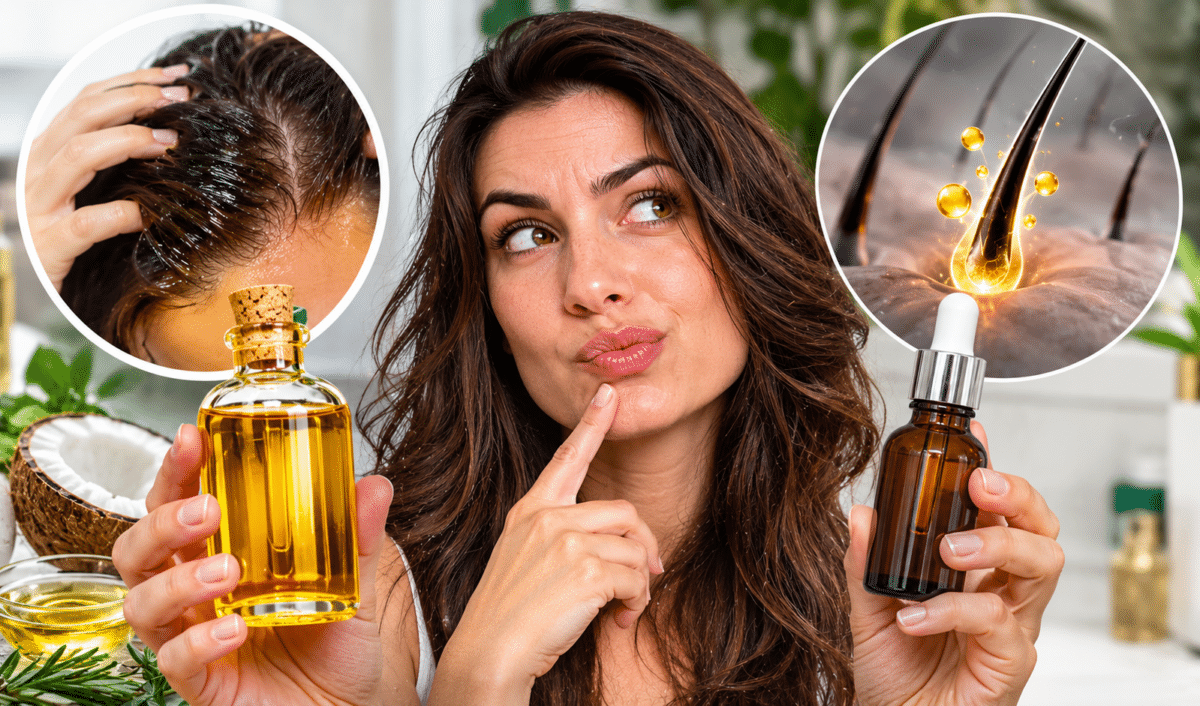
Walk down any beauty aisle and you will see two shelves making similar promises. On one side, amber bottles of rosemary, castor and coconut oil. On the other, sleek droppers labeled “growth serum,” “density booster” or “follicle activator.” Both claim to give you thicker, fuller hair. Both cost real money, and both are all over social media.
The honest comparison starts with a question most shoppers never ask: what is this product legally allowed to claim? In the United States, the answer separates cosmetics from drugs, and it explains far more about results than the price tag or the ingredient list.
What We Know
- Growth claims make a product a drug. The FDA says products intended to affect the structure or function of the body are drugs, and it lists “hair restoration” among the claims cited in its warning letters.
- Minoxidil is the approved topical option. A federal rule, 21 CFR 310.527, says other OTC hair-grower ingredients lack adequate data to be recognized as safe and effective.
- Coconut oil reduces protein loss. A 2003 Journal of Cosmetic Science study found coconut oil, unlike mineral and sunflower oil, reduced protein loss from hair.
- Caffeine has one notable trial. In 210 men, a 0.2% caffeine liquid was found not inferior to 5% minoxidil over 6 months.
- Stronger minoxidil works better. A 48-week trial in 393 men found 5% minoxidil produced 45% more regrowth than 2%.
What Is Still Unclear
- Independent replicationSeveral natural-ingredient trials are small and some were funded by product makers. Larger independent studies are scarce.
- Peptides and “growth factors”Many serum ingredients have lab or company data, but few published head-to-head trials in people.
- Long-term resultsRosemary, caffeine and pumpkin seed oil trials lasted 3 to 6 months; long-term benefit is unknown.
- Which oils help scalpsOils that help hair strands may not help the scalp, and heavy oils can worsen dandruff in some people.
The Legal Line That Separates the Two Shelves
Under the Federal Food, Drug, and Cosmetic Act, a cosmetic is something applied to the body for cleansing, beautifying or altering appearance. A drug is something intended to treat or prevent disease or affect the structure or function of the body. Hair growth is a body function, so a product that promises to grow hair is, legally, a drug.
That has practical consequences. Drugs must show safety and effectiveness and carry a Drug Facts label with an active ingredient. Cosmetics do not need FDA approval before they are sold. FDA staff have also said the agency does not recognize the term “cosmeceutical”; a product is a drug, a cosmetic or both. This is why many serums use careful wording such as “for the look of thicker hair” or “supports a healthy scalp.”
Hair oils usually do this
- Coat and smooth the cuticle
- Reduce friction and tangling
- Add shine and tame frizz
- Some, like coconut, reduce protein loss
- Regulated as cosmetics
Growth serums usually do this
- Target the scalp and follicles
- Lightweight, absorb quickly
- Minoxidil versions are OTC drugs
- Others use caffeine, peptides, botanicals
- Cosmetic versions cannot legally promise regrowth
- 1938FD&C Act separates drugs and cosmetics.
- 1988Minoxidil approved for hair loss as Rogaine.
- 1989FDA rule deems other OTC hair-grower ingredients unproven.
- 1996Minoxidil becomes available over the counter.
- 2022MoCRA expands FDA authority over cosmetics.
Where Hair Oil Genuinely Wins
Hair oils work on the hair shaft, the visible part that is no longer alive. They cannot change how fast a follicle grows, but they can change how much length survives. That matters because breakage, not slow growth, is why many people feel their hair “never grows.”
The best-known evidence comes from a 2003 study by researchers at Marico Industries, an Indian company that sells coconut oil products, published in the Journal of Cosmetic Science. They compared coconut, sunflower and mineral oil on hair. Coconut oil was the only one that reduced protein loss significantly for both undamaged and damaged hair, whether used before or after washing. The researchers linked this to coconut oil’s small, straight lauric acid molecules, which can penetrate the hair, while mineral oil does not penetrate at all.
What protein loss means
When hair swells with water and is combed, cuticle cells can chip away, and protein is lost. Over time this leaves hair rough, dull and prone to splitting. Applying a penetrating oil before washing may limit that swelling.
When oil works on the scalp, too
Some oils have been tested as scalp treatments for pattern hair loss. In a 2015 SKINmed trial of 100 people, rosemary oil and 2% minoxidil produced similar hair count increases at 6 months, with no change at 3 months. In a 2021 Journal of Cosmetic Dermatology trial of 60 women, topical pumpkin seed oil was compared with 5% minoxidil foam over 3 months and the pumpkin seed oil group’s vellus, or fine, hair measure fell from 22.5 to 15.8, with hair shaft diversity falling from 30.5% to 24.0%. These are promising but small studies, and they do not make the oils approved treatments.
Where Growth Serums Earn Their Price
For thinning caused by androgenetic alopecia, the most common type of hair loss, the strongest evidence belongs to minoxidil. A 2002 randomized trial published in the Journal of the American Academy of Dermatology followed 393 men for 48 weeks. Those using 5% minoxidil gained an average of 18.6 hairs per square centimeter, compared with 12.7 for 2% and 3.9 for placebo.
Change in hair density with minoxidil
Average change in hair count per square centimeter from baseline. Olsen et al., JAAD 2002 (48 weeks, solution); Olsen et al., 2007 (16 weeks, foam). As summarized in a 2019 review in Drug Design, Development and Therapy.
The trade-off is side effects. In the same trial, itching was reported by 4% of men using 5% minoxidil compared with 1% on 2%. Minoxidil can also cause temporary shedding in the first weeks and must be used continuously to maintain results.
The caffeine serum that matched minoxidil in one trial
Caffeine is the best-studied cosmetic serum ingredient. In a 2017 randomized trial of 210 men published in Skin Pharmacology and Physiology, a 0.2% caffeine liquid was compared with 5% minoxidil for 6 months. The share of hairs in the growth phase improved by 11.68% with minoxidil and 10.59% with caffeine, a difference of 1.09%, and the authors concluded caffeine was not inferior. The study was open-label, and one author was employed by the company that makes the caffeine product.
Caffeine vs minoxidil: share of hairs in growth phase
Percent of anagen hairs and improvement. Dhurat et al., Skin Pharmacology and Physiology, 2017. Per-protocol population, frontal and occipital trichograms.
- 393Men in the 48-week minoxidil trial
- 4% vs 1%Itching with 5% vs 2% minoxidil
- 1.09%Gap between caffeine and minoxidil results
- 60Women in the pumpkin seed oil trial
How Long Each Study Waited for Results
A recurring theme across these trials is patience. None measured meaningful scalp changes in less than about 3 months, and the larger ones ran 6 months or more.
Trial length for common hair ingredients
Weeks of treatment before final measurement. Olsen 2002 (JAAD); Dhurat 2017 (Skin Pharmacol Physiol); Panahi 2015 (SKINmed); Koyama 2016 (Eplasty); Ibrahim 2021 (J Cosmet Dermatol).
Worked example: reading the minoxidil numbers
- 5% minoxidil gain at 48 weeks+18.6 hairs per sq cm
- Placebo gain at 48 weeks+3.9 hairs per sq cm
- Net benefit of 5% over placebo18.6 – 3.9 = 14.7
- Net benefit of 2% over placebo12.7 – 3.9 = 8.8
- 5% advantage over 2%, net14.7 ÷ 8.8 = about 1.7 times
The trial figures are from Olsen et al.; the subtraction is our arithmetic. Subtracting placebo matters, because hair counts also rise somewhat in untreated groups. Any serum that reports gains without a placebo or comparison group is telling you less than it seems.
Choosing by Goal, Not by Bottle
| Your main goal | Better choice | Key evidence | Time to judge | Watch for |
|---|---|---|---|---|
| Dry, brittle ends | Oil | Coconut oil reduced protein loss | 2 to 4 weeks | Greasy roots |
| Frizz and shine | Oil | Coats cuticle, reduces friction | Immediate | Buildup |
| Pattern thinning, men | Minoxidil serum | 48-week trial, 393 men | 4 to 6 months | Itching, early shed |
| Pattern thinning, women | Minoxidil serum | FDA-approved for women | 4 to 6 months | Facial hair growth |
| Prefer non-drug option | Caffeine or rosemary | Single trials, 100 to 210 people | 6 months | Limited replication |
| Flaky, itchy scalp | Medicated shampoo | Dandruff treatments are OTC drugs | 2 to 4 weeks | Heavy oils can worsen flakes |
- Damage onlyUse an oil on mid-lengths and ends, 1 to 2 times a week.
- Mild thinningTry a non-drug serum for 6 months, with photos to compare.
- Visible pattern lossUse OTC minoxidil daily; judge at 4 to 6 months.
- No change at 6 monthsSee a dermatologist about prescription options.
- Sudden or patchy lossSee a doctor first; serums are not the answer.
Decoding the Words on the Label
| Label wording | What it usually means | Regulated as | Can it promise regrowth? |
|---|---|---|---|
| “Drug Facts” with minoxidil 2% or 5% | Approved hair regrowth treatment | OTC drug | Yes |
| “For thicker-looking hair” | Cosmetic appearance claim | Cosmetic | No |
| “Supports scalp health” | General cosmetic claim | Cosmetic | No |
| “Clinically tested” | Some testing occurred; details vary | Usually cosmetic | No |
| “Cosmeceutical” | Marketing term; not recognized by FDA | Cosmetic or drug | Only if a drug |
| “Regrows hair” without Drug Facts | Possible illegal drug claim | Unclear | Be cautious |
Mistakes That Waste Money
What people get wrong
- Expecting oil to regrow hair in weeks. Oils mostly protect strands; scalp trials lasted 3 to 6 months.
- Quitting minoxidil after early shedding. Temporary shedding is common in the first weeks.
- Trusting “clinically proven” without numbers. Look for the number of people, length and comparison group.
- Using heavy oil on a flaky scalp. It can feed buildup; treat dandruff separately.
- Applying 5% men’s minoxidil without checking the label. Follow the instructions for your product and talk to a clinician if unsure.
Before You Buy Either Bottle
- Decide your goal: damage, frizz or thinning.
- Look for a Drug Facts panel if you want regrowth.
- Check the active ingredient and percentage, such as 2% or 5%.
- Patch-test a new oil or serum for 24 to 48 hours.
- Take photos on day 1 and again at 3 and 6 months.
- Use oils on mid-lengths and ends, not heavy on the scalp.
- Expect 4 to 6 months before judging any scalp product.
- See a dermatologist for sudden, patchy or painful loss.
Frequently Asked Questions
Is hair oil or hair serum better for hair growth?
For regrowing hair, a minoxidil serum or foam has the strongest evidence and is FDA-approved. Hair oils mainly protect strands, reduce breakage and add shine.
Does rosemary oil work as well as minoxidil?
One 2015 trial of 100 people found rosemary oil and 2% minoxidil produced similar hair count gains at 6 months. It has not been confirmed in large independent studies.
Do caffeine hair serums work?
A 2017 trial of 210 men found a 0.2% caffeine liquid was not inferior to 5% minoxidil after 6 months. The study was open-label and partly industry-linked.
Is coconut oil good for hair?
A 2003 study found coconut oil reduced protein loss from hair, unlike sunflower or mineral oil. It may help with damage and breakage but is not a proven growth treatment.
Can a hair serum legally claim to regrow hair?
Only if it is regulated as a drug. The FDA treats products that claim to restore hair growth as drugs. Cosmetic serums can only make appearance claims.
How long does it take for a hair growth serum to work?
Most trials measured results at 3 to 6 months. Minoxidil trials ran up to 48 weeks, with the clearest gains later in treatment.
Can I use hair oil and minoxidil together?
Many people use oil on lengths and minoxidil on the scalp. Apply minoxidil to a dry scalp as directed and ask a dermatologist about combining products.
Which oil is best for hair?
Coconut oil has the best lab evidence for reducing protein loss. Rosemary and pumpkin seed oil have small trials for pattern thinning.
The Short Version
Hair oil and hair growth serum solve different problems. Oils work on the strands, smoothing the cuticle, cutting friction and, in coconut oil’s case, reducing protein loss in lab tests. Serums target the scalp. Only minoxidil is FDA-approved for OTC hair regrowth, and a 48-week trial showed 5% minoxidil added about 14.7 hairs per square centimeter beyond placebo. Caffeine, rosemary and pumpkin seed oil have small trials with promising results. Choose by goal, check for a Drug Facts label if you want regrowth, and give any scalp product 4 to 6 months.

Omisha is a health writer passionate about turning complex medical research into clear, actionable content readers can trust. She covers everything from nutrition and mental wellness to chronic disease management, always grounding her work in credible science and real-world relevance. When she's not writing, she's usually reading up on the latest health studies or exploring new wellness trends to write about next.