London Life and Your Skin: How Hard Water, Short Winter Days and Damp Weather Change a Skincare Routine
For Americans moving to or wintering in London, three local conditions reshape what skin needs. Here is the evidence behind each one, a simple morning and evening routine, and a few reflections on making it stick.
The first week in London feels like a film set: red buses in the drizzle, Victorian terraces, a pub on every corner. The second week, your skin starts talking. Faces feel tight after washing. Kettles grow a white crust. By December, it is dark before 4 p.m., and the face in the mirror looks duller than it did in Austin or Atlanta. None of this is imagined. London’s water, light and weather are measurably different from most of the United States, and a routine that worked at home often needs adjusting. The good news: the fixes are small, cheap and based on solid evidence.
Why London Is Harder on Skin Than Most American Cities
London sits at about 51.5 degrees north, a latitude no city in the contiguous United States reaches. Seattle is at roughly 47.6 degrees and New York at 40.7. That geography drives two things skin notices: dramatically shorter winter days and weaker winter sunlight. Add the city’s geology, which fills its tap water with dissolved chalk, and a typically damp, mild climate that encourages long hot showers and central heating, and you have a recipe for dryness and irritation even in people who never had skin trouble at home.
Latitude in degrees north. Higher latitude means shorter winter days and weaker winter sun. Standard geographic coordinates.
The Chalk in Your Shower: What “Hard Water” Means
Hardness measures dissolved calcium and magnesium, expressed as milligrams of calcium carbonate per liter. The U.K. Drinking Water Inspectorate classes water above 200 mg/l as hard and above 300 as very hard. Thames Water, which supplies most of London, says most water in the South-East of England is naturally hard because it filters through chalk and limestone. An industry analysis by water-softener company Culligan Harvey puts average London hardness at about 293 parts per million, close to the “very hard” line.
Upper bound of each band in mg/l as calcium carbonate. Bands from the Drinking Water Inspectorate; London figure from a Culligan Harvey industry analysis. U.S. agencies use different cutoffs.
Above 300 mg/l counts as very hard.
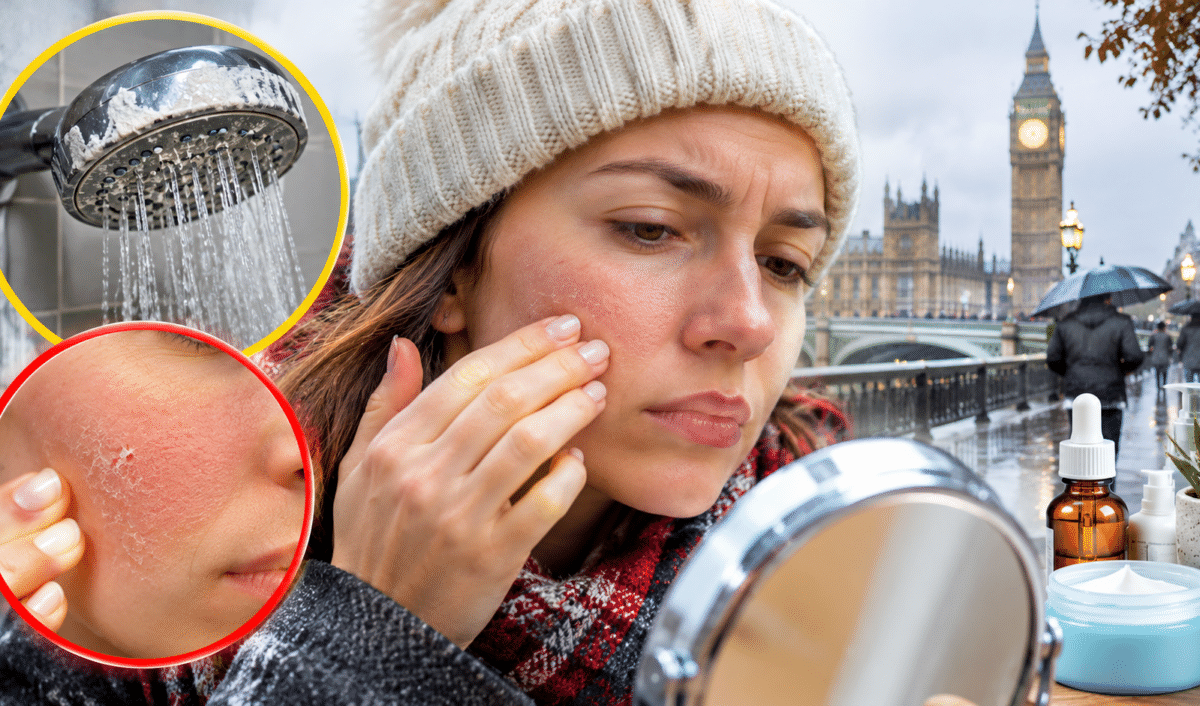
Hard water is safe to drink; the DWI and water companies are clear on that. The skin question is different. In a 2017 study, researchers at King’s College London and the University of Sheffield found that exposing skin to hard water damaged the skin barrier. Hard water’s high alkalinity can raise skin surface pH, which is normally acidic, and minerals can combine with soap residues that cling to the skin.
What the eczema research found
A King’s College London study of 1,303 three-month-old infants, published in the Journal of Allergy and Clinical Immunology, found that living in a hard water area was associated with a 61% to 87% higher risk of eczema compared with softer water, depending on chlorine levels. A later analysis found infants with filaggrin gene mutations exposed to hard water had about 2.7 times the risk. These studies concern babies; for adults, the evidence is mostly about barrier function and comfort rather than disease.
What We Know and What Is Still Unclear
What We Know
- London water is hard to very hard because of chalk geology.
- Lab work shows hard water can raise skin pH and weaken the barrier.
- Hard water is linked to higher infant eczema risk in U.K. studies.
- No U.K. sunlight supports vitamin D production from October to early March.
- The NHS advises 10 micrograms of vitamin D daily in autumn and winter.
What Is Still Unclear
- How much hard water affects healthy adult skin over the long term.
- Whether shower filters meaningfully soften water; many do not remove calcium.
- Whether whole-home softeners prevent eczema; the SOFTER trial tested feasibility.
- How much grey-sky UV contributes to skin aging over a few years abroad.
The Light Problem: Vitamin D and Winter Glow
Because the winter sun sits so low, U.K. sunlight lacks the right ultraviolet wavelength for the skin to make vitamin D from October to early March, according to U.K. government guidance. The NHS advises everyone to consider a daily 10-microgram (400 IU) supplement during autumn and winter, and all year for people who get little sun. That is lower than the U.S. Recommended Dietary Allowance of 15 micrograms (600 IU) for most adults, which reflects different national approaches rather than a different human need.
Micrograms per day for adults. Sources: NHS and U.K. government guidance; U.S. National Institutes of Health RDA.
10 mcg equals 400 IU; 100 mcg equals 4,000 IU.
Short days do not mean no ultraviolet. UVA rays, which contribute to skin aging, pass through cloud and window glass year round. The British Nutrition Foundation found that 68% of British adults were unaware of the winter vitamin D advice, which suggests newcomers are even less likely to know it.
On June 21, London’s sun rises at 4:43 a.m. and sets at 9:21 p.m. On December 21, it rises at 8:03 a.m. and sets at 3:53 p.m. That is a swing of 8 hours 48 minutes. Someone working 9 to 5 indoors in December may see daylight only at lunchtime, which is why a short midday walk matters for mood as much as for skin.
A London-Proof Routine, Morning and Night
The routine below is deliberately simple. It focuses on protecting the skin barrier from hard water and central heating, and on daily sun protection. Product categories, not brands, are what matter.
| Step | Morning | Evening | London adjustment |
|---|---|---|---|
| 1. Cleanse | Lukewarm water rinse or gentle cleanser | Cream or gel cleanser, 30 to 60 seconds | Choose non-foaming, low-pH formulas; avoid bar soap |
| 2. Rinse | Short, lukewarm | Short, lukewarm | Hot water plus hard water dries skin faster |
| 3. Treat | Optional vitamin C serum | Retinoid 2 to 3 nights a week if tolerated | Introduce actives slowly while skin adjusts |
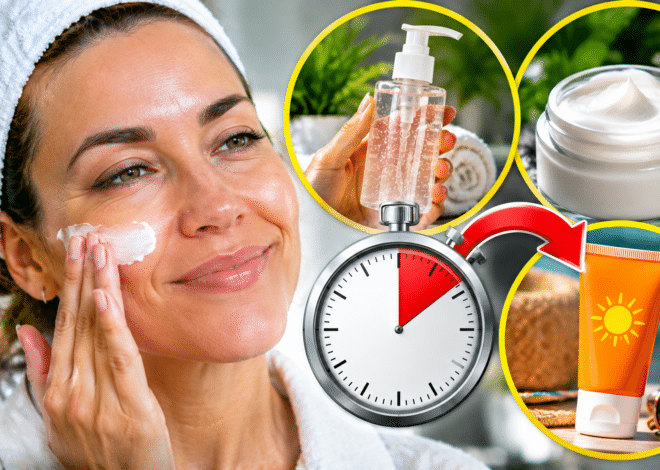
| 4. Moisturize | Light lotion on damp skin | Richer cream with ceramides or glycerin | Apply within 3 minutes of washing to lock in water |
| 5. Protect | Broad-spectrum SPF 30 or higher | None needed | Use it on grey days too; UVA passes through cloud |
| Weekly | Gentle exfoliant once | Check hands and lips | Shower-head cleaning reduces limescale buildup |
General guidance reflecting common dermatologist recommendations for dry or barrier-impaired skin. Patch test new products; see a dermatologist or GP for persistent problems.
Small swaps with an outsized effect
Many Americans arrive with foaming cleansers designed for oilier skin in warmer climates. In hard water, foaming cleansers can leave more residue and strip more oil. Switching to a cream cleanser, shortening showers, and keeping a heavier hand cream by the sink often resolves the tight, flaky feeling within two to three weeks. Lips and hands, which face cold wind and frequent washing, usually need the most attention.
A Year of London Skin, Stop by Stop
- October to early MarchNo vitamin D from sunlight; start the 10-microgram supplement and richer creams.
- December 21Shortest day, 7 hours 50 minutes; central heating at its peak dries skin.
- Late March to AprilSunlight strong enough for vitamin D returns; lighten moisturizer if skin feels oily.
- May to AugustUV peaks; SPF 30 or higher and reapplication outdoors become essential.
- June 21Longest day, 16 hours 38 minutes of daylight; evenings outdoors mean more sun exposure.
- End of SeptemberLast month of reliable vitamin D sunlight; plan the winter switch.
Reading Your Skin: A Four-Level Check
Use the ladder below to decide when routine tweaks are enough and when to get help. Thresholds are indicative, based on common clinical guidance rather than formal criteria.
Tightness after washing for the first 2 to 3 weeks that eases with a gentler cleanser and moisturizer.
Flaking or redness lasting more than 4 weeks despite routine changes.
Itchy, rough patches on hands, elbows or face; U.K. pharmacists can advise on emollients.
Cracked, weeping or infected skin, or eczema flares that disturb sleep.
A Worked Example: Pricing a Winter Skin Plan
The figures below are hypothetical budget estimates, chosen only to show how small the investment can be compared with the instinct to buy a whole new shelf of products.
Five-month winter plan, October to February
- Days of vitamin D supplement (about 150 days)150 tablets
- Hypothetical cost per tabletabout 5 pence
- Vitamin D cost for the seasonabout 7.50 pounds
- One cream cleanser, lasting about 3 months, hypotheticalabout 10 pounds
- One rich moisturizer plus hand cream, hypotheticalabout 20 pounds
- Indicative total for the seasonabout 37.50 pounds
Hypothetical prices for illustration only; actual costs vary widely by brand and retailer. 150 times 0.05 equals 7.50.
- Skipping sunscreen because the sky is grey; UVA still reaches the skin.
- Blaming a new product when the real change is the water.
- Taking long, hot showers to escape the cold, which worsens dryness.
- Assuming a shower filter removes hardness; many filters target chlorine instead.
- Adding several new actives at once while skin is already irritated.
Reflections: What a London Routine Teaches
There is a quieter lesson inside all the numbers. A skincare routine in a new city is less about products than about rhythm. The dark afternoons push the evening routine earlier; the morning ritual of tea, cleanser and moisturizer becomes an anchor in a place where so much else is unfamiliar. People who settle well in London often describe the same pattern: fewer products, done consistently, plus deliberate time in whatever daylight there is.
That mindset carries beyond skin. A ten-minute lunchtime walk along the Thames, a weekend in one of the Royal Parks, and an early night when it is pitch dark at 5 p.m. are as much a part of looking well as any cream. The city rewards people who adapt to its seasons rather than fighting them.
- Simplify: keep 4 core products for the first month while your skin adjusts.
- Protect: apply moisturizer within 3 minutes of every wash.
- Supplement: take 10 micrograms of vitamin D from October to March, per NHS advice.
- Shield: wear SPF 30 or higher daily, rain or shine.
- Move: get outside for at least 10 to 15 minutes of daylight on winter workdays.
Researchers at King’s College London launched the SOFTER trial to test whether installing a domestic water softener around birth could prevent skin barrier breakdown and eczema in hard water areas. The U.K. inspectorate advises that anyone installing a softener keep an unsoftened kitchen tap for drinking and cooking. Renters can rarely install one, which is why barrier-focused skincare is the practical first step.
Frequently Asked Questions
Is London water bad for your skin?
London’s water is safe to drink but hard to very hard. Research from King’s College London found hard water can raise skin pH and damage the skin barrier, which can cause dryness and irritation, especially in people prone to eczema.
How hard is London tap water?
Most London water is classed as hard to very hard. An industry analysis estimates average hardness at about 293 mg/l as calcium carbonate; the U.K. classes above 200 as hard and above 300 as very hard.
Do I need sunscreen in London?
Yes. UVA rays, which contribute to skin aging, pass through clouds year round. Dermatologists generally recommend a broad-spectrum SPF 30 or higher daily, with extra care from May to August when UV peaks.
Should I take vitamin D in London?
The NHS advises everyone to consider a daily 10-microgram (400 IU) vitamin D supplement from October to early March, when U.K. sunlight is too weak for the skin to make vitamin D.
Why is my skin so dry after moving to the UK?
Common causes include hard water, central heating, colder wind and switching to longer hot showers. A gentle cleanser, moisturizer applied to damp skin and shorter lukewarm showers usually help within a few weeks.
Do shower filters soften hard water?
Most small shower filters target chlorine and do little to remove calcium and magnesium. True softening generally requires a whole-home softener, which renters often cannot install.
How many hours of daylight does London get in winter?
On December 21, the shortest day, London gets about 7 hours 50 minutes of daylight, with sunrise at 8:03 a.m. and sunset at 3:53 p.m.
What is the best skincare routine for hard water?
Use a non-foaming cleanser, rinse with lukewarm water, apply a moisturizer with ceramides or glycerin while skin is damp, and wear SPF daily. Introduce active ingredients slowly and see a pharmacist or GP if irritation persists.
The Short Version
London life changes skin for three measurable reasons. Its tap water is hard to very hard, which research links to a higher skin pH and a weaker barrier. Its latitude of 51.5 degrees north cuts December daylight to 7 hours 50 minutes and stops vitamin D production from October to early March. And damp cold plus central heating dries skin. The fix is simple: a gentle cleanser, moisturizer on damp skin, daily SPF 30, the NHS-advised 10 micrograms of vitamin D in winter, and time outdoors in whatever light the day offers.

Omisha is a health writer passionate about turning complex medical research into clear, actionable content readers can trust. She covers everything from nutrition and mental wellness to chronic disease management, always grounding her work in credible science and real-world relevance. When she's not writing, she's usually reading up on the latest health studies or exploring new wellness trends to write about next.