Nutrition Vitamin C
Which Fruits Have the Most Vitamin C — and How Many Servings Do You Actually Need Each Day?
Guava, black currants, kiwi and lychee all deliver more vitamin C per cup than an orange. Here are 11 fruits ranked by USDA data, the daily targets by age and what the research says about colds.
By The Health DeskFact-checked against USDA FoodData Central values, NIH Office of Dietary Supplements guidance, CDC and NHANES data, and the Cochrane LibraryUpdated November 17, 2026Scope U.S. adults and children, whole fruit
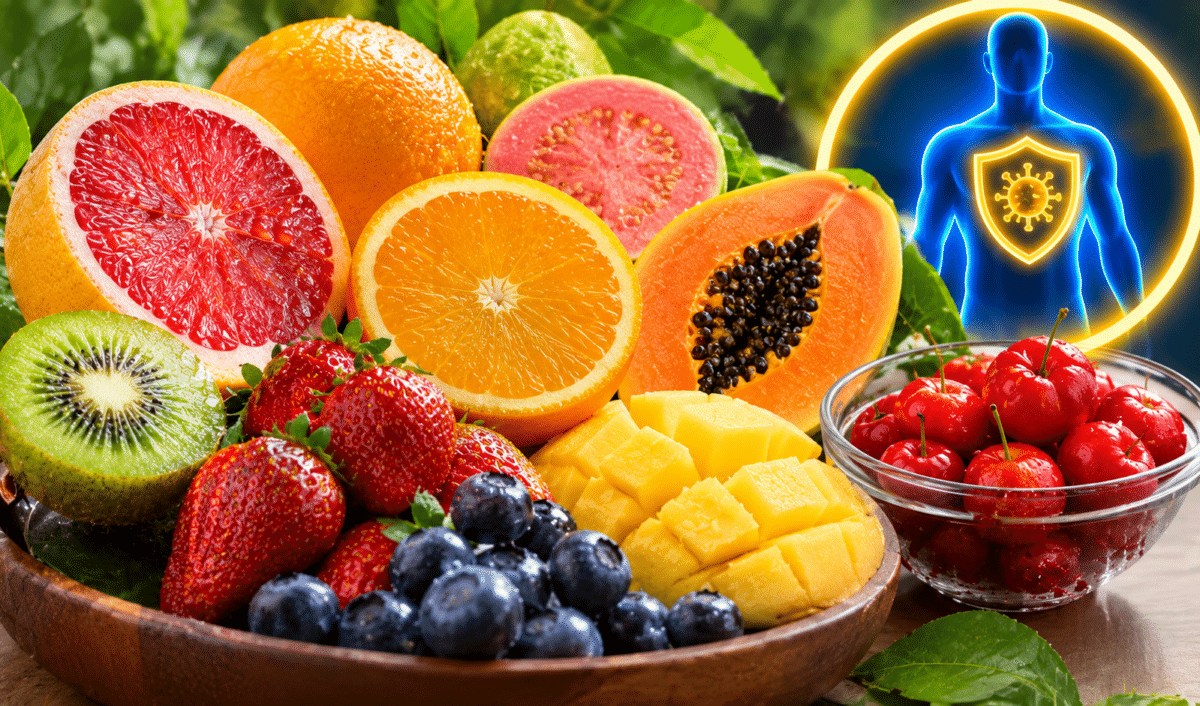
Ask most Americans to name a vitamin C food and the answer is almost always the orange. It is a reasonable choice, but it is not the leader. Cup for cup, guava carries nearly four times as much vitamin C, and kiwi, lychee and strawberries also outrank it. Several of these fruits are sitting in ordinary U.S. supermarkets right now.
That matters because the human body cannot make or store much vitamin C. Unlike most animals, people have to get it from food every day. Harvard’s Nutrition Source describes it as a water-soluble vitamin that is not well stored, so it must be replenished daily. Below are 11 fruits ranked by USDA figures, how they stack up against federal targets and what the evidence says about vitamin C and colds.
What We Know
- Guava, black currants, kiwi and lychee beat oranges per cup.
- Adults need 75 to 90 mg daily; smokers need 35 mg more.
- Below about 10 mg a day for weeks causes scurvy.
- Regular intake modestly shortens colds but rarely prevents them.
What Is Still Unclear
- Whether intakes well above the RDA improve long-term health.
- Whether current targets are high enough for heavier adults.
- How much ripeness, storage and variety change each fruit’s content.
- Why vitamin C status has not improved in two decades.
Why Your Body Needs a Daily Delivery
Vitamin C, also called ascorbic acid, helps the body make collagen, the protein that holds skin, blood vessels and wounds together. It acts as an antioxidant and helps absorb iron from plant foods. According to the CDC’s nutrition report, approximately 70% to 90% of vitamin C is absorbed at usual intakes of 30 to 180 milligrams a day. Above that, absorption falls and the excess leaves in urine.
Too little has real consequences. The CDC notes that scurvy can occur if intake stays below 10 milligrams a day for many weeks. Within about a month of very low intake, early signs such as fatigue, easy bruising, dry skin and bleeding gums can appear, according to a CDC-led analysis of national survey data. Scurvy is rare in the United States, but lower-level deficiency is not.
The national picture has not improved. A 2023 CDC-led study in the Journal of Applied Laboratory Medicine found that the vitamin C status of U.S. adults was essentially unchanged between 2003 to 2006 and 2017 to 2018. Deficiency remained high among people with low dietary intake and among smokers. In the 2017 to 2018 survey, 13.9% of adults eating less than 20 milligrams a day were deficient, compared with 7.4% of those eating 20 to 50 milligrams.
The 11 Fruits, Ranked by Vitamin C Per Cup
The values below come from USDA FoodData Central, as compiled by nutrition databases including Nutrition Advance and The Coconut Mama. Amounts are per one-cup serving unless noted. Actual content varies with variety, ripeness and storage.
- Guava377 mg per cupOne 55-gram fruit has about 125 mg, or 139% of the Daily Value. Also unusually high in protein for a fruit, about 4 grams per cup.
- Black currants203 mg per cupEuropean black currants hold 181 mg per 100 grams. Common in Europe, harder to find fresh in the U.S.; look for frozen.
- Kiwifruit167 mg per cupOne medium kiwi has about 64 mg, close to a woman’s entire daily need.
- Lychee136 mg per cupEach small fruit carries about 7 mg, so a handful adds up quickly. Often sold canned in syrup, which adds sugar.
- Strawberries97.6 mg per cupAmerica’s most accessible top-five option, available fresh or frozen year-round.
- Oranges95.8 mg per cupA large orange has about 98 mg. Whole fruit adds fiber that juice lacks.
- Papaya88.3 mg per cupA small 157-gram papaya provides about 95.6 mg, or 106% of the Daily Value.
- Grapefruit79.1 mg per cupOne whole pink or red grapefruit has about 91 mg. Interacts with some prescription drugs.
- Pineapple78.9 mg per cupAbout 88% of the Daily Value per cup of chunks, plus the enzyme bromelain.
- Mango60.1 mg per cupAbout 67% of the Daily Value per cup, along with vitamin A.
- Cantaloupe65% DV per cupAbout 58 mg by this desk’s calculation from the 90 mg Daily Value. Also rich in water and vitamin A.
Vitamin C Per One-Cup Serving, 11 Fruits
Per 100 Grams, the Order Shifts
Cup measurements favor dense, chopped fruit. Comparing by weight removes that bias. Per 100 grams, USDA data show guava at 228 mg, black currants at 181 mg, kiwi at 92.7 mg, lychee at 71.5 mg and papaya at 60.9 mg. A tomato, for comparison, has 13.7 mg. Outside U.S. supermarkets, the acerola cherry is in a league of its own at roughly 2,850 mg per 100 grams, according to Aroma-Zone’s compilation.
Vitamin C Per 100 Grams of Fruit
How Much You Need Depends on Who You Are
The Recommended Dietary Allowance, set by the National Academies and published by the NIH Office of Dietary Supplements, varies by age, sex and life stage. Smokers need 35 milligrams more a day because tobacco smoke increases oxidative stress. The Tolerable Upper Intake Level for adults is 2,000 milligrams a day; above it, digestive upset and diarrhea become more likely, Harvard’s Nutrition Source notes.
Daily Vitamin C Needs by Life Stage
| Fruit, 1 cup | Vitamin C | % Daily Value (90 mg) | % of women’s RDA (75 mg) | % of smoker men’s need (125 mg) | Note |
|---|---|---|---|---|---|
| Guava | 377 mg | 419% | 503% | 302% | Highest common fruit |
| Black currants | 203 mg | 226% | 271% | 162% | Often sold frozen |
| Kiwifruit | 167 mg | 186% | 223% | 134% | Eat skin for more fiber |
| Lychee | 136 mg | 151% | 181% | 109% | Canned adds sugar |
| Strawberries | 97.6 mg | 108% | 130% | 78% | Year-round frozen |
| Oranges | 95.8 mg | 106% | 128% | 77% | Whole beats juice for fiber |
| Papaya | 88.3 mg | 98% | 118% | 71% | Possible latex cross-allergy |
| Grapefruit | 79.1 mg | 88% | 105% | 63% | Check drug interactions |
| Pineapple | 78.9 mg | 88% | 105% | 63% | Contains bromelain |
| Mango | 60.1 mg | 67% | 80% | 48% | Higher in natural sugar |
| Cantaloupe | 58.5 mg | 65% | 78% | 47% | Wash rind before cutting |
Percentages calculated by this desk from the USDA values and rounded to the nearest whole percent. Cantaloupe milligrams derived from its reported 65% Daily Value.
Vitamin C and Colds: What the Evidence Really Shows
The idea that vitamin C wards off colds has been debated for more than 70 years. The most thorough answer comes from a Cochrane review by Harri Hemilä and Elizabeth Chalker, which pooled 63 randomized trials involving 11,306 adults and children. Taking at least 200 milligrams a day regularly did not reduce the number of colds in the general population. It did shorten them: by 8% in adults and 14% in children.
The exception was people under extreme physical stress. In five trials with 598 marathon runners, skiers and soldiers on subarctic exercises, regular vitamin C cut the risk of catching a cold by about half. Taking vitamin C only after symptoms began did not consistently help. In children, doses of 1 to 2 grams a day shortened colds by 18%.
Vitamin C and the Common Cold: Cochrane Findings
From Sailors’ Scourge to Supermarket Staple
Vitamin C has one of the most dramatic histories in nutrition. Scurvy once killed more British sailors than enemy action, according to an account in Atlas Obscura. The fix was known, forgotten and rediscovered several times before science identified the molecule.
- 1593Admiral Sir Richard Hawkins recommends orange and lemon juice against scurvy
- 1747James Lind tests 6 remedies on 12 sailors aboard HMS Salisbury; citrus wins
- 1753Lind publishes A Treatise of the Scurvy
- 1795British Admiralty begins supplying lemon juice to crews
- 1795 to 1814Navy distributes 1.6 million gallons of lemon juice
- 1920sAlbert Szent-Györgyi isolates the compound later named ascorbic acid
- 1937Szent-Györgyi wins the Nobel Prize for his vitamin C research
The British Navy sometimes substituted lime juice when lemons ran short, which is how British sailors earned the nickname “limeys.” Lime juice turned out to be less effective, a reminder that not all citrus is equal, a point the fruit rankings above still illustrate.
Getting the Most Vitamin C From Your Fruit
Vitamin C is fragile. It breaks down with heat, light, air and time. The CDC-led NHANES researchers note that five varied servings of fruits and vegetables a day can provide more than 200 mg, more than twice the 90 mg Daily Value. These habits help keep that vitamin C in the food.
- Eat fruit raw when possibleVitamin C is heat-sensitive, so fresh fruit retains more than cooked or baked fruit.
- Cut close to eating timeExposure to air after slicing gradually reduces content.
- Store cool and darkRefrigerate cut fruit and keep whole fruit out of direct sunlight.
- Use frozen without guiltFrozen strawberries, mango and black currants are practical year-round options.
- Pair with iron-rich plant foodsVitamin C improves iron absorption from beans, lentils and spinach.
- Spread intake across the dayAbsorption is most efficient at 30 to 180 mg at a time.
- 75 mgDaily RDA for adult women
- 90 mgDaily RDA for adult men
- +35 mgExtra for smokers
- 120 mgDuring breastfeeding
- 2,000 mgAdult upper limit
- 10 mgBelow this for weeks risks scurvy
Frequently Asked Questions
Which fruit has the most vitamin C?
Among common fruits, guava has the most, about 377 mg per cup or 228 mg per 100 grams. The acerola cherry is far higher but rarely sold fresh in the U.S.
Does kiwi have more vitamin C than an orange?
Yes, per cup. Kiwi has about 167 mg per cup compared with about 96 mg for orange sections. One medium kiwi has about 64 mg.
How much vitamin C do I need a day?
Adult men need 90 mg and women 75 mg a day. Pregnant women need 85 mg, breastfeeding women 120 mg, and smokers 35 mg more than nonsmokers.
Can you get too much vitamin C from fruit?
It is very difficult. The adult upper limit is 2,000 mg a day, mostly a concern with supplements. Excess can cause diarrhea and stomach upset.
Does vitamin C prevent colds?
For most people, no. A Cochrane review found regular vitamin C shortened colds by 8% in adults and 14% in children but did not reduce how often people caught them.
What are the signs of vitamin C deficiency?
Early signs include fatigue, easy bruising, dry skin and bleeding gums. Severe, prolonged deficiency causes scurvy.
Is orange juice as good as an orange?
Orange juice provides vitamin C, roughly 76 to 124 mg per cup depending on the product in USDA data, but lacks the fiber of whole fruit and contains more sugar per serving.
Does cooking destroy vitamin C?
Heat breaks down vitamin C, so raw fruit generally keeps more. Light, air and long storage also reduce content.
The Short Version
Oranges are good, but not the best. Per cup, guava (377 mg), black currants (203 mg), kiwi (167 mg) and lychee (136 mg) lead, followed by strawberries, oranges, papaya, grapefruit, pineapple, mango and cantaloupe. Adult women need 75 mg a day and men 90 mg, with smokers needing 35 mg more, so one cup of most of these fruits covers the day. Regular vitamin C modestly shortens colds but does not prevent them for most people. Eat fruit raw, fresh and often.

Omisha is a health writer passionate about turning complex medical research into clear, actionable content readers can trust. She covers everything from nutrition and mental wellness to chronic disease management, always grounding her work in credible science and real-world relevance. When she's not writing, she's usually reading up on the latest health studies or exploring new wellness trends to write about next.