Strength TrainingLeg DayHip Health
Does Your Leg Day Only Move Forward and Back? 3 Side-to-Side Moves That Train the Hips You Are Missing
Squats, lunges and deadlifts work mostly in one direction. Lateral lunges, Cossack squats and band walks load the side hip and inner thigh muscles that steady your knees and pelvis, according to muscle-activation and injury-prevention research.
By The Strength and Fitness DeskFact-checked against peer-reviewed EMG studies, BJSM trial data and CDC figuresUpdated November 11, 2026Scope U.S. adults who strength train
Walk into almost any American gym on leg day and you will see the same pattern. Squats go down and up. Lunges step forward. Deadlifts hinge and stand. Leg presses push straight out. All of it happens in what trainers call the sagittal plane, the front-to-back direction. It builds big quads and glutes. It also leaves a gap.
Life does not move only forward. You step sideways off a curb, pivot to dodge a shopping cart, catch your balance on a slippery driveway and cut across a pickleball court. The muscles that control those sideways moments, the side glutes and the inner thigh adductors, often get little direct training. Three lateral moves can fill that gap in about 12 minutes, and the research behind them is more specific than most fitness advice.
What We Know
- Lateral band walks activated the gluteus medius to 61% of maximum in a 21-person EMG study.
- About 40% to 60% of maximum activation is often cited as the range needed to build strength.
- An adductor program cut groin problems from 21.3% to 13.5% in semiprofessional soccer players.
- More than 1 in 4 U.S. adults 65 and older fall each year, according to the CDC.
What Is Still Unclear
- Few trials test lateral lunges or Cossack squats directly for injury prevention in recreational lifters.
- EMG studies are small, mostly in young adults, and measure activation rather than long-term gains.
- Activation values vary widely between people and studies.
- The ideal weekly dose of lateral work for non-athletes has not been established.
The Direction Most Leg Days Ignore
Exercise scientists describe movement in three planes. Most gym exercises live in one of them. That matters because muscles are trained most effectively in the directions you load them, and the hip has muscles whose main job is side-to-side control.
The key side muscles are the gluteus medius and minimus on the outside of the hip, which pull the leg outward and keep the pelvis level when you stand on one foot, and the adductors on the inner thigh, which pull the leg inward and control the knee as you cut or slide. Equinox coach Dennis Torres, a former basketball player who has had ankle sprains, told the company’s magazine that lateral lunges left him “much more stable.”
Why the Side Hip Protects the Knee
When the gluteus medius is weak, the knee tends to drift inward during squats, landings and stairs, a pattern called knee valgus. Research summarized by Equinox links hip abductor strengthening to better knee mechanics and less inward collapse, and links hip abductor weakness to iliotibial band syndrome in distance runners. Training the muscle in a standing, side-to-side pattern is one of the most practical ways to strengthen it.
The 3 Moves, Step by Step
These three exercises cover the side hip and inner thigh from different angles: one loads the working leg while stretching the other, one takes the hip through a deep range, and one trains the side glutes under constant tension. Sets and reps below are indicative starting points for healthy adults.
Lateral Lunge: The Gateway Side Move
Glute max 41% in sideways lunge, DiStefano 2009Adductors and quads
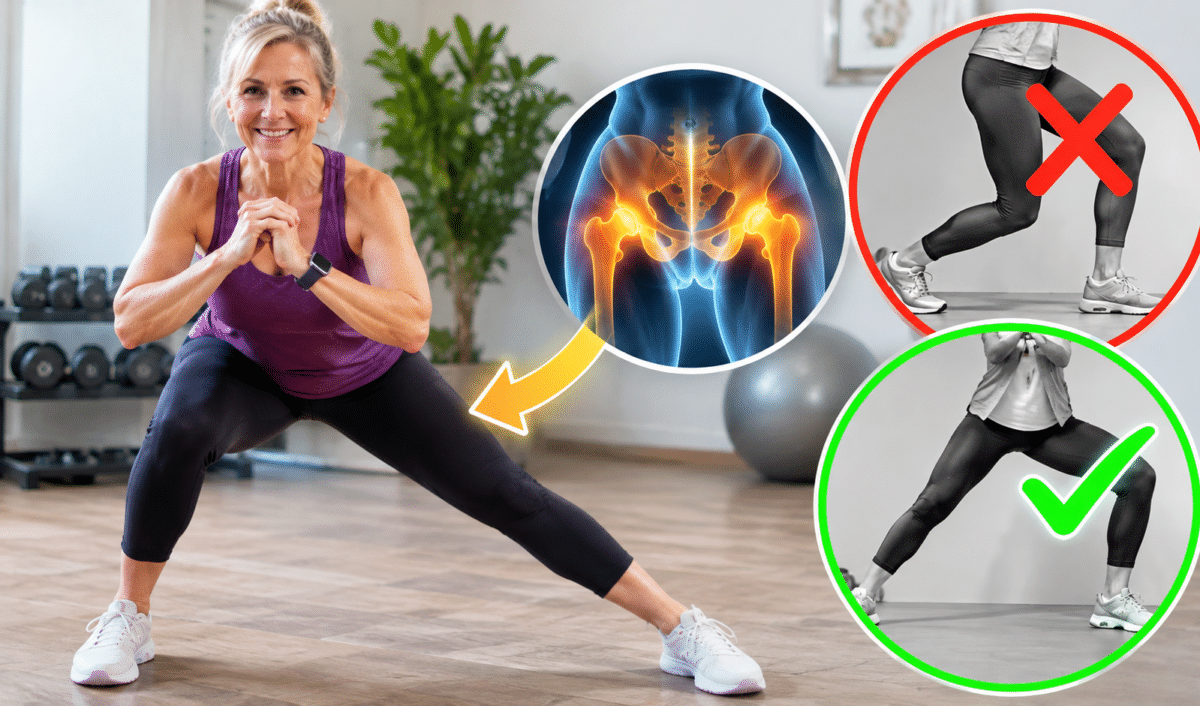
Stand with feet together. Take a wide step to the right, push your hips back and bend the right knee while keeping the left leg straight. Keep your chest up and the right knee tracking over the toes. Push off the right foot to return. Start with body weight, then hold a dumbbell or kettlebell at your chest. The moving leg loads the glutes and quads while the straight leg stretches the inner thigh.
Cossack Squat: Deep Range, Big Payoff
Deeper than a lateral lungeMobility plus strength
Start in a very wide stance with toes slightly out. Shift your weight to one side and sit down into that hip as low as you comfortably can, while the other leg straightens with the toes pointing up. Keep the working heel down. Shift through the bottom to the other side. Hold onto a post or a counterweight in front of you at first. It demands ankle, hip and adductor mobility, so depth comes with practice.
Lateral Band Walk: Side Glutes Under Constant Tension
Glute medius 61%, DiStefano 2009Glute max 27%
Place a mini band around your legs just above the knees or around the ankles. Lower into a quarter squat with feet hip-width apart. Step sideways with the lead foot, then follow with the trailing foot, never letting the feet come together or the band go slack. Keep your toes pointing forward and your pelvis level. Twelve steps right, then twelve steps left, counts as one set.
Gluteus Medius Activation by Exercise
40% to 60% activation zone
The numbers reveal a useful split. The lateral band walk ranked third for the gluteus medius, ahead of forward lunges. The sideways lunge activated the gluteus medius less, at 39%, but it worked the larger gluteus maximus to 41%, similar to the forward lunge at 44%. That is why pairing a lunge-type move with a band walk covers both jobs.
Gluteus Maximus Activation by Exercise
40% to 60% activation zone
What About the Cossack Squat?
The Cossack squat was not tested in the 2009 study, and published activation data for it is limited. It works like a deeper, slower lateral lunge, which is why trainers favor it for adductor flexibility and strength through a long range of motion. Treat it as a progression once lateral lunges feel easy, rather than a replacement.
The Inner-Thigh Evidence From Soccer
The strongest real-world evidence for training the side-to-side muscles comes from the adductors. In a 2019 cluster-randomized trial in the British Journal of Sports Medicine, Harøy and colleagues assigned 35 Norwegian semiprofessional men’s soccer teams, 652 players in all, to either their usual training or an Adductor Strengthening Programme built around one exercise, the Copenhagen adduction, a side plank with the top leg on a bench.
Teams did the program three times a week during a 6- to 8-week preseason, then once a week through a 28-week season. The odds of groin problems fell to 0.59 of the control group’s. That is not proof that lateral lunges prevent injuries in office workers, but it shows that directly strengthening the side-to-side muscles can change injury rates.
Gluteus Medius in Side-Loaded Rehab Exercises
The Boren study shows that side-loaded positions can drive very high side-glute activation. Values above 100% are possible because the maximum test contraction is not always a person’s absolute limit. Side planks with a leg lift and the Copenhagen adduction make strong finishers once the three main moves are comfortable.
Fitting Lateral Work Into Leg Day
Equinox’s Torres recommends one or two lateral exercises in each workout, either as a body-weight warm-up or loaded for strength. The table below shows how the three moves compare and how to scale them. Rep targets are indicative.
| Move | Main muscles | Beginner version | Progression | Indicative sets x reps |
|---|---|---|---|---|
| Lateral lunge | Glutes, quads, adductors | Body weight, shorter step | Goblet dumbbell or kettlebell | 2 to 3 x 8 per side |
| Cossack squat | Adductors, glutes, quads | Hold a post, partial depth | Goblet weight, full depth | 2 to 3 x 6 per side |
| Lateral band walk | Gluteus medius and minimus | Light band above knees | Heavier band at ankles | 2 to 3 x 12 steps each way |
| Side plank with leg lift | Gluteus medius, core | From knees | Full side plank | 2 x 8 lifts per side |
| Copenhagen adduction | Adductors, core | Short lever, knee on bench | Long lever, ankle on bench | 2 x 5 to 10 per side |
A Six-Week Lateral Progression
The soccer program front-loaded its work, three sessions a week in preseason, then dropped to once a week to maintain gains. A similar pattern works for lifters. This plan is indicative, not taken from a specific trial.
- Weeks 1 to 2Learn the patternBody weight only, 2 sets each, 2 sessions a week. Focus on knee tracking and level hips.
- Weeks 3 to 4Add load3 sets each. Light goblet weight on lunges, a medium band, partial-depth Cossacks.
- Weeks 5 to 6Build depthHeavier weight and band, deeper Cossacks, add a side plank finisher.
- Warm up with band walksOne easy set of 12 steps each way wakes up the side glutes before heavier lifts.
- Do your main liftSquats or deadlifts first, while you are fresh.
- Pair a lateral move with a forward oneFor example, alternate lateral lunges with forward lunges or split squats.
- Finish with Cossacks or side planksUse slower tempo and full control for mobility and strength.
- Train lateral work 1 to 2 days a weekMatching Equinox’s one to two lateral moves per workout.
- Stop if you feel sharp knee or groin painMild muscle burn is normal; sharp pain is not.
Why It Matters Beyond the Gym
The CDC reports that more than 1 in 4 adults 65 and older fall each year. Stepping sideways to catch yourself after a stumble is a classic moment when side-to-side strength and control are needed. Starting lateral training in your 30s, 40s or 50s builds a habit and a strength base that may pay off decades later, though direct trials linking these specific moves to fewer falls are lacking.
- 3 moves, 2 to 3 sets eachLateral lunge, Cossack, band walk
- 1 to 2 sessions a weekAbout 12 minutes added
- Knees over toesNo inward collapse
- Band stays tightFeet never touch on walks
- Progress over 6 weeksBody weight, then load, then depth
- Add a side finisherSide plank or Copenhagen
Frequently Asked Questions
What are lateral leg exercises?
Lateral exercises move side to side in the frontal plane. Examples include lateral lunges, Cossack squats, lateral band walks, side steps and skaters.
Why should I add lateral movements to leg day?
Most leg exercises move forward and back. Lateral moves train the side glutes and inner thighs that stabilize the pelvis and knees during side steps, cuts and single-leg balance.
Do lateral band walks work the glutes?
Yes. A 2009 JOSPT study found lateral band walks activated the gluteus medius to 61% of maximum, among the highest of the exercises tested.
What is the difference between a lateral lunge and a Cossack squat?
A Cossack squat is a deeper, wider version of the lateral lunge. You sit lower into one hip and turn the straight leg’s toes up, which demands more hip and adductor mobility.
How often should I do lateral exercises?
One to two lateral exercises per workout, one or two days a week, is a practical starting point for most lifters.
Can lateral exercises prevent injuries?
In a 2019 trial of 652 soccer players, an inner-thigh strengthening program cut groin problems by 41%. Direct evidence for recreational gym-goers is more limited.
Are Cossack squats bad for your knees?
Not when done with control and appropriate depth. Keep the working heel down, the knee tracking over the toes, and do not force depth. Stop if you feel sharp pain.
Do I need equipment for lateral leg exercises?
No. All three moves can be done with body weight. A mini band and a dumbbell or kettlebell let you progress.
The Short Version
Most leg days train forward and back. Adding lateral lunges, Cossack squats and lateral band walks trains the side glutes and inner thighs that stabilize your hips and knees. A 2009 study found band walks activated the gluteus medius to 61% of maximum, and a 2019 soccer trial found adductor strengthening cut groin problems by 41%. Do two to three sets of each, once or twice a week, about 12 extra minutes. Progress from body weight to load to depth over six weeks, and keep your knees tracking over your toes.

Omisha is a health writer passionate about turning complex medical research into clear, actionable content readers can trust. She covers everything from nutrition and mental wellness to chronic disease management, always grounding her work in credible science and real-world relevance. When she's not writing, she's usually reading up on the latest health studies or exploring new wellness trends to write about next.