Empty Fridges, 5 a.m. Hikes and Turkey Trots: Inside the “Almond Family,” and How to Handle It This Thanksgiving
A viral term for households where diet culture spans generations is back in the spotlight before Thanksgiving. Here is what research says about its effects on kids and how to keep the holiday about connection, not calories.
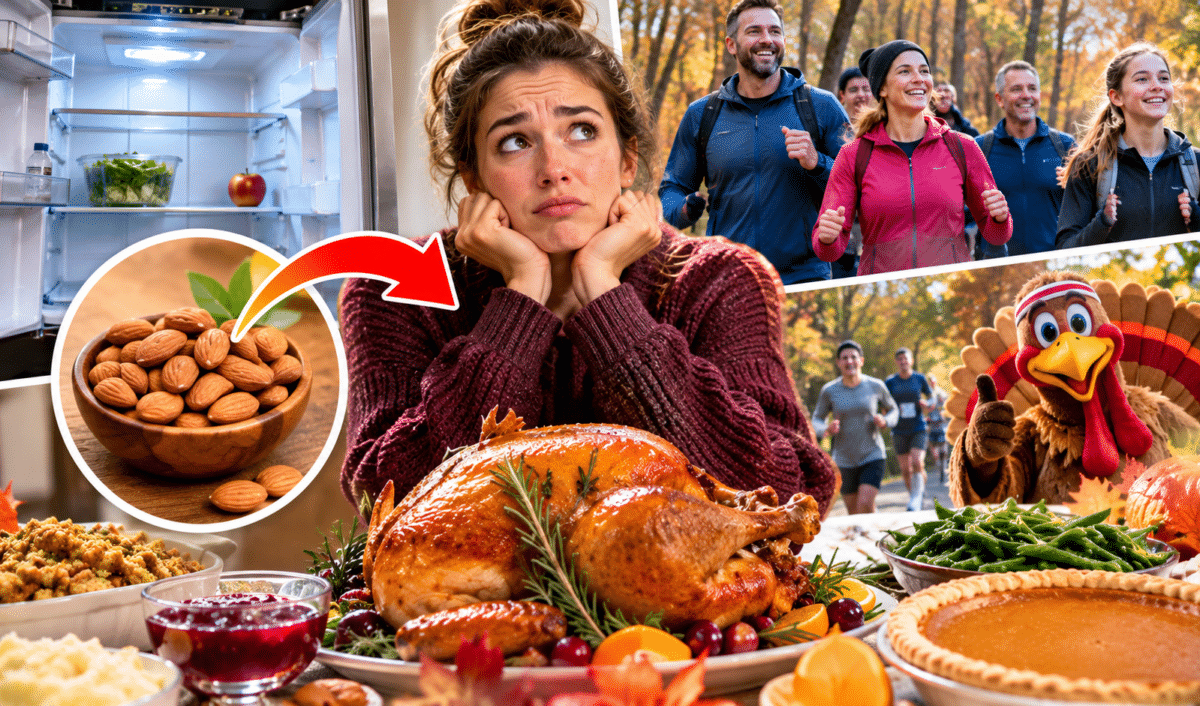
You arrive for Thanksgiving and open the fridge for a snack. There is frozen chicken, black coffee and very little else. Someone has already been up since 5 a.m. on a hike. Tomorrow’s plan is a turkey trot before dinner, and someone will mention, more than once, how many calories are in the stuffing. If this sounds familiar, there is now a name for it. A Yahoo feature published in November 2026 calls it the “almond family,” and its stories of whole households shaped by diet culture have struck a nerve heading into the holiday.
Where the “Almond” Label Came From
The term started as “almond mom,” shorthand online for a mother who passes harmful food ideas to her children. As Yahoo’s Stephanie McNeal reports, the label may have been inspired by a reality TV moment in which Yolanda Hadid reportedly told her daughter Gigi to eat “a couple of almonds and chew them really well” after Gigi said she felt weak from hunger. “Almond family” widens the lens. Diet culture, the piece argues, does not come only from moms; dads, grandparents and whole households pass it down too.
The families described have been called the “turkey trot on Thanksgiving” family and the “vacation exercise” family online. Some of their habits, like running and hiking, are objectively healthy. What sets them apart is the tone: food framed as something to control, movement framed as a way to earn or burn it, and a constant, low-level commentary that children absorb.
- Ohio, 30AmandaMarried into a family of cyclists and marathoners; was told there is “never enough food in the house.”
- San Francisco, 35RachelSays the family drive is “woven through our DNA”; exercise felt mostly about appearance.
- Boston area, parent of a 6-year-oldMelissaBegan scraping cheese off pizza around age 8 after a parent’s cholesterol diagnosis set off “hyper-diet mode.”
- Brooklyn, 29Heather HurstWriter who describes a grandfather for whom black coffee served as a meal.
People and details as reported by Yahoo (November 2026). Last names appear only where the original article used them.
The Turkey Trot Is Not the Problem
It is worth being clear: running on Thanksgiving morning is a popular, positive tradition. RunSignup, a race registration platform, calls Thanksgiving “the biggest running day in the US.” In 2016, Running USA counted 961,882 finishers across 726 Thanksgiving races. RunSignup recorded 1,109,909 turkey trot participants across 936 races in 2024, and reported about 1.3 million registrations in 2025, up 20% from the year before. The nation’s oldest turkey trot, the YMCA Turkey Trot in Buffalo, New York, dates to 1896.
Participants or finishers. Sources: Running USA (2016, all platforms, finishers); RunSignup platform data (2019 to 2025, registrations). Platform counts undercount national totals.
Turkey trots draw younger runners too: 20.7% of 2023 participants were 18 to 29, versus 13.9% at races across the year.
Turkey trots also raise money: RunSignup says races it managed in 2024 raised more than $3.6 million for charity. Many families walk them together, with kids and dogs. The distinction is whether the race is a celebration of being together, or a ticket that has to be punched before anyone is allowed to enjoy the meal.
How Diet Culture Passes Down a Generation
Pediatrician and obesity medicine physician Dr. Karla Lester told Yahoo that the pattern is “intergenerational,” and that for some families, “controlling what you’re eating is kind of this higher level morality.” Research backs up the concern that children absorb these messages even when nobody tells them what not to eat. “My parents never explicitly told me I couldn’t eat anything,” Melissa told Yahoo. “But their habits were so regimented and strict, and their conversations about food were so negative, that more of it stuck with me than I realized.”
What studies show about weight talk at home
A 2013 JAMA Pediatrics study from the University of Minnesota surveyed 2,793 adolescents with an average age of 14.4 and 3,709 parents. Mothers and fathers who engaged in weight-related conversations had teens who were more likely to diet, use unhealthy weight-control behaviors and binge eat. Among teens who were not overweight, 35.3% of those whose mothers talked about weight were dieting, compared with 22.6% of those whose mothers talked about healthful eating instead.
The effects can last. A 2018 Pediatrics study followed 556 participants from adolescence for 15 years. Those whose parents encouraged them to diet as teens had higher risks of overweight, dieting, binge eating, unhealthy weight-control behaviors and lower body satisfaction as adults, and were more likely to encourage their own children to diet.
Percent of non-overweight adolescents who reported dieting, by type of mother’s conversation. Source: Berge et al., JAMA Pediatrics (2013), as reported by HCPLive; sample sizes from study abstract.
Participant bars scaled to 3,709. The study found similar patterns for fathers and for binge eating.
What We Know
- Parental weight talk is linked to more teen dieting and binge eating.
- Encouragement to diet in adolescence is linked to problems 15 years later.
- Average holiday weight gain is under a pound, not 5 to 10.
- Turkey trots are a fast-growing, family-friendly tradition.
What Is Still Unclear
- How many U.S. families fit the “almond family” pattern; no surveys measure it.
- Whether online labels help families change or simply assign blame.
- How fathers’ and grandparents’ food talk compares with mothers’ in effect.
The Holiday Weight Myth Driving the Anxiety
Much of the Thanksgiving pressure rests on a belief that Americans gain 5 to 10 pounds between Thanksgiving and New Year’s. A National Institutes of Health study published in the New England Journal of Medicine in 2000 tested that idea by weighing 195 adults throughout the year. Average weight gain during the holiday period was 0.37 kg, or about 0.8 pounds. Only 14% gained more than 5 pounds.
The study did find that the small gain often was not lost later, and a 2017 review of holiday studies found gains of 0.4 to 0.9 kg among adults. That is a reason for steady, year-round habits, not for policing a single meal. One Thanksgiving dinner is not what shapes long-term health.
Pounds. Sources: Yanovski et al., NEJM (2000), 195 adults; NIH release; Journal of Obesity review (2017), converted from kilograms.
14% of NEJM participants gained more than 5 pounds; most gained far less.
A worked example: the myth by the numbers
- Commonly claimed holiday gain5 lb
- Measured average in the NEJM study0.8 lb
- How many times larger the myth isAbout 6 times
- Study participants195 adults
- Share who gained more than 5 lb14%, about 27 people
- Share who did not86%, about 168 people
Calculation: 5 divided by 0.8 equals 6.25; 14% of 195 equals 27.3. Figures are averages from one study and do not predict any individual’s experience.
Healthy Tradition or Red Flag? A Side-by-Side Guide
Many active, health-minded families are not almond families at all. The difference is in the messages that travel with the habits. The table below is an indicative guide based on the experts and research cited in this article, not a diagnostic tool.
| Situation | Healthy version | Almond family version | What kids may learn |
|---|---|---|---|
| Turkey trot | Fun family tradition, walk or run | Required to “earn” dinner | Food must be paid for with exercise |
| Kitchen | Varied food, snacks available | Empty fridge, little to eat | Hunger is normal and should be ignored |
| Table talk | Talk about flavors, people, plans | Calorie counts and “bad” foods | Foods are moral, good or bad |
| Vacations | Some activity, plenty of rest | Built around workouts | Rest must be justified |
| Bodies | Comments on strength and energy | Comments on weight and size | Worth depends on appearance |
| Seconds or dessert | Allowed without remarks | Monitored or criticized | Enjoying food invites judgment |
Indicative comparison drawing on Yahoo’s reporting, Dr. Karla Lester’s comments and JAMA Pediatrics and Pediatrics research.
- Thinking only moms pass down diet culture; dads, grandparents and siblings do too.
- Assuming “no rules” means no messages; kids absorb habits and tone.
- Believing Thanksgiving causes 5 to 10 pounds of gain; the measured average is under 1 pound.
- Treating the turkey trot itself as the problem; the issue is using it to justify eating.
- Framing weight talk as “health” talk; research links weight talk to more teen dieting.
How to Handle It at the Table This Thursday
Thanksgiving falls on November 26, 2026. Lester’s advice, as reported by Yahoo, centers on practical boundaries around food and weight talk and steering conversations elsewhere, while working over time to challenge long-held beliefs. The steps below translate that and broader pediatric guidance into a plan.
- Decide your line in advanceFor example: no comments on anyone’s body or plate, especially children’s.
- Prepare 2 or 3 redirectsHave ready questions about travel, sports, games or family stories.
- Bring a dish and snacksIf the fridge runs bare, a contribution keeps everyone fed.
- Join the trot for funWalk it, wear costumes, skip the “earned it” talk.
- Talk to kids afterwardSpend 5 minutes on what they heard and what your family believes.
- Model enjoymentAs Melissa does with her son, treat food as pleasure, not guilt.
- The week before: agree with your partner on boundaries and redirect lines.
- Thanksgiving morning: eat breakfast; arriving hungry fuels tension.
- Turkey trot, often 8 to 9 a.m.: frame it as family time, not a calorie offset.
- Dinner: change the subject at the first weight or calorie comment.
- Evening: check in with kids for a few minutes.
- Following weeks: keep building a relaxed relationship with food at home.
When Food Worries Go Beyond the Holiday
Diet culture is not an eating disorder, but it can be a risk factor. According to a 2020 Deloitte Access Economics report for Harvard’s STRIPED program and the Academy for Eating Disorders, 9% of Americans, or 28.8 million people, will have an eating disorder in their lifetime, and about 10,200 deaths a year are associated with eating disorders. The ladder below is indicative, based on common clinical guidance.
Percent of population. Source: Deloitte Access Economics for STRIPED and the Academy for Eating Disorders (2020), 2018 to 2019 data.
Bars scaled so 10% fills the track. Estimated yearly economic cost: $64.7 billion.
Occasional diet talk or food guilt: set boundaries and model balanced eating.
A child or teen skipping meals, hiding food or exercising to “make up” for eating: talk to a pediatrician.
Persistent preoccupation with weight, rigid rules or rapid weight change: seek an eating disorder evaluation.
Fainting, dizziness, chest pain or thoughts of self-harm: seek medical care right away or call or text 988.
The National Alliance for Eating Disorders runs a toll-free helpline staffed by licensed, eating disorder-specialized therapists at 1-866-662-1235, offering support and treatment referrals. In a crisis, the 988 Suicide and Crisis Lifeline is available by call or text.
Frequently Asked Questions
What is an almond family?
It is an online term for a household where diet culture is shared across generations, including moms, dads and grandparents. Common signs include bare fridges, early-morning workouts, exercise-focused vacations and frequent negative talk about food and calories.
Where did the term almond mom come from?
The label may have been inspired by a reality TV moment in which Yolanda Hadid reportedly told her daughter Gigi to eat a couple of almonds and chew them well after Gigi said she felt weak from hunger.
Is doing a turkey trot on Thanksgiving unhealthy?
No. Turkey trots are a healthy, popular tradition, with more than a million Americans taking part. Problems arise only when exercise is framed as a way to earn or burn off the holiday meal.
How much weight do people really gain over the holidays?
A NEJM study of 195 adults found an average gain of about 0.8 pounds between Thanksgiving and New Year’s, far less than the 5 to 10 pounds often claimed. Only 14% gained more than 5 pounds.
How do I stop relatives from commenting on food at Thanksgiving?
Set boundaries in advance, prepare a few redirect topics, and change the subject at the first weight or calorie comment. Pediatrician Karla Lester recommends practical boundaries around food and weight talk.
Does talking about weight affect kids?
Research suggests yes. A JAMA Pediatrics study found teens whose parents talked about weight were more likely to diet, use unhealthy weight-control behaviors and binge eat than those whose parents focused on healthful eating.
What should I say instead of commenting on weight?
Focus on how food tastes, who made it, family stories, and how movement makes people feel, such as stronger or more energized, rather than on weight, size or calories.
When should I worry about a teen’s eating habits?
Talk to a pediatrician if a teen skips meals, hides food, exercises to compensate for eating, or shows rapid weight change or intense preoccupation with weight. For urgent concerns, seek medical care right away.
The Short Version
The “almond family” describes households where diet culture runs through generations: empty fridges, dawn workouts and constant food judgment. Turkey trots, joined by more than a million Americans, are not the problem; using them to earn dinner is. Research links parental weight talk to more teen dieting and binge eating, and the feared holiday weight gain averages under a pound. This Thanksgiving, set boundaries, redirect food talk, bring a dish, enjoy the trot for fun, and check in with kids afterward. If food worries persist, reach out for professional support.

Omisha is a health writer passionate about turning complex medical research into clear, actionable content readers can trust. She covers everything from nutrition and mental wellness to chronic disease management, always grounding her work in credible science and real-world relevance. When she's not writing, she's usually reading up on the latest health studies or exploring new wellness trends to write about next.