35-Minute Nonstop Zumba Workout: What It Burns, How Hard It Really Is and How Often to Do It
Lab data, the 2024 Compendium of Physical Activities and federal exercise guidelines show what a 35-minute nonstop dance session does for your heart, your calorie burn and your weekly activity target.
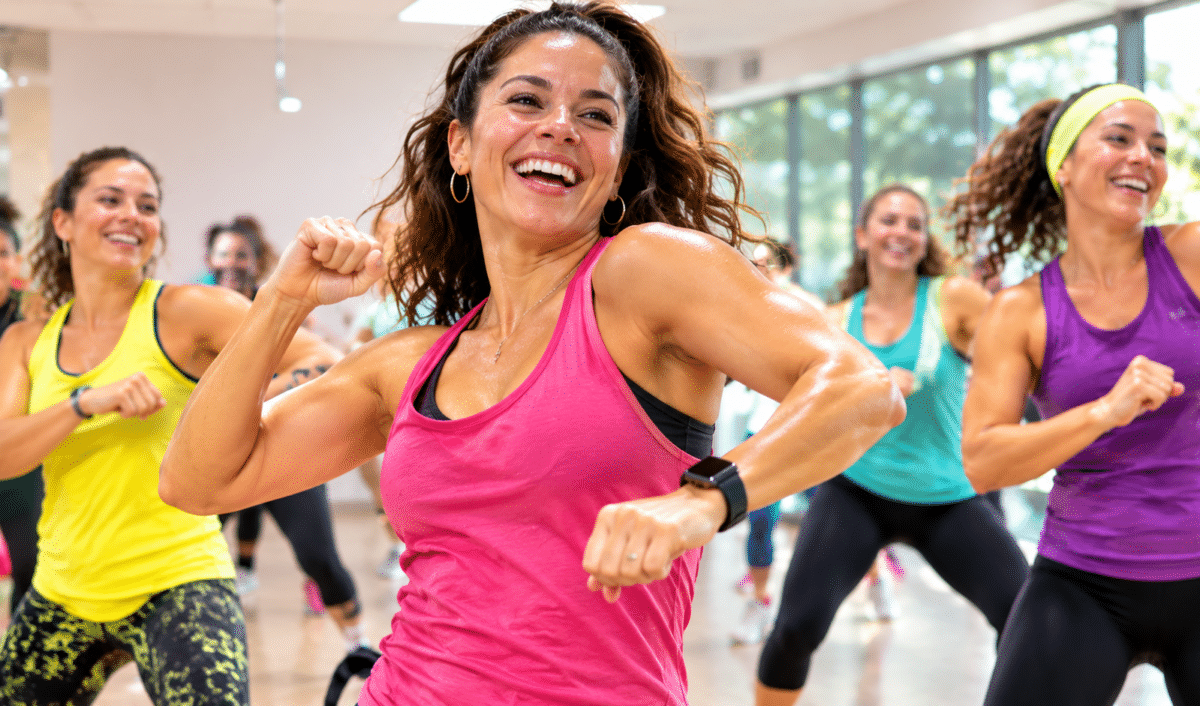
You press play, the first merengue beat drops, and for the next 35 minutes there is no pause button, no rest between sets and no counting reps. A nonstop Zumba session feels more like a party than a workout, which is exactly why so many people stick with it. The real questions are whether that party is hard enough to count, how many calories it burns for someone your size, and how many sessions a week you actually need. Exercise science has fairly clear answers to all three.
Why a Dance Party Became One of the World’s Biggest Workouts
Zumba started as an accident. As the American Council on Exercise tells the story, Colombian instructor Alberto “Beto” Perez forgot his usual aerobics music one day in the mid-1990s and taught with Latin dance tapes from his car instead. The class was an instant hit. Perez brought it to Miami in 1999, and the company was founded in 2001. In its 25th-anniversary announcement in 2026, Zumba reported more than 15 million weekly participants in 200,000 locations across 189 countries.
That appeal matters because most Americans still fall short on exercise. CDC data show that in 2024, 47.2% of adults met the federal guideline for aerobic activity, with men at 52.3% and women at 42.4%. Only 24.2% of adults met both the aerobic and muscle-strengthening guidelines in 2020, and 46.3% met neither. A workout people enjoy enough to repeat can close that gap.
Percent of adults 18 and older. Sources: CDC National Center for Health Statistics data briefs (aerobic guideline, 2024; combined guidelines, 2020).
Inside the Lab: How Hard Zumba Actually Pushes Your Heart
The most-cited measurement comes from the American Council on Exercise, which commissioned exercise scientists at the University of Wisconsin-La Crosse to test a real class. Nineteen experienced female participants, ages 18 to 22, wore heart-rate monitors through a full session. The researchers estimated oxygen use from each person’s own treadmill test.
The results, published in the Journal of Sports Science and Medicine, showed an average heart rate of 154 beats per minute, or 79% of maximum, and 66% of maximal oxygen uptake. Class length ranged from 32 to 52 minutes, averaging 38 minutes 48 seconds, and participants burned an average of 369 calories, about 9.5 per minute. ACE notes that fitness guidelines suggest 64% to 94% of maximum heart rate to improve cardiovascular endurance, and every participant landed inside that range.
Percent of maximum. Source: Luettgen et al., Journal of Sports Science and Medicine (2012), ACE-commissioned study of 19 women. Guideline band from ACE.
Why your own number may differ
Those participants were young, experienced and averaged about 136 pounds, so the 369-calorie figure is not a universal promise. A heavier person typically burns more per minute; a beginner who is still learning steps may move less vigorously at first. Instructor style matters too: classes that mix high and low intensity, which Zumba describes as interval-style, can swing your heart rate up and down through a session.
Moderate or Vigorous? The MET Number That Settles It
Exercise scientists rate activities in METs, multiples of the energy you use sitting still. Under the federal Physical Activity Guidelines, 3 to 5.9 METs counts as moderate and 6 or more as vigorous. The 2024 Adult Compendium of Physical Activities, an international reference published in the Journal of Sport and Health Science, lists a Zumba group class at 6.5 METs and Zumba to a home video at 5.5 METs.
That small gap has a real consequence. A live or group-style session at full effort qualifies as vigorous, so each minute counts double toward weekly targets. A gentler home video lands in the moderate zone. The Compendium also places high-impact aerobic dance at 8.0 METs and low-impact aerobic dance at 4.8, which shows how much your own effort level shifts the outcome.
METs and indicative calories for 35 minutes at 155 lb (70.3 kg). MET values: 2024 Adult Compendium of Physical Activities. Calories estimated as MET x 3.5 x kg / 200 per minute; indicative only.
What We Know
- Zumba raised heart rate to an average 79% of maximum in a lab study.
- The 2024 Compendium rates group classes at 6.5 METs, a vigorous level.
- A 2016 systematic review of 11 studies found Zumba improves aerobic capacity.
- Federal guidelines call for 150 moderate or 75 vigorous minutes a week.
What Is Still Unclear
- Whether Zumba alone reliably reduces body weight; a 2020 meta-analysis could not conclude it does.
- How calorie burn differs in older, heavier or less experienced dancers; the key lab study tested 19 young women.
- How much strength benefit Zumba adds; evidence is limited.
A Song-by-Song Plan for 35 Nonstop Minutes
Most Zumba routines are built from songs of 3 to 5 minutes, alternating faster and slower rhythms. The playlist below is an indicative structure, not official Zumba choreography, designed to keep you moving for the full 35 minutes while letting your heart rate rise and settle in waves.
- 1Warm-up merengueMarching steps, arm swings and shoulder rolls to raise body temperature.0:00 to 4:00
- 2Salsa basicsSide-to-side and forward-back steps at a moderate pace.4:00 to 8:00
- 3Reggaeton pushBigger hip and knee drives; first climb toward a hard effort.8:00 to 12:00
- 4Cumbia active recoveryLighter steps while still moving; catch your breath without stopping.12:00 to 16:00
- 5Soca or pop peakJumps, fast footwork and arm work; the session’s highest heart rate.16:00 to 21:00
- 6Strength-style trackSquats, lunges and slow, low dance moves for legs and glutes.21:00 to 26:00
- 7Final high-energy finisherOne last push with the moves you know best.26:00 to 31:00
- 8Cool-down and stretchSlow sway, then calf, hamstring, hip and shoulder stretches.31:00 to 35:00
No heart-rate monitor? The CDC’s talk test works. During moderate activity you can talk but not sing. During vigorous activity you cannot say more than a few words without pausing for breath. Aim for the vigorous zone during tracks 3, 5 and 7.
Calories by Body Weight: What 35 Minutes Can Burn
Calorie burn scales with body weight and effort. The table below applies the Compendium’s MET values to four common U.S. body weights. Treat these as estimates: fitness level, age, sex and how hard you dance all shift the real number.
| Body weight | Low-impact dance, 4.8 METs | Zumba home video, 5.5 METs | Zumba group class, 6.5 METs | High-impact dance, 8.0 METs |
|---|---|---|---|---|
| 130 lb | 173 kcal | 199 kcal | 235 kcal | 289 kcal |
| 155 lb | 207 kcal | 237 kcal | 280 kcal | 345 kcal |
| 185 lb | 247 kcal | 283 kcal | 334 kcal | 411 kcal |
| 215 lb | 287 kcal | 329 kcal | 388 kcal | 478 kcal |
Indicative estimates for 35 minutes using MET x 3.5 x body weight in kg / 200 per minute. MET values from the 2024 Adult Compendium of Physical Activities.
Indicative calories at 6.5 METs. Calculation based on 2024 Compendium values; individual results vary.
A Worked Example: Hitting the Federal Target With Zumba Alone
Consider a hypothetical 155-pound adult who wants to meet the federal guideline using 35-minute sessions. The arithmetic shows why effort level decides how many sessions are needed.
Weekly plan by the numbers
- Vigorous target for adults, per federal guidelines75 minutes
- Group-intensity sessions needed at 35 minutes3 (105 minutes)
- Moderate target if dancing to an easier home video150 minutes
- Home-video sessions needed at 35 minutes5 (175 minutes)
- Indicative weekly burn, 3 group sessions at 280 kcal840 kcal
- Indicative weekly burn, 5 home sessions at 237 kcal1,185 kcal
Hypothetical example. 75 divided by 35 equals 2.1, rounded up to 3 sessions; 150 divided by 35 equals 4.3, rounded up to 5. Calorie figures use the Compendium-based estimates above.
The guidelines also call for muscle-strengthening activity on at least 2 days a week. A strength-style Zumba track helps, but a 2016 systematic review in PM&R found only limited evidence for strength gains from Zumba, so adding two short resistance sessions is the safer way to cover that half of the guideline.
- Assuming every session burns 369 calories; that figure came from 19 young, experienced women in a class averaging nearly 39 minutes.
- Expecting large weight loss from Zumba alone; a 2020 meta-analysis could not confirm it reduces body mass.
- Skipping the warm-up and jumping straight into fast footwork, which raises strain on calves and knees.
- Dancing in running shoes with heavy treads that grip during pivots and twist the knee.
- Treating Zumba as a full strength program instead of adding 2 days of resistance work.
Making it joint-friendly without losing the beat
Nonstop does not have to mean high-impact. Replacing jumps with step-touches, keeping one foot on the floor during turns and shrinking the range of hip and knee drives lowers the pounding on joints. The trade-off is intensity: the Compendium rates low-impact aerobic dance at 4.8 METs versus 8.0 for high-impact, so a fully low-impact session sits in the moderate zone. Swinging your arms higher and staying in constant motion during recovery songs can recover some of that effort. Zumba itself offers gentler formats, including Zumba Gold for active older adults and beginners.
What the Research Says About Results Over Weeks
Several reviews have pooled Zumba studies. A 2016 systematic review in PM&R analyzed 11 studies with 586 participants aged 18 to 65 and concluded that Zumba can be considered an effective activity for improving aerobic capacity, with small but positive effects on body weight and measurable psychological and social benefits. A 2020 meta-analysis in the International Journal of Environmental Research and Public Health found Zumba may improve peak oxygen uptake but could not conclude it reduces body mass, noting that few randomized trials met its criteria.
The practical takeaway is simple. Zumba reliably works the heart and lungs, and its enjoyment helps people keep showing up, which matters more than any single session. For weight loss, pair it with nutrition changes and strength work rather than relying on the dance floor alone. The progression below is indicative, based on common training experience.
Learning steps; expect lighter effort while coordination catches up.
Moves feel automatic; you can push harder on peak tracks and recover faster.
With consistent sessions, aerobic fitness gains typically become noticeable.
Chest pain, dizziness, joint problems, pregnancy or heart conditions: check with a clinician first.
The Compendium’s one-MET gap between home video and group class may reflect the energy and effort of a live class rather than the steps themselves. Turning up the volume, using a larger space and committing to full-size moves can bring a home session closer to class intensity.
Frequently Asked Questions
How many calories does 35 minutes of Zumba burn?
Estimates based on the 2024 Compendium of Physical Activities suggest roughly 235 to 390 calories for a group-intensity session, depending on body weight, and about 200 to 330 calories for an easier home video. A 155-pound adult burns around 237 to 280 calories.
Is Zumba a good workout for weight loss?
Zumba burns meaningful calories and improves aerobic fitness, but a 2020 meta-analysis could not conclude that it reduces body mass on its own. Combining it with dietary changes and strength training gives better odds of lasting weight loss.
Is Zumba moderate or vigorous exercise?
The 2024 Compendium rates a Zumba group class at 6.5 METs, which is vigorous, and a home video at 5.5 METs, which is moderate. Your own effort decides where your session falls.
How many times a week should I do Zumba?
Three 35-minute sessions at group-class intensity exceed the federal target of 75 vigorous minutes per week. At a moderate home-video pace, five sessions reach the 150-minute moderate target.
Can beginners do a 35-minute nonstop Zumba workout?
Yes, with adjustments. Beginners can keep moves small, march in place during complex steps and slow down on peak songs. Anyone with heart, joint or other health concerns should talk to a clinician before starting vigorous exercise.
What heart rate should I reach during Zumba?
In the ACE study, participants averaged 79% of maximum heart rate. Fitness guidelines cited by ACE suggest 64% to 94% of maximum to improve cardiovascular endurance.
What shoes are best for Zumba?
Cross-training or dance-fitness shoes with a smoother sole and a pivot point suit Zumba better than running shoes, whose heavy tread can grip the floor during turns and strain knees and ankles.
Does Zumba build muscle?
Some Zumba tracks include squats and lunges, but a 2016 systematic review found only limited evidence for strength gains. Federal guidelines recommend separate muscle-strengthening activity on at least 2 days a week.
The Short Version
A 35-minute nonstop Zumba workout is real cardio. Lab data show an average of 79% of maximum heart rate, and the 2024 Compendium rates group classes at 6.5 METs, a vigorous level, and home videos at 5.5 METs. Expect roughly 235 to 390 calories at group intensity, depending on body weight. Three group-intensity sessions a week meet the federal 75-minute vigorous target; add two days of strength work for full benefit. Warm up, wear pivot-friendly shoes and check with a clinician if you have health concerns.

Omisha is a health writer passionate about turning complex medical research into clear, actionable content readers can trust. She covers everything from nutrition and mental wellness to chronic disease management, always grounding her work in credible science and real-world relevance. When she's not writing, she's usually reading up on the latest health studies or exploring new wellness trends to write about next.