Health Desk Workers and Blood Sugar 2026
Does a Soleus Push-Up Every Work Hour Really Help Your Blood Sugar — and What Did the Original Study Actually Test?
The seated calf drill keeps going viral as an hourly desk habit. The University of Houston research behind it is real, but participants did the move almost continuously for hours, not in short hourly bursts.
By The Health DeskFact-checked against the iScience paper reports, CDC diabetes data and peer-reviewed sitting researchUpdated November 15, 2026Scope U.S. adults who sit for work
The pitch is irresistible. Set a reminder at the top of every hour, lift your heels under the desk for a few minutes, and quietly protect yourself from the damage of a sitting job. No sweat, no gym, no one in the meeting even notices. Personal experiments with the “soleus push-up” every work hour have become a staple of wellness writing and social media, usually ending with the writer feeling more alert and less stiff.
Feeling better is real and worth having. But the headline numbers people quote, a 52% smaller blood sugar spike and 60% less insulin, come from a lab protocol that looked very different from an hourly reminder. This guide explains what the research showed, how to do the move correctly, how it stacks up against short walking breaks, and how to build an hourly routine that is honest about what it can deliver.
What We Know
- Sustained soleus push-ups lowered blood sugar and insulin responses in a 2022 lab study.
- The soleus can keep working for hours with little fatigue.
- Frequent movement breaks during sitting improve blood sugar in other trials.
- About 1 in 4 U.S. adults sits for more than 8 hours a day.
What Is Still Unclear
- Whether a few minutes every hour produces any measurable blood sugar change.
- Long-term effects on weight, diabetes risk or heart health.
- How easily most people can perform the precise movement without coaching.
- Whether results replicate in larger, independent studies.
What the Soleus Push-Up Actually Is
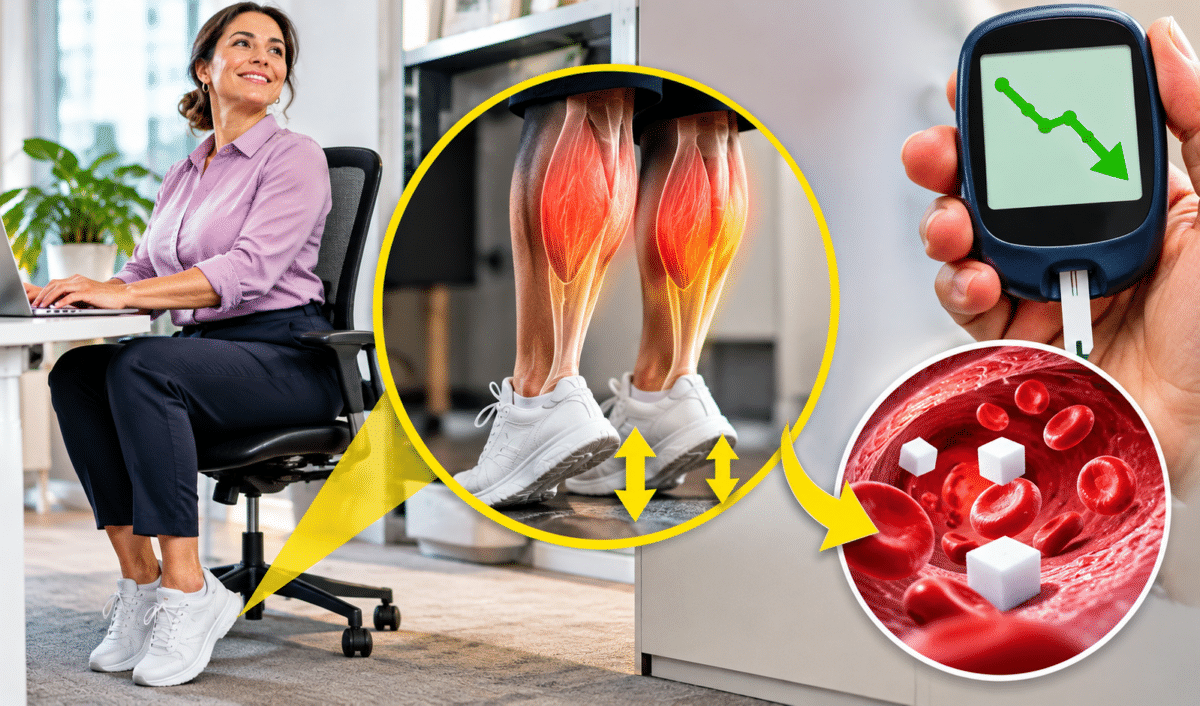
The soleus is a flat muscle deep in the calf, under the more visible gastrocnemius. It makes up only about 1% of body weight, according to the University of Houston, but it is built for endurance. It helps you stand, walk and pump blood back from the legs toward the heart. Unlike most muscles, it can run on blood glucose and fats rather than burning through its own stored glycogen, which is why it can keep working for hours without tiring.
Marc Hamilton, a professor of health and human performance at the University of Houston, developed the soleus push-up to exploit that property. “It’s been inside our bodies all along, but no one ever investigated how to use it to optimize our health, until now,” he said in a university statement reported by IFLScience. The movement looks like a seated heel raise, but with a specific rhythm that keeps the soleus, rather than the larger calf muscle, doing most of the work.
- Step 1Sit tallFeet flat, knees bent about 90 degrees, shins vertical.Setup: 10 seconds
- Step 2Lift the heelsPress through the front of the feet; toes stay down.Up: about 1 second
- Step 3Lower fullyLet heels return to the floor at a relaxed pace.Down: about 1 second
- Step 4Keep goingRepeat smoothly; the lab version ran continuously.Lab dose: up to 270 min
Hamilton has cautioned that the movement is harder to master than it looks. “It’s a very specific movement that right now requires wearable technology and experience to optimize,” he said, according to IFLScience. Bouncing your heels quickly, standing up or pushing hard through the toes may shift effort onto other muscles.
Inside the 2022 University of Houston Study
The research, published in September 2022 in the journal iScience by Hamilton, Deborah Hamilton and Theodore Zderic, ran two experiments with a total of 25 participants whose lifestyles ranged from sedentary to active. In the first, 10 people sat for four and a half hours while researchers took muscle and blood samples, according to a summary in the Stansberry Research health bulletin. Oxygen use roughly doubled compared with ordinary sitting, yet MRI showed the muscle barely touched its glycogen stores.
In the second experiment, 15 participants drank a 75-gram glucose drink and either sat still or performed soleus push-ups throughout the following three hours, with blood samples taken every 15 minutes. Compared with sitting still, the movement produced a 52% smaller blood glucose rise and a 60% lower insulin response. Fat metabolism between meals roughly doubled, the researchers reported.
Soleus Push-Ups Versus Sitting Still: Lab Results
The Detail Most Retellings Skip
Participants did not do 20 heel raises and return to typing. They continued the contractions throughout the entire three-hour glucose test, and in the longest sessions the movement ran for up to 270 minutes. Summaries of the paper note that the 52% and 60% figures came from that prolonged, closely controlled protocol. It cannot be assumed that a few casual seated heel raises each hour produce comparable results. The study also compared the movement with sitting still, not with walking or other exercise.
How It Compares With Short Walking Breaks
The most useful comparison comes from a 2023 Columbia University study led by Keith Diaz and published in Medicine and Science in Sports and Exercise. Eleven adults sat in an ergonomic chair for eight hours on separate days, testing five schedules: one minute of walking every 30 minutes, one minute every 60 minutes, five minutes every 30 minutes, five minutes every 60 minutes, and no walking.
Five minutes of walking every 30 minutes was the only schedule that significantly lowered both blood sugar and blood pressure, and it reduced blood sugar spikes after large meals by 58% compared with sitting all day. A one-minute walk every 30 minutes gave modest blood sugar benefits. Walking every 60 minutes, for either one or five minutes, provided no blood sugar benefit, according to Columbia. All walking schedules lowered blood pressure by 4 to 5 mmHg.
Walking Breaks in an 8-Hour Sitting Day: Minutes and Blood Sugar Effect
The pattern is instructive for an hourly soleus routine. Once an hour may simply be too infrequent for blood sugar, at least for walking. That does not prove the same holds for soleus push-ups, but it suggests doing them more often, or for longer stretches, is a safer bet than relying on a single hourly burst. Walking every 30 minutes also improved mood and reduced fatigue, a benefit worth having even if blood sugar is not your main concern.
| Approach | How often | Total per 8 hours | Blood sugar evidence | Practical at a desk? |
|---|---|---|---|---|
| Sustained soleus push-ups (lab) | Continuous | Up to 270 min | 52% smaller rise, 60% less insulin | Hard to sustain unaided |
| Hourly soleus push-ups, 3 min | Every 60 min | 24 min | Not tested | Easy, discreet |
| Soleus push-ups, 5 min every 30 min | Every 30 min | 80 min | Not tested; closer to lab dose | Easy during calls |
| Walk 5 min every 30 min | Every 30 min | 80 min | 58% smaller meal spike | Needs space and time |
| Walk 1 min every 30 min | Every 30 min | 16 min | Modest benefit | Very practical |
| Walk 1 or 5 min every 60 min | Every 60 min | 8 to 40 min | No blood sugar benefit | Practical |
Totals are calculated by this desk from each schedule. Results come from different studies with different people and meals, so they are not a head-to-head comparison.
Why Desk Workers Care About This
The appeal makes sense given the numbers. A CDC analysis published in JAMA in 2018 found that 25.7% of U.S. adults reported sitting more than 8 hours a day and 44.6% were physically inactive. About 1 in 10 reported both. Meanwhile, the CDC’s National Diabetes Statistics Report estimates that 97.6 million U.S. adults, or 38.0%, have prediabetes, and 38.4 million people have diabetes, with 22.8% of affected adults undiagnosed.
Sitting, Inactivity and Blood Sugar Problems Among U.S. Adults
Prediabetes rarely causes symptoms, and many people with it do not know. Repeated large blood sugar swings after meals are one target for prevention, which is why any low-effort movement that blunts them draws attention. The soleus push-up’s real promise is for people who cannot easily get up, such as those in long meetings, on flights or with mobility limits.
A Realistic Hourly Plan for Your Workday
If you want to try the hourly approach, structure it so you get more total movement, not less. The plan below pairs soleus push-ups with short walks and leans toward the 30-minute rhythm that worked in the walking study. It is an indicative template, not a tested protocol.
- 9:00Start the day with soleus push-ups during email triage5 min SPU
- 9:30Stand and walk to refill water2 min walk
- 10:00Soleus push-ups through the first call or meeting10 min SPU
- 10:30Walk a lap of the floor or take stairs5 min walk
- 12:00Post-lunch walk, the highest-value break of the day10 to 15 min
- 1:00Soleus push-ups while reading after lunch10 min SPU
- 2:30Stand, stretch calves and walk5 min walk
- 4:00Soleus push-ups during the afternoon slump5 min SPU
Indicative schedule built by this desk. Adjust times to your workday and any medical advice.
Setting Yourself Up to Stick With It
The hardest part is remembering. Tie the movement to existing cues such as calls, video meetings or reading long documents, when your hands are busy but your legs are free. A quiet timer works better than willpower. Wear shoes that let your feet press comfortably, and keep the knee bent around 90 degrees so the soleus, not the larger calf, does the work.
- Pick two anchorsOne morning meeting and one post-lunch task.
- Start at 5 minutesBuild toward 10-minute stretches as the rhythm feels natural.
- Add a 30-minute nudgeStand or walk 1 to 5 minutes every half hour when possible.
- Prioritize after mealsThe glucose study measured the 3 hours after sugar intake.
- Keep real exerciseAim for 150 minutes of moderate activity a week.
- Ask about testingA simple A1C or fasting glucose test can reveal prediabetes.
- Knees at 90 degreesKeeps the work on the soleus
- 5 to 10 minute setsLonger beats shorter
- Every 30 minutesMove in some way
- After mealsThe key window in the study
- Not a workoutKeep 150 weekly minutes
- Calf pain or swellingStop and check with a doctor
Frequently Asked Questions
What is a soleus push-up?
A seated heel raise designed to work the soleus, a deep calf muscle. You sit with knees bent about 90 degrees, lift your heels while keeping the front of your feet down, and lower them in a steady rhythm.
Do soleus push-ups lower blood sugar?
In a 2022 lab study, doing them continuously for three hours after a glucose drink cut the blood sugar rise by 52% and insulin by 60% compared with sitting still. Shorter routines have not been tested.
How long should you do soleus push-ups?
There is no tested short dose. The study used sustained contractions for hours. Longer sets of 5 to 10 minutes, repeated through the day, are closer to that protocol than a single brief set.
Is doing soleus push-ups every hour enough?
It is unproven. A Columbia study found walking once an hour, for one or five minutes, gave no blood sugar benefit, while five minutes every 30 minutes cut meal spikes by 58%.
Are soleus push-ups the same as calf raises?
They look similar, but soleus push-ups are done seated with bent knees, which shifts work to the soleus rather than the larger gastrocnemius used in standing calf raises.
Can soleus push-ups help you lose weight?
No study has shown weight loss. The research measured blood sugar, insulin, oxygen use and fat metabolism during sessions, not changes in body weight.
Who might benefit most from soleus push-ups?
People who sit for long stretches and cannot easily stand, such as in meetings, on flights or with limited mobility. They are an add-on, not a substitute for walking or exercise.
How many Americans have prediabetes?
The CDC estimates 97.6 million U.S. adults, or 38.0%, have prediabetes, including 48.8% of adults 65 and older.
The Short Version
The soleus push-up is a seated heel raise that targets a fatigue-resistant calf muscle. In a 2022 study of 25 people, doing it continuously for three hours after a glucose drink cut the blood sugar rise by 52% and insulin by 60% versus sitting still. An hourly few-minute version has not been tested, and walking research suggests once an hour may be too infrequent. Use longer sets, move every 30 minutes when possible, walk after meals and keep regular exercise.

Omisha is a health writer passionate about turning complex medical research into clear, actionable content readers can trust. She covers everything from nutrition and mental wellness to chronic disease management, always grounding her work in credible science and real-world relevance. When she's not writing, she's usually reading up on the latest health studies or exploring new wellness trends to write about next.