Fitness Strength and Cardio Home Workouts 2026
Can a 20-Minute Full-Body Dumbbell HIIT Workout Do the Job of Separate Cardio and Strength Days — and Where It Falls Short?
A timed five-move plan using one pair of dumbbells, plus what controlled studies and federal survey data say about interval training, muscle-strengthening and how much this kind of session can realistically deliver.
By The Fitness DeskFact-checked against peer-reviewed meta-analyses, CDC survey data and the 2024 Compendium of Physical ActivitiesUpdated November 14, 2026Scope Healthy U.S. adults training at home
Most people do not skip workouts because they hate exercise. They skip them because the plan in their head is an hour long, and the day only has 20 spare minutes. Cardio on one day, weights on another, stretching somewhere in between: by Wednesday the schedule has already collapsed. A single pair of dumbbells and a timer offer a different deal.
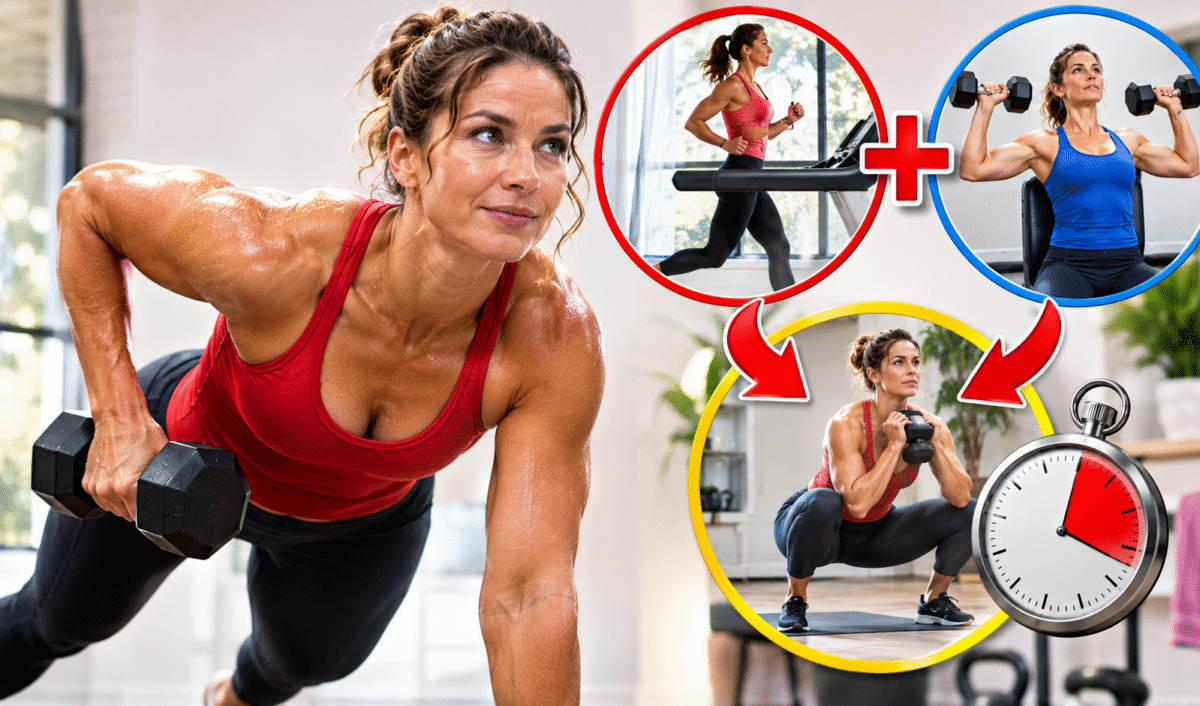
A full-body dumbbell HIIT workout combines strength moves with short rest periods, so your heart rate stays high while your muscles work against load. It is not magic, and it does not replace every kind of training. But the research on interval training and on muscle-strengthening suggests a well-built 20-minute session can cover more ground than most people expect. Here is the plan, the evidence and the limits.
What We Know
- Interval training reduced fat mass at least as well as steady cardio in pooled trials.
- HIIT programs needed about 40% less time in one review of 13 trials.
- 30 to 60 minutes a week of muscle-strengthening is linked to lower death risk.
- Only about 1 in 4 U.S. adults meet both federal activity guidelines.
What Is Still Unclear
- Which single interval format is best; studies use many different protocols.
- Whether dumbbell circuits build as much strength as heavier, slower lifting.
- Exact calories for you, which depend on body size and effort.
- How well people stick with intense training over many months.
Five Moves, One Pair of Dumbbells, Three Rounds
Each move runs for 40 seconds, followed by 20 seconds of rest while you set up the next one. Five moves make a five-minute round. Do three rounds and you have 15 minutes of training, which, with a three-minute warm-up and two-minute cool-down, gives exactly 20 minutes. The order alternates lower body, upper body and full body so one muscle group recovers while another works.
- 1LEGSGoblet Squat40s on20s offHold one dumbbell vertically at your chest. Sit your hips back and down until thighs are near parallel, then drive up through your heels. Keep your chest tall.
- 2BACKBent-Over Row40s on20s offHinge at the hips with a flat back, dumbbells hanging. Pull elbows toward your hips, squeeze shoulder blades, then lower with control.
- 3FULLDumbbell Thruster40s on20s offHold dumbbells at your shoulders, squat, then use the drive up to press them overhead in one smooth motion. This is the heart-rate spike of the round.
- 4LEGSAlternating Reverse Lunge40s on20s offHold dumbbells at your sides. Step one foot back and lower until both knees bend near 90 degrees, then return and switch legs.
- 5CORERomanian Deadlift to Upright Row40s on20s offHinge forward with soft knees, lowering dumbbells along your legs. Stand, then lift them to chest height with elbows high. Keep the weight light to moderate.
The Warm-Up and Cool-Down Are Not Optional
Spend the first three minutes on movements that rehearse the session without load: marching, bodyweight squats, arm circles, hip hinges and a few slow lunges. This raises muscle temperature and lets you notice any joint that feels off before it is carrying weight. The last two minutes should bring your breathing down with walking in place and gentle stretches for the hips, hamstrings, chest and shoulders. Skipping both is the fastest way to turn a quick workout into a sore week.
Why Intervals and Weights Make a Smart Pairing
High-intensity interval training alternates short bursts of hard work with recovery. Its appeal is efficiency, and the research largely supports that. A 2017 review in Obesity Reviews of 13 trials in overweight and obese adults found that HIIT and moderate continuous training both reduced whole-body fat mass over about 10 weeks of three weekly sessions, but HIIT required roughly 40% less training time, according to the summary reported by Medical Xpress.
A larger 2019 analysis in the British Journal of Sports Medicine pooled 36 studies with 1,012 people. Interval training produced a total weight reduction of 1.58 kg compared with 1.13 kg for moderate continuous exercise, a 28.5% greater reduction, according to the BMJ release. There was no significant difference in body fat percentage. The researchers also cautioned that higher intensity may bring greater injury risk and cardiovascular stress and that people may find it harder to stick with.
Interval Training Versus Steady Cardio: What Reviews Found
Adding dumbbells changes the equation in a useful way. A bodyweight HIIT session can leave muscles underloaded, while a slow strength routine may barely raise your heart rate. Combining the two means each minute does double duty: muscles work against resistance, and short rests keep effort high. For busy adults who would otherwise do neither, that overlap is the point.
The Strength Side of the Story
Muscle-strengthening carries its own benefits. A 2022 review in the British Journal of Sports Medicine by Momma and colleagues analyzed 16 cohort studies and found that about 30 to 60 minutes a week of muscle-strengthening activity was associated with roughly 10% to 20% lower risk of death from all causes, cardiovascular disease and cancer, as reported by News-Medical. When combined with aerobic activity, the risk of death from any cause was 40% lower. These were observational studies, so they show association, not proof of cause.
Lower Risk When Strength and Aerobic Activity Are Combined
How Hard Is This Workout, in Numbers?
Exercise scientists use METs, short for metabolic equivalents, to rate how hard an activity is compared with sitting still. The 2024 Adult Compendium of Physical Activities lists high-intensity interval exercise at 7.0 METs for moderate effort and 11.0 METs for vigorous effort such as burpees and squat jumps. Vigorous weight lifting is rated 6.0, kettlebell circuits with minimal rest are 7.5, and general bodyweight resistance work is 3.0.
How Different Training Styles Compare in Intensity
A dumbbell HIIT session like this one will most likely land between 5.0 and 7.5 METs averaged over the full 20 minutes, since rest periods, the warm-up and the cool-down pull the average down. Pushing the thrusters and lunges hard can approach the vigorous range during work intervals.
What 20 Minutes Burns at Different Body Weights
A standard formula estimates calories per minute as METs times 3.5 times body weight in kilograms, divided by 200. The table below applies it to a 20-minute session at three effort levels from the Compendium. Heavier people burn more because moving a larger body takes more energy.
| Body weight | Moderate circuit, 5.0 METs | Moderate HIIT, 7.0 METs | Vigorous HIIT, 11.0 METs | Weekly at 7.0 METs, 3 sessions |
|---|---|---|---|---|
| 132 lb (60 kg) | 105 calories | 147 calories | 231 calories | 441 calories |
| 154 lb (70 kg) | 123 calories | 172 calories | 270 calories | 515 calories |
| 187 lb (85 kg) | 149 calories | 208 calories | 327 calories | 625 calories |
| 220 lb (100 kg) | 175 calories | 245 calories | 385 calories | 735 calories |
| 254 lb (115 kg) | 201 calories | 282 calories | 443 calories | 845 calories |
These are gross estimates calculated by this desk, rounded to the nearest calorie, and indicative only. Few people sustain 11.0 METs for a full 20 minutes; the vigorous column is a ceiling, not a typical result. Fitness trackers and gym machines often overestimate calorie burn as well.
Picking the Right Dumbbell Weight
A good starting load lets you finish every 40-second interval in all three rounds with steady form, ending each round feeling challenged but not wrecked. Different moves need different loads, which is why many people use adjustable dumbbells or two pairs. Lower-body moves such as squats and lunges usually tolerate the most weight; overhead pressing tolerates the least.
| Experience level | Goblet squat (one bell) | Row and deadlift (each hand) | Thruster (each hand) | Target reps per 40 seconds |
|---|---|---|---|---|
| New to lifting | 8 to 15 lb | 5 to 10 lb | 3 to 8 lb | 8 to 10 |
| Some experience | 15 to 25 lb | 10 to 20 lb | 8 to 15 lb | 10 to 12 |
| Regular lifter | 25 to 40 lb | 20 to 30 lb | 15 to 25 lb | 10 to 14 |
| Older adult or returning after a break | 5 to 12 lb | 5 to 10 lb | 3 to 5 lb | 6 to 10 |
| Joint pain or limited mobility | Bodyweight to 8 lb | 3 to 8 lb | Skip; use a front raise | 6 to 8 |
These ranges are indicative starting points based on common coaching practice, not results from a specific study. Individual strength varies widely, so adjust after your first session. If you can comfortably beat the top of the rep range in round three, go up one dumbbell size next time.
A Six-Week Build-Up Plan
Progress comes from gradually doing a little more: more reps, more weight or less rest. The suggested schedule below starts conservatively and increases challenge every two weeks.
- Week 1 and 22 sessions, 30s on and 30s off, 2 rounds
- Week 33 sessions, 40s on and 20s off, 2 rounds
- Week 43 sessions, full 3 rounds, 20 minutes
- Week 5Add 2 to 5 lb to squats and rows
- Week 63 sessions plus 1 longer walk of 30 minutes
This plan is an indicative progression, not a medically tailored program. If you have heart disease, high blood pressure, joint problems, are pregnant or have been inactive for a long time, talk to a health professional before starting high-intensity training.
Most Americans Are Not Doing Both Kinds of Exercise
Federal guidelines recommend that adults get at least 150 minutes of moderate or 75 minutes of vigorous aerobic activity each week, plus muscle-strengthening on at least 2 days. According to the CDC’s National Center for Health Statistics, only 24.2% of adults met both guidelines in 2020. Men were more likely than women to meet both, and the share fell with age.
Adults Meeting Both Aerobic and Strength Guidelines, 2020
Geography matters too. A CDC MMWR report on the same 2020 survey found that 16.1% of adults in nonmetropolitan counties met both guidelines, compared with 27.8% in large central metro areas. By region, the West led at 28.5%, with the South lowest at 22.0%. A home dumbbell routine sidesteps some of the barriers behind those gaps, such as distance to a gym or membership costs.
Strength Training Is Climbing the Trend Charts
The American College of Sports Medicine’s 2026 fitness trends survey, based on responses from about 2,000 clinicians, researchers and exercise professionals, ranked traditional strength training using free weights like dumbbells and kettlebells in its top 10. Exercise for weight management and fitness programs for older adults also ranked near the top, two goals a short dumbbell routine can support.
- Set up a 6-by-6-foot spaceClear the floor so lunges and hinges have room.
- Use an interval timerSet 40 seconds on, 20 off, 15 intervals.
- Test your weightsDo 5 reps of each move before you start the clock.
- Log your repsWrite down reps per move to track progress each week.
- Space sessions 48 hours apartMonday, Wednesday and Friday is a simple pattern.
- Fill other days lightlyWalk 20 to 30 minutes to reach weekly aerobic targets.
- 20 minutes total3 warm-up, 15 work, 2 cool-down
- 40 on, 20 offFive moves per round
- 3 rounds10 minutes of hard work
- 15 to 20 rep loadWeight you could lift that many times fresh
- 2 to 3 sessions weeklyWith rest days between
- Stop for warning signsChest pain, dizziness or sharp joint pain
Frequently Asked Questions
Is a 20-minute dumbbell HIIT workout enough?
For many adults, yes, when done 2 to 3 times a week. It can count toward muscle-strengthening and vigorous activity, but adding some walking or other aerobic activity helps meet the full weekly guidelines.
How many calories does a 20-minute dumbbell HIIT workout burn?
Roughly 120 to 270 calories for a 154-pound adult depending on intensity, based on standard MET calculations. Heavier people burn more.
Is HIIT better than cardio for fat loss?
Reviews find similar or slightly greater results. A 2019 analysis found 1.58 kg of weight loss with intervals versus 1.13 kg with steady cardio, with no difference in body fat percentage.
What weight dumbbells should I use for HIIT?
Choose a weight you could lift 15 to 20 times with good form, then aim for 10 to 12 reps per 40-second interval. Many beginners start with 5 to 15 pounds.
How often should I do dumbbell HIIT?
Two to three times a week with at least one day between sessions is a common approach, allowing muscles to recover.
Can dumbbell HIIT build muscle?
It can improve strength and muscle, especially for beginners. People seeking maximum strength often add heavier, slower lifting with longer rests.
Is dumbbell HIIT safe for beginners or older adults?
Generally yes with lighter weights, longer rests and good form. Check with a doctor first if you have heart, blood pressure or joint conditions.
What are the exercise guidelines for adults?
At least 150 minutes of moderate or 75 minutes of vigorous aerobic activity a week, plus muscle-strengthening on 2 or more days.
The Short Version
A 20-minute full-body dumbbell HIIT workout of five moves, done for three rounds at 40 seconds on and 20 seconds off, delivers 10 minutes of hard work that trains both muscles and heart. Research reviews show interval training reduces weight at least as well as steady cardio in less time, and strength work of 30 to 60 minutes a week is linked to lower death risk. Pick a weight you could lift 15 to 20 times, train 2 to 3 times a week and add some easy walking on other days.

Omisha is a health writer passionate about turning complex medical research into clear, actionable content readers can trust. She covers everything from nutrition and mental wellness to chronic disease management, always grounding her work in credible science and real-world relevance. When she's not writing, she's usually reading up on the latest health studies or exploring new wellness trends to write about next.