Health and Fitness Bone Health Over 50
Can 50 Heel Drops a Day Help Protect Your Bones as You Age — and What Did the Original Study Actually Find?
A fitness trainer is promoting heel drops as a simple bone-loading move you can do while the kettle boils. The research behind it is real but modest, and it shows where the exercise helps and where it falls short.
ByThe Health DeskFact-checkedAgainst CDC data, peer-reviewed trials and BHOF factsUpdatedNovember 15, 2026ScopeU.S. adults, home exercise
Bone loss does not hurt. There is no ache, no warning, no moment when you feel your hips getting thinner. For millions of Americans, the first sign is a broken wrist after a small stumble or a hip fracture after a fall that would once have meant only a bruise. By then, the problem has been building for years.
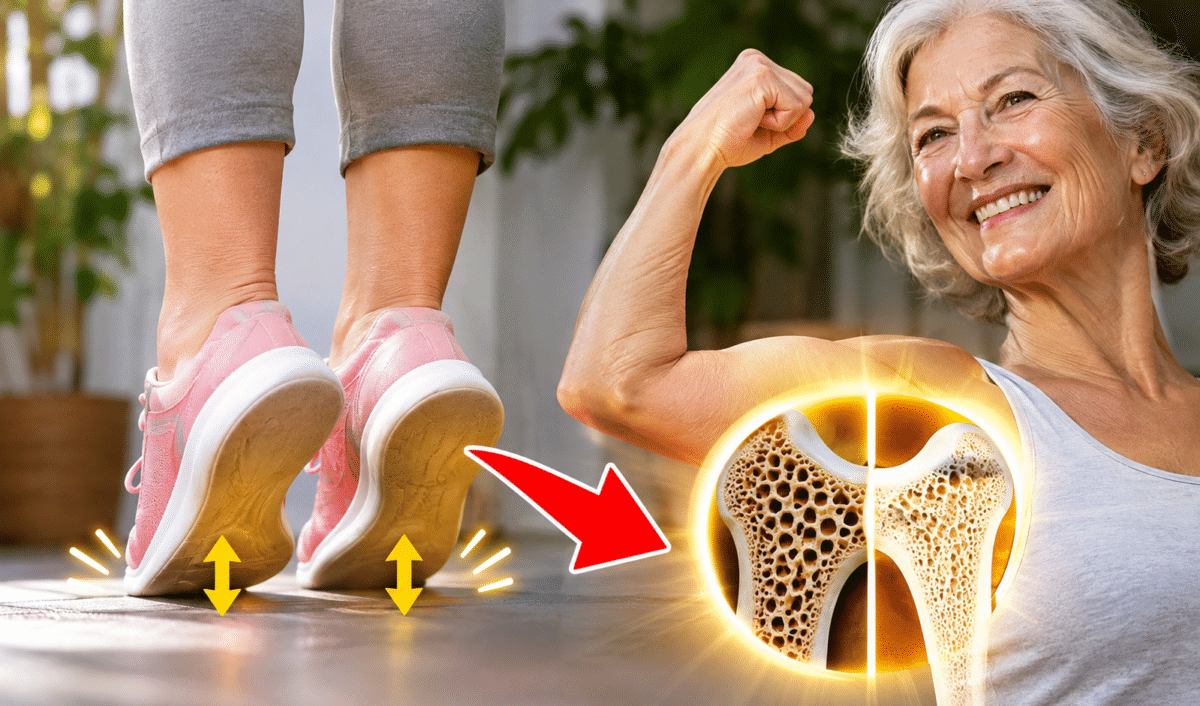
That is why a simple suggestion from a fitness trainer has been getting attention. In an article published November 13, 2026, by the fitness site T3, Steve Powell, Director of Training and Education at Power Plate, recommended heel drops, rising onto your toes and dropping back onto your heels, as an easy way to give your bones a little extra loading. The idea is not new, and the evidence is more nuanced than a viral clip suggests. Here is what is known.
What We Know
- Heel drops produced ground forces of 2.5 to 3 times body weight in a 1995 trial.
- Bone responds to impact and heavy loading more than to gentle movement.
- About 1 in 5 U.S. women 50 and older has osteoporosis, per CDC data.
- Combined lifting and impact training raised spine bone density in the LIFTMOR trial.
What Is Still Unclear
- Whether heel drops alone reduce fractures; no trial has tested that.
- The ideal number of daily repetitions or sessions.
- How well results apply to men and younger women.
- Long-term benefits beyond 12 months of heel drop practice.
The Kettle-Boiling Exercise, Step by Step
Powell describes heel drops as a “low-level plyometric exercise that introduces a small, controlled impact through the lower body,” according to T3. The movement takes seconds to learn. The key difference from a standard calf raise is the lowering phase: instead of easing your heels down slowly, you let them land a little faster so the floor sends a short jolt up through your legs and hips.
- Set upStand tall, feet hip-width apart, near a counter or rail for balance.5 seconds
- RiseLift your heels and come up onto the balls of your feet.About 1 second
- DropLet your heels land quickly but under control, knees soft, not locked.Under 1 second
- RepeatReset your posture and go again for the full set.10 to 50 reps
T3 reports that Powell suggests starting with 10 to 20 repetitions and building toward 50 as strength and confidence improve. He also cautions that the aim is a comfortable, controlled landing, not the hardest possible slam. Shoes or bare feet both work; choose whichever feels steadier and kinder to your joints.
Why a Small Jolt Matters to Bone
Bone is living tissue that constantly breaks down and rebuilds. Cells called osteoblasts lay down new bone, and osteoclasts remove old bone. Mechanical strain, especially sudden, higher-than-usual forces, signals the skeleton that it needs to stay strong. Gentle, steady activity like slow walking provides relatively little of that signal. A quick heel strike delivers a brief spike of force, which is the kind of stimulus bone appears to respond to.
What the 1995 Heel Drop Study Really Showed
The research T3 points to is a randomized controlled trial by E.J. Bassey and S.J. Ramsdale, published in the journal Bone in April 1995. It enrolled 44 healthy postmenopausal women. The test group did 50 heel drops a day at home, keeping knees and hips extended, and attended a weekly exercise class that included some high-impact activity. The control group attended a similar weekly class with only low-impact activity and did daily flexibility exercises.
The ground forces during heel drops were 2.5 to 3.0 times body weight, with a rapid rate of force rise of 50 to 100 kilonewtons per second, according to the trial abstract. Using one patient with an instrumented hip implant, the researchers found these forces appeared to travel largely undamped up to the thigh bone. That matters, because the hip is where some of the most serious fractures happen.
Here is the part often left out of social media clips. After 12 months, initial analysis showed no significant increase in bone mineral density at any measured site in either group, and the groups did not differ from each other. There was, however, evidence of a maintenance effect in the test group among women more than six years past menopause. Compliance was 83%, and leg extensor power rose 15% in both groups.
In plain terms, heel drops did not build new bone in this study. But holding bone steady matters for older women, who typically lose bone year after year. Maintaining density during a period of expected decline can be a meaningful result, even if it is a smaller win than the headlines imply.
How Many Americans Are Losing Bone
The scale of the problem explains why simple, at-home moves get so much interest. According to the CDC’s National Center for Health Statistics, the age-adjusted prevalence of osteoporosis at the hip or lower spine among adults 50 and older was 12.6% in 2017 to 2018. It was far higher in women, at 19.6%, than in men, at 4.4%. Among women 65 and older, the figure reached 27.1%.
Osteoporosis Among U.S. Adults 50 and Older, 2017 to 2018
Osteoporosis is only the far end of the spectrum. The same CDC brief found that 43.1% of adults 50 and older had low bone mass, a precursor to osteoporosis, including 51.5% of women and 33.5% of men. And the trend in women is moving the wrong way: osteoporosis prevalence among women rose from 14.0% in 2007 to 2008 to 19.6% in 2017 to 2018, while the change in men was not significant.
Low Bone Mass Among U.S. Adults 50 and Older, 2017 to 2018
The Silent Timeline of Bone Loss
The Bone Health and Osteoporosis Foundation describes a predictable lifecycle. The skeleton builds fastest in childhood and the teen years, reaches peak bone mass around age 30, and then begins a slow decline. For women, rapid loss starts around age 50 with menopause, when falling estrogen speeds up bone breakdown. The foundation notes a woman can lose up to 20% of her bone density in the five to seven years after menopause.
- Rapid growth; more bone built than will ever be lost
- Peak bone mass; slow loss begins
- Rapid loss begins for women
- Loss slows somewhat for women
- Rapid loss begins for men
Ages from the Bone Health and Osteoporosis Foundation’s bone lifecycle guide. Individual timing varies.
Why One Fracture Often Leads to Another
The real goal of bone health is not a better scan result. It is avoiding broken bones. The Bone Health and Osteoporosis Foundation estimates that about 10 million Americans have osteoporosis and another 44 million have low bone density. Osteoporosis is responsible for an estimated two million broken bones each year, yet nearly 80% of older Americans who break a bone are not tested or treated for the disease, according to the foundation.
Hip fractures are the most serious. Of nearly 300,000 hip fracture patients each year, one-quarter end up in nursing homes and half never regain their previous function, the foundation reports. Women face high odds of a second break: a 2021 report summarized by the Society for Women’s Health Research found that among female Medicare beneficiaries, about 10% had another fracture within 12 months of the first.
Those figures come from the Society for Women’s Health Research summary of a report on 2016 Medicare data, which found about 1.8 million beneficiaries had roughly 2.1 million osteoporotic fractures that year. The pattern is why doctors pay close attention to anyone who has already broken a bone after age 50.
Where Heel Drops Fit Among Bone-Building Exercises
The strongest recent evidence for exercise and bone comes from programs that combine heavy resistance training with impact. The LIFTMOR trial, published in the Journal of Bone and Mineral Research (online in 2017), randomized 101 postmenopausal women with low to very low bone mass. One group did 30-minute supervised sessions twice a week for 8 months, including deadlifts, overhead presses and back squats at high intensity, plus impact loading.
That high-intensity group improved lumbar spine bone density by 2.9%, compared with a 1.2% decline in a low-intensity home exercise control group, according to the published trial. Femoral neck density rose 0.3% in the high-intensity group. A separate 2021 randomized trial in Osteoporosis International compared bone-loading exercise with the osteoporosis drug risedronate and found medication produced larger spine gains, showing exercise is a partner to treatment, not a replacement.
Change in Bone Density With Different Approaches
GainLoss
Heel drops sit at the gentle, accessible end of this range. They need no equipment, no gym and no supervision for most healthy people, which makes them easy to start. Heavy lifting and jumping deliver larger loads but carry more risk and usually need coaching, especially for people who already have osteoporosis. For many readers, the best plan is a ladder: start with heel drops and bodyweight moves, then progress toward strength training as fitness allows.
| Who | Starting heel drops | Build toward | Support and form | Talk to a clinician first? |
|---|---|---|---|---|
| Healthy adult under 50 | 20 reps | 50 reps, 1 to 2 times a day | No support needed if balance is good | Not usually |
| Woman near or after menopause | 10 to 20 reps | 50 reps daily, as in the 1995 trial | Fingertips on a counter | If you have risk factors |
| Adult 65 and older | 10 reps | 20 to 50 reps daily | Hold a counter or rail every time | Recommended |
| Diagnosed low bone mass | 10 reps, gentle landing | As advised by a professional | Supervised at first | Yes |
| Diagnosed osteoporosis or past fracture | Only if cleared | As advised by a physical therapist | Softer, controlled lowering | Yes, before starting |
| Knee, hip or foot pain or replacement | Use a slow heel lower instead | Gentle progression only | Supportive shoes | Yes |
These starting points are indicative suggestions based on the 1995 trial protocol and common exercise practice, not results from a single study. Your needs may differ, especially if you have been diagnosed with low bone density or have had a fracture.
Building a Bone-Friendly Week
Heel drops are most useful as a daily habit stacked onto something you already do. The kettle example works because the routine is fixed: water takes two to three minutes to boil, enough time for a set of 20 to 50. Brushing your teeth, waiting for a microwave or standing in line are other cues. The Bone Health and Osteoporosis Foundation recommends regular weight-bearing and muscle-strengthening exercise as one of the best ways to protect against osteoporosis and broken bones.
- Anchor heel drops to a daily cueOne set of 10 to 50 while the kettle boils or the coffee brews.
- Add 2 days of strength trainingSquats, lunges, rows and presses with weights or bands.
- Mix in balance workStanding on one leg for 10 to 30 seconds helps prevent the falls that cause fractures.
- Keep walkingBrisk walking supports heart health and adds steady weight-bearing.
- Feed your bonesGet enough calcium, vitamin D and protein; ask your doctor about your needs.
- Ask about a bone density scanA DEXA scan is the standard way to measure bone mineral density.
Reading a Bone Density Result
A DEXA scan reports a T-score, which compares your bone density with that of a healthy young adult. Under widely used World Health Organization definitions, a T-score of -1.0 or higher is considered normal, a score between -1.0 and -2.5 indicates low bone mass, and -2.5 or lower indicates osteoporosis. Your doctor will also consider age, fracture history and other risk factors, not just the number.
- 10 to 50 heel drops a dayStart small and build gradually
- 2.5 to 3x body weightForce each drop delivers
- 2 strength days a weekFor muscle and bone
- Hold support at 65+A counter or rail every time
- T-score of -2.5 or lowerOsteoporosis range on a DEXA scan
- Pain means stopSwitch to a slow heel lower
Frequently Asked Questions
Do heel drops really help bone density?
They may help maintain it. In a 1995 trial of 44 postmenopausal women, 50 daily heel drops did not raise bone density but showed a bone maintenance effect in women more than six years past menopause.
How many heel drops should I do a day?
The original study used 50 a day. Starting with 10 to 20 and building toward 50 as comfort improves is a common approach.
Are heel drops safe if I have osteoporosis?
Check with your doctor or a physical therapist first. People with osteoporosis or a past fracture may need a gentler, controlled version or supervision.
What is the best exercise for bone density?
Programs that combine weight-bearing impact with strength training appear most effective. In the LIFTMOR trial, high-intensity lifting with impact raised spine bone density by 2.9% in 8 months.
How common is osteoporosis in the United States?
CDC data show 12.6% of adults 50 and older had osteoporosis in 2017 to 2018, including 19.6% of women and 4.4% of men.
Is walking enough to prevent bone loss?
Walking helps, but it may not provide enough force on its own. Adding impact moves like heel drops and strength training gives bones a stronger signal.
At what age does bone loss start?
Most people reach peak bone mass around age 30. Women often lose bone rapidly around menopause, up to 20% in the five to seven years afterward.
Can men benefit from heel drops?
Likely, since one in three men 50 and older has low bone mass, though the main heel drop study included only women.
The Short Version
Heel drops, rising onto your toes and letting your heels land quickly, create forces of 2.5 to 3 times body weight. In a 1995 trial, 50 a day helped some older women maintain bone density but did not increase it. Larger gains came from a trial combining heavy lifting with impact. With osteoporosis affecting 19.6% of U.S. women 50 and older, heel drops are an easy start. Pair them with strength training, balance work and a bone density test when appropriate.

Omisha is a health writer passionate about turning complex medical research into clear, actionable content readers can trust. She covers everything from nutrition and mental wellness to chronic disease management, always grounding her work in credible science and real-world relevance. When she's not writing, she's usually reading up on the latest health studies or exploring new wellness trends to write about next.