Health Back and Nerve Pain U.S. 2026
Which Stretches Actually Help Sciatica Pain — and How Do You Know When to Stop?
Five stretches physical therapists and major clinics commonly recommend, with hold times, a simple symptom traffic-light guide, what the research shows about nerve glides, and the warning signs that need same-day care.
By The Health DeskFact-checked against StatPearls, Cleveland Clinic, Ohio State Wexner and peer-reviewed meta-analysesUpdated November 15, 2026Scope U.S. adults with sciatica symptoms
It often starts with something ordinary: lifting a laundry basket, a long drive, a twist to grab something from the back seat. Then a sharp, burning or electric pain runs from the lower back through the buttock and down one leg, sometimes all the way to the foot. Sitting makes it worse. Sleeping becomes a negotiation. That is sciatica, and the first question most people ask is what they can do about it at home.
Gentle stretching is one of the most common answers, and for good reason. But “sciatica stretches” are not one-size-fits-all. The right movement depends on what is irritating the nerve, and a stretch that eases one person’s pain can aggravate another’s. This guide walks through five widely recommended options, how to tell whether a stretch is helping or hurting, and when home care is not enough.
What We Know
- Sciatica is usually caused by a herniated or bulging lumbar disc.
- Most cases improve within weeks with conservative care.
- Staying active is generally better than prolonged bed rest.
- Nerve glides reduced pain in pooled trials of lumbar radiculopathy.
What Is Still Unclear
- Which single stretch works best; few trials compare them directly.
- The ideal number of daily sessions and repetitions.
- How well results apply when the cause is stenosis rather than a disc.
- Whether stretching prevents future flare-ups over years.
Why Your Leg Hurts When the Problem Is in Your Back
The sciatic nerve is the largest nerve in the body. It forms from nerve roots in the lower spine, runs through the buttock and travels down the back of each leg. Sciatica is not a diagnosis by itself but a description of pain or tingling along that path. “A prevalent misconception often mislabels any low back pain or radicular leg pain as sciatica,” StatPearls notes; true sciatica comes from the nerve or its roots.
The most common cause is a herniated or bulging lumbar disc pressing on a nerve root, according to both StatPearls and Cleveland Clinic. Other causes include spinal stenosis, a narrowing of the spaces around the nerves that is more common after 55, as well as degenerative disc disease, spondylolisthesis, pregnancy and, less often, irritation at the piriformis muscle in the buttock. That variety is exactly why one stretch does not fit everyone.
How Common Is Sciatica?
StatPearls reports no clear difference between men and women, with peak incidence in the fourth decade of life. Heavy manual labor, prolonged sitting, obesity and smoking are commonly cited risk factors. The wide prevalence range is not a contradiction: stricter definitions, such as requiring a clinical exam, produce much lower numbers than surveys asking about back pain with leg pain.
The Five Stretches, Step by Step
Work on a firm bed, yoga mat or carpeted floor. Move slowly, breathe normally and never bounce. A stretch should create a mild pull, not a sharp or shooting pain. Holds of 20 to 30 seconds are common in clinic guidance; Providence recommends 15 to 30 seconds for the piriformis stretch, while nerve glides use gentle repetitions rather than holds.
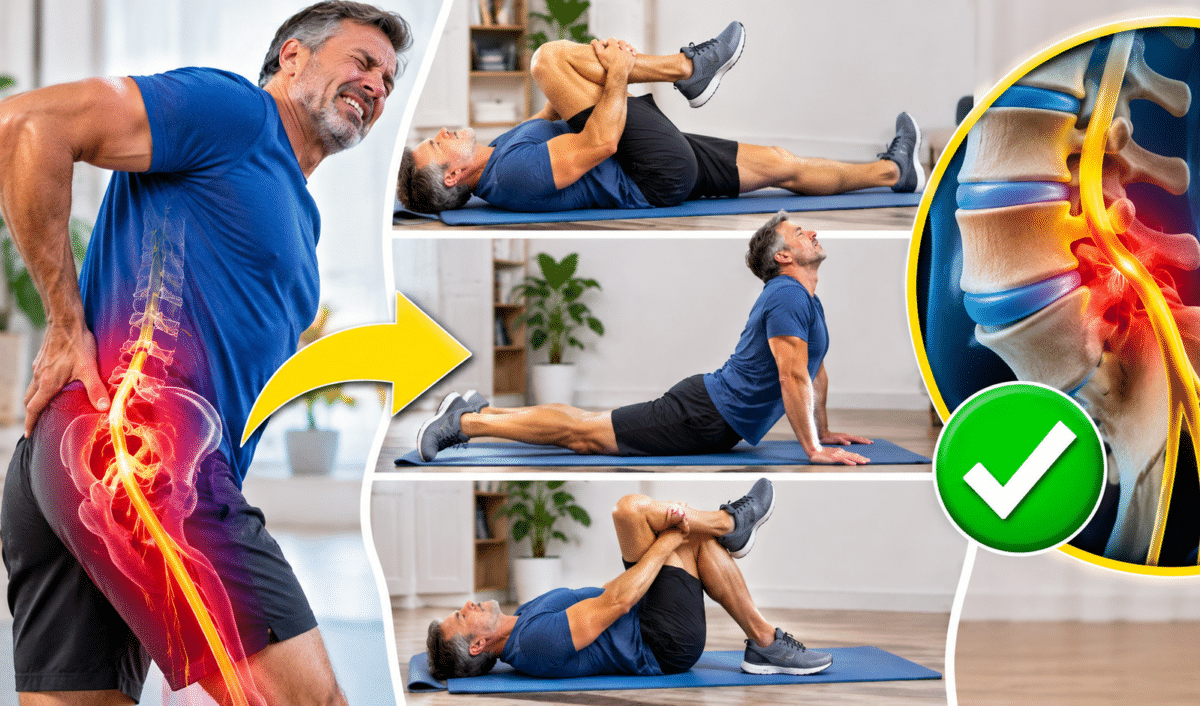
- 30sHOLDStretch 1 · Lower back and glutesKnee-to-ChestLie on your back with knees bent. Bring one knee toward your chest, holding behind the thigh or over the shin, until you feel a gentle stretch, as Cleveland Clinic describes. Lower and switch sides. This position slightly opens the spaces where nerve roots exit the spine, which often eases stenosis-type pain.3 holds each sideAbout 3 minutesSkip if it sends pain down the leg
- 30sHOLDStretch 2 · Piriformis and hipFigure-4 Piriformis StretchLie on your back with knees bent. Cross your right ankle over your left knee, then use your hands to pull the left thigh toward your chest, as Providence instructs. Hold, then switch. It targets the piriformis, a buttock muscle that sits near the sciatic nerve and can mimic or add to sciatica symptoms.3 holds each sideAbout 3 minutesGo easy with a hip replacement
- 10REPSStretch 3 · Nerve mobilitySeated Sciatic Nerve GlideSit tall on a chair. Straighten the painful leg as you look up, then bend the knee as you look down, in a smooth rhythm. The goal is to slide the nerve gently, not stretch it hard. This is the stretch with the strongest trial data, discussed below.2 sets of 10 each sideAbout 2 minutesStop at tingling, not after it
- 5REPSStretch 4 · Spine extensionProne Press-UpLie face down with hands under your shoulders. Keep hips on the floor and slowly press your upper body up, letting your lower back sag, then lower. Gentle back extension can relieve disc-related symptoms in some people, but it often aggravates stenosis, so test carefully.2 sets of 5 to 10About 1.5 minutesAvoid with known stenosis unless advised
- 30sHOLDStretch 5 · Back of the thighGentle Seated Hamstring StretchSit near the edge of a chair with one leg straight, heel on the floor and knee slightly soft. Hinge forward from the hips with a straight back until you feel a mild pull behind the thigh. Ohio State’s Wexner Medical Center lists the seated hamstring stretch among options that can ease pressure on the nerve.3 holds each sideAbout 3 minutesKeep it mild; a tense nerve dislikes force
Daily Time Budget for the Five-Stretch Routine
The Traffic-Light Test: Is the Stretch Helping?
Physical therapists often judge an exercise by where the symptoms go, not just how much they hurt. When leg pain retreats toward the back, therapists call it centralization and generally treat it as a good sign. When pain spreads farther down the leg, or numbness and tingling increase, the movement is usually stopped or changed. Use this simple guide during and right after each stretch.
Pain thresholds are indicative, based on common physical therapy practice, not a validated clinical scale.
What the Research Says About Nerve Glides
Most stretches for sciatica are backed by clinical experience more than head-to-head trials. Nerve glides, also called neural mobilization or nerve flossing, are the exception with a sizable body of randomized studies. A 2023 systematic review and meta-analysis in the journal Life pooled 20 randomized controlled trials with 877 adults with lumbar radiculopathy or sciatica.
Neural mobilization significantly reduced pain, with a standardized effect size of 1.097, and disability, with an effect size of 0.964, the authors reported. By common benchmarks, both count as large effects. The improvement in disability was most notable in chronic cases, and none of the 20 trials reported adverse events. The authors cautioned that study quality was generally weak, results varied widely between trials, and publication bias was possible.
Nerve Glides for Sciatica: Size of the Effect
A separate 2022 review in the South African Journal of Physiotherapy, covering 21 studies and 914 patients with spinally referred leg pain, also found medium to large effects on pain. Those authors noted that mostly high risk of bias prevents firm conclusions. The takeaway: nerve glides look promising and low-risk, but the evidence is not yet definitive.
Matching the Stretch to Your Pattern
The table below links each stretch to the pattern it is most often used for. It is a starting point for experimenting safely, not a diagnosis. If you are unsure what is driving your pain, a physical therapist can test which direction of movement helps.
| Stretch | Main target | Often helps when | Use caution when | Typical dose |
|---|---|---|---|---|
| Knee-to-chest | Lower back, glutes | Pain eases when bending forward or sitting | Bending forward worsens leg pain | 3 x 30 s each side |
| Figure-4 piriformis | Piriformis, hip rotators | Deep buttock pain worse with sitting | Hip replacement or hip pain | 3 x 15 to 30 s each side |
| Seated nerve glide | Sciatic nerve mobility | Leg pain with tingling, worse with leg straight | Symptoms increase or linger | 2 x 10 each side |
| Prone press-up | Lumbar extension | Pain eases when standing or lying flat | Known stenosis or pain worse leaning back | 2 x 5 to 10 |
| Seated hamstring | Back of the thigh | Tight hamstrings after long sitting | Stretch reproduces leg pain | 3 x 30 s each side |
Typical doses are drawn from clinic guidance and common physical therapy practice and are indicative. Your clinician may adjust them for your diagnosis and stage of recovery.
A Realistic Recovery Timeline
Most cases of sciatica resolve in less than 4 to 6 weeks without long-term complications, StatPearls notes. Pain that persists for 6 to 8 weeks without responding to conservative care should be imaged, with MRI as the preferred test. Ohio State Wexner Medical Center advises seeing a doctor if sciatica does not improve with self-care, persists more than a couple of weeks or gets worse.
- Days 1 to 2Cold or heat, short walks, gentle movement as tolerated
- Week 1 to 2Add 2 to 3 stretches that pass the traffic-light test
- Weeks 2 to 4See a clinician if not improving or getting worse
- Weeks 4 to 6Most people improve; add core and hip strengthening
- Weeks 6 to 8Persistent pain may need MRI and specialist review
- Keep movingShort, frequent walks usually beat lying in bed.
- Use cold, then heatMany people prefer cold in the first day or two of a flare and heat afterward, Cleveland Clinic notes.
- Test two or three stretchesKeep the ones that score green on the traffic-light test.
- Break up sittingStand and move every 30 to 60 minutes if sitting aggravates pain.
- Ask about over-the-counter pain reliefNSAIDs such as ibuprofen may help short term if safe for you.
- Book physical therapyA therapist can tailor exercises and add strengthening.
Red Flags That Need Urgent Care
Rarely, sciatica-like symptoms signal cauda equina syndrome, severe compression of the nerves at the base of the spine, or another serious problem such as infection. These are emergencies; do not try to stretch through them.
- Bladder or bowel changesNew loss of control or inability to urinate
- Saddle numbnessNumbness in the groin, buttocks or inner thighs
- Worsening leg weaknessFoot drop or stumbling
- Pain in both legsBilateral symptoms can signal cauda equina
- Fever with back painPossible infection
- After a major fall or accidentPain following significant trauma
Frequently Asked Questions
What is the fastest way to relieve sciatica pain?
Gentle movement, short walks, cold or heat and stretches that do not worsen leg pain are common first steps. Over-the-counter pain relievers may help short term. Severe or worsening pain needs medical evaluation.
How long should you hold a sciatica stretch?
About 20 to 30 seconds for static stretches such as knee-to-chest or figure-4, repeated 2 to 3 times per side. Nerve glides use smooth repetitions, often 10 per set, instead of holds.
Can stretching make sciatica worse?
Yes. Aggressive stretching or the wrong direction of movement can irritate the nerve. Stop any stretch that sends pain farther down the leg or increases numbness or tingling.
How long does sciatica usually last?
Most cases improve within 4 to 6 weeks with conservative care. Pain lasting 6 to 8 weeks without improvement may need imaging and specialist review.
Is walking good for sciatica?
Generally yes. Major clinics advise staying as active as pain allows, and prolonged bed rest is linked to slower recovery.
What are nerve glides, and do they work?
Nerve glides gently slide the sciatic nerve through its path. A 2023 meta-analysis of 20 trials with 877 people found large reductions in pain and disability, though study quality varied.
What causes sciatica?
A herniated or bulging lumbar disc is the most common cause. Spinal stenosis, degenerative disc disease, spondylolisthesis, pregnancy and piriformis irritation are other causes.
When is sciatica an emergency?
Seek emergency care for loss of bladder or bowel control, numbness in the groin or inner thighs, rapidly worsening leg weakness, symptoms in both legs or fever with back pain.
The Short Version
Five stretches commonly recommended for sciatica are knee-to-chest, figure-4 piriformis, a seated nerve glide, the prone press-up and a gentle seated hamstring stretch. Hold static stretches 20 to 30 seconds, never bounce, and stop anything that pushes pain farther down the leg. Nerve glides have the strongest trial support, with large effects in a 2023 review of 20 trials. Most sciatica improves within 4 to 6 weeks. Bladder or bowel changes, groin numbness or worsening weakness need emergency care.

Omisha is a health writer passionate about turning complex medical research into clear, actionable content readers can trust. She covers everything from nutrition and mental wellness to chronic disease management, always grounding her work in credible science and real-world relevance. When she's not writing, she's usually reading up on the latest health studies or exploring new wellness trends to write about next.