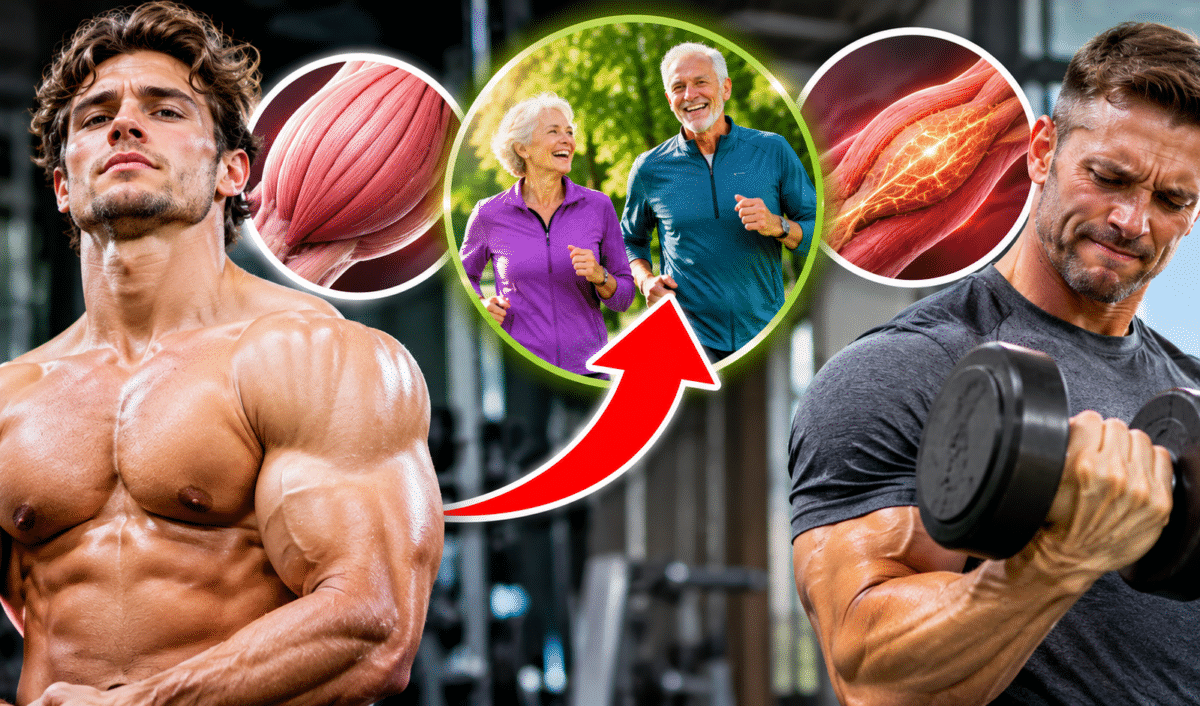
Muscle Size vs. Strength: Which Matters More for Living Longer?
Studies of more than 2 million adults point the same way: how strong your muscles are, and how quickly they can produce force, predicts longevity better than how big they look.
Picture two 65-year-olds with the same arms. One can lift a full suitcase into an overhead bin and stand from a low couch without using her hands. The other cannot. On a body scan, their muscle might look similar. On a long-term health chart, the research suggests they are on different paths. For decades, health advice focused on building or keeping muscle mass. A growing stack of large studies now says the better question is what that muscle can do.
Why This Question Matters More After 40
Muscle quietly declines with age. The National Institutes of Health notes that starting around age 30, adults lose about 3% to 5% of muscle mass per decade. Harvard Health Publishing reports that age-related muscle loss can run 1% to 2% a year from about age 35 and accelerate to 3% a year after 60, and that adults who do not strength train can expect to lose 4 to 6 pounds of muscle per decade. Researchers estimate that 10% to 20% of older adults have sarcopenia, the clinical condition of low muscle mass and function.
Yet most Americans are not doing much about it. Healthy People 2030 data show 31.5% of U.S. adults did muscle-strengthening activities on 2 or more days a week in 2022, short of the 36.6% national target. Only 22.5% met both the aerobic and muscle-strengthening guidelines that year, according to the CDC.
- Age 30Muscle mass starts declining about 3% to 5% per decade
- Age 35Loss can reach 1% to 2% a year in typical adults
- Age 50Muscle power declines steeply, European data suggest
- Age 60Loss can accelerate to about 3% a year
- Age 65+1 in 3 adults falls each year, Harvard Health notes
Size, Strength and Power Are Three Different Things
Muscle size, or mass, is how much muscle tissue you have, measured by scans such as DXA or CT. Strength is how much force muscle can produce, often measured by grip strength with a handheld dynamometer. Power is force multiplied by speed, how quickly you can produce that force, as when you catch yourself from a trip or rise briskly from a chair.
These measures are related but not identical. Strength depends on muscle size and on muscle quality, nerve signaling and fat infiltration within the muscle. That is why two people with similar muscle mass can differ widely in strength, and why researchers increasingly treat strength and power as the more meaningful markers of aging.
Early work in the Health, Aging and Body Composition study of nearly 3,000 older Americans found that strength, but not muscle size, predicted mortality. That finding helped push researchers to look beyond mass.
Head to Head: What Happens When Studies Measure Both
The most useful studies measure size and strength in the same people. A 2018 study in Medicine and Science in Sports and Exercise analyzed 4,449 U.S. adults aged 50 and older from the National Health and Nutrition Examination Survey. Low muscle mass affected 23.1% by one definition, and low strength affected 19.4%. The authors concluded that low muscle strength was independently associated with higher mortality “regardless of muscle mass, metabolic syndrome, sedentary time, or leisure-time physical activity.”
A large prospective study of Chinese adults offered a direct comparison. Compared with others, those in the lowest fifth of appendicular muscle mass had a 28% higher risk of death, those in the lowest fifth of total muscle mass had a 38% higher risk, and those in the lowest fifth of grip strength had a 68% higher risk.
Hazard ratios for lowest sex-specific fifth versus others. Source: prospective cohort study of Chinese adults (2022, PMC9433076). 1.00 means no added risk.
Violet bars measure strength or quality; aqua bars measure size. Bars scaled so 2.00 fills the track.
Two million people, one consistent signal
A 2018 meta-analysis in the Archives of Physical Medicine and Rehabilitation pooled data from about 2 million men and women. Higher handgrip strength was associated with a 31% lower risk of all-cause mortality, with a slightly stronger association in women, at 40%. The landmark PURE study in The Lancet, covering 139,691 adults aged 35 to 70 in 17 countries, found every 5 kg drop in grip strength was linked to a 16% higher risk of death, and that grip was a stronger predictor of death than systolic blood pressure.
Percent change in mortality risk. Sources: Garcia-Hermoso et al., Arch Phys Med Rehabil (2018); Leong et al., The Lancet (2015); LaMonte et al., JAMA Network Open (2026); Momma et al., BJSM (2022).
The Newest Twist: Power May Beat Strength
A study by Claudio Gil Araujo and colleagues in Mayo Clinic Proceedings in 2025 followed 3,889 adults aged 46 to 75 in Brazil’s CLINIMEX Exercise cohort for a median of 10.8 years. Researchers measured relative muscle power with an upright row test and relative strength with handgrip, both adjusted for body weight. During follow-up, 14.2% of men and 8.9% of women died.
Men in the lowest category of relative power had 5.88 times the mortality hazard of those in the highest; women had 6.90 times. For relative grip strength, the figures were 1.62 and 1.71, and these did not reach statistical significance after full adjustment. The authors concluded that relative muscle power was a stronger predictor of mortality than relative strength. Critics note the two tests used different muscle groups, which may affect the comparison.
Hazard ratio, lowest versus highest category, relative to body weight. Source: Araujo et al., Mayo Clinic Proceedings (2025), 3,889 adults aged 46 to 75, median follow-up 10.8 years.
Grip strength results were not statistically significant after full adjustment in this study.
What We Know
- Low strength predicts mortality regardless of muscle mass in U.S. data.
- Low grip carried higher risk than low muscle mass in a direct comparison.
- Body size did not explain the strength link in women aged 63 to 99.
- 30 to 60 minutes a week of strength training is linked to 10% to 20% lower death risk.
What Is Still Unclear
- Whether building strength causes longer life; most studies are observational.
- Whether power truly beats strength; only a few studies compare them.
- Why benefits of strength training appear to plateau after about an hour a week.
- The best single test for routine checkups.
Strength Counts Even When Cardio Falls Short
A February 2026 study in JAMA Network Open, led by Michael LaMonte of the University at Buffalo, followed 5,472 women aged 63 to 99 for an average of 8.4 years. Every 7 kg of greater grip strength was linked to a 12% lower mortality rate, and faster chair stands were linked to lower risk too, even after accounting for accelerometer-measured activity, sitting time, walking speed and inflammation.
Two findings stand out. Women who did not meet the 150-minute aerobic guideline still had significantly lower mortality if they were stronger. And when strength was scaled to body weight and to lean body mass, the link remained. “We also showed that differences in body size did not explain the muscular strength relationship with death,” LaMonte said.
LaMonte noted that women 80 and older are the fastest-growing U.S. age group, and that “even using soup cans or books as a form of resistance provides stimulus to skeletal muscles” for people without access to gyms.
Two Tests You Can Do at Home Today
You do not need a lab to gauge your strength. The five-repetition chair stand test measures how quickly you can stand up and sit down five times without using your arms. In a 2025 study of 43,605 middle-aged and older adults, a median time of 11 seconds served as the reference. A time of 7 seconds was linked to 26% lower mortality risk, while 18 seconds was linked to 18% higher risk.
| Chair stand time, 5 reps | Percentile in study | Mortality hazard ratio | What it suggests |
|---|---|---|---|
| 7 seconds | 10th, fastest | 0.74 | 26% lower risk than median |
| 11 seconds | 50th, median | 1.00 | Reference |
| 18 seconds | 90th, slowest | 1.18 | 18% higher risk than median |
| Cannot complete without arms | Not reported | Not reported | Talk to a clinician about strength |
| Grip, each 5 kg lower | PURE study | 1.16 | 16% higher risk per step |
Sources: 5-repetition chair stand study of 43,605 adults (2025, PMC12492024); Leong et al., The Lancet (2015). Population averages, not individual predictions.
- Set up safelyUse a sturdy chair against a wall, seat about 17 inches high.
- Cross your armsFold arms across your chest so they cannot help.
- Time 5 full standsStand fully upright and sit back down 5 times as fast as is safe.
- Record and repeatNote your time and retest every 3 months to track change.
- Check grip at a clinicAsk whether your provider has a dynamometer at your next visit.
A Worked Example: How Small Gains Add Up
Consider a hypothetical 70-year-old woman who builds grip strength through twice-weekly training. Using the JAMA Network Open figure of 12% lower mortality rate per 7 kg, the arithmetic illustrates how gains compound, though observational links cannot promise individual results.
Illustrative strength gains and associated risk
- Weekly strength training, 2 sessions of 25 minutes50 minutes
- Within the 30 to 60 minute range linked to lowest riskYes
- Hypothetical grip gain over a year7 kg
- Associated mortality rate change at 7 kg12% lower
- If gain reached 14 kg, combined estimateAbout 23% lower
- Adding aerobic activity, per BJSM meta-analysisUp to 40% lower
Hypothetical example. 14 kg equals two 7 kg steps: 0.88 times 0.88 equals 0.774, about 23% lower. Associations come from observational studies and do not guarantee results for any individual.
- Chasing muscle size alone; big muscles do not guarantee strength or power.
- Assuming cardio is enough; strength predicted survival even in women below the aerobic guideline.
- Thinking more is always better; benefits plateau around an hour a week in pooled data.
- Training only slowly; power, moving with speed, may matter most as you age.
- Waiting until 60; muscle and power losses start decades earlier.
U.S. guidelines recommend muscle-strengthening activities involving all major muscle groups on 2 or more days a week. Harvard epidemiologist I-Min Lee has noted that two 30-minute strength workouts per week would meet the guideline if all major muscle groups are targeted. Older adults may benefit from adding controlled, faster lifting phases to train power, under guidance if they have health conditions.
Frequently Asked Questions
Is muscle strength or muscle mass more important for longevity?
Most large studies find strength is the stronger predictor. A 2018 study of 4,449 U.S. adults found low strength was linked to higher mortality regardless of muscle mass, and a Chinese cohort found low grip strength carried higher risk than low muscle mass.
Why is grip strength linked to living longer?
Grip strength reflects overall muscle strength and health. The PURE study of 139,691 adults found each 5 kg drop in grip was linked to a 16% higher risk of death, making it a stronger predictor than systolic blood pressure.
What is muscle power and why does it matter?
Power is force times speed, how fast you can produce strength. A 2025 Mayo Clinic Proceedings study found the lowest power group had 5.88 to 6.90 times higher mortality risk, a stronger link than grip strength in that study.
How much strength training do I need to live longer?
A 2022 meta-analysis found 30 to 60 minutes a week was linked to 10% to 20% lower risk of death, with no clear extra benefit beyond about an hour. Guidelines recommend at least 2 days a week.
Does muscle mass still matter?
Yes. Muscle mass supports strength, metabolism and recovery from illness, and low muscle mass is linked to higher risk. But strength and power appear to capture more about how well muscle works.
How can I test my strength at home?
Try the five-repetition chair stand test: time how long it takes to stand up and sit down five times with arms crossed. In a study of 43,605 adults, 11 seconds was the median, and 7 seconds was linked to lower mortality risk.
Is it too late to build strength after 60?
No. Muscle responds to training at any age. Studies of women aged 63 to 99 found higher strength linked to lower mortality, and even simple resistance such as soup cans or books provides stimulus.
Should I do cardio or strength training for longevity?
Both. A 2022 meta-analysis found combining strength training with aerobic activity was linked to a 40% lower risk of premature death, greater than either alone.
The Short Version
When it comes to living longer, what your muscles can do matters more than how big they are. Large studies consistently find low strength predicts higher mortality regardless of muscle mass, and low grip strength carries more risk than low muscle mass. Newer research suggests power, strength delivered quickly, may matter even more. Just 30 to 60 minutes of strength training a week is linked to 10% to 20% lower risk of death, and up to 40% lower when paired with aerobic exercise. Test your chair stands, train twice a week, and include some faster movements.

Omisha is a health writer passionate about turning complex medical research into clear, actionable content readers can trust. She covers everything from nutrition and mental wellness to chronic disease management, always grounding her work in credible science and real-world relevance. When she's not writing, she's usually reading up on the latest health studies or exploring new wellness trends to write about next.