Nutrition Science · Eggs & Protein · United States
Raw vs. Cooked Eggs: Which Gives Your Body More Protein — and Does It Change Your Muscles?
Human studies found far more egg protein is digested when eggs are cooked, yet a 2022 trial saw similar muscle-building rates. Here is what the evidence shows, and what U.S. food safety rules add.
- By the Nutrition Science Desk
- Checked against peer-reviewed studies, FDA and USDA
- Updated November 24, 2026
- Scope: healthy U.S. adults
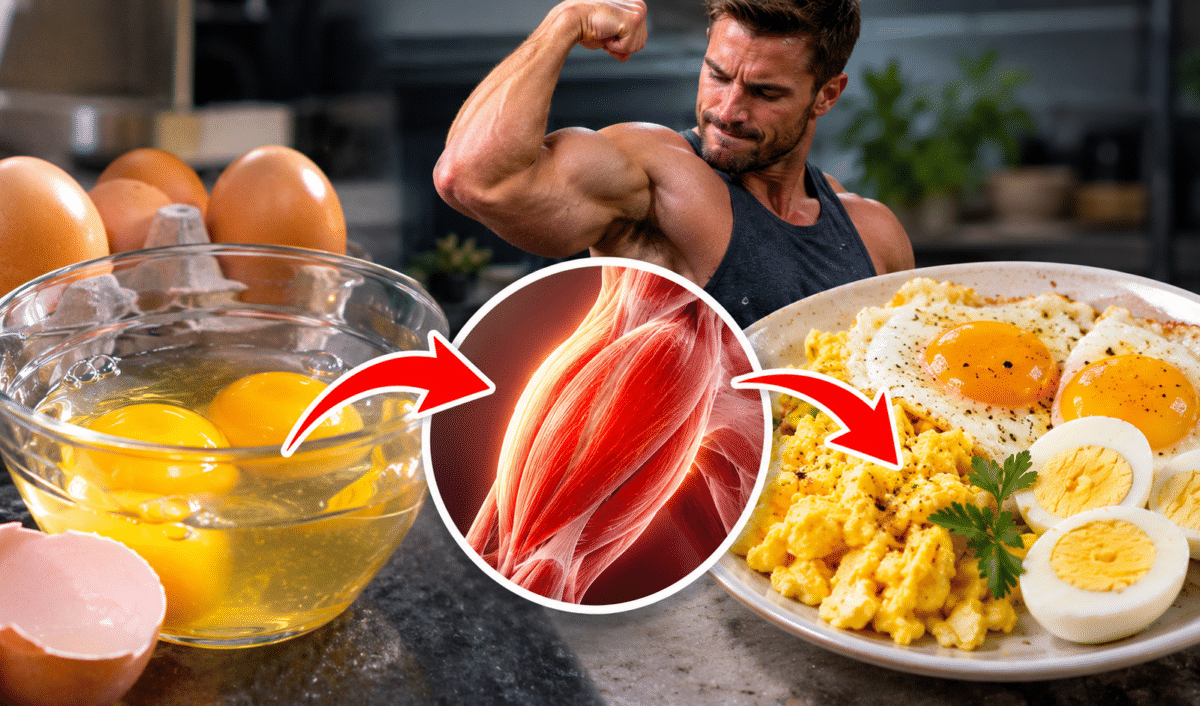
Five raw eggs cracked into a glass, swallowed in one go. The scene from the 1976 film Rocky still shows up in gym videos and social feeds, often with the claim that raw eggs are a purer, more natural protein. The research points the other way, and the details are more interesting than the myth.
The question has two parts. First, how much of an egg’s protein does your gut actually digest and absorb when it is raw versus cooked? Second, does that difference change what happens in your muscles? Researchers in Belgium answered the first in the late 1990s. A team in the Netherlands tackled the second in 2022.
The answer: Cooked eggs deliver more usable protein. In a 1998 human study, about 91% of cooked egg protein was digested in the small intestine, compared with about 51% for raw. A 2022 trial found boiled eggs also raised blood amino acids higher, though muscle protein synthesis was similar after 5 raw or 5 boiled eggs. Add the Salmonella risk the FDA warns about, and cooking wins on both nutrition and safety.
- 90.9%Cooked egg protein digested (1998 study)
- 51.3%Raw egg protein digested (same study)
- 6.3 gProtein in one large egg (USDA data)
- 79,000Yearly U.S. illnesses from Salmonella eggs (FDA estimate)
What We Know From the Research
These points come from peer-reviewed studies and federal agencies. They are the solid ground under everything else in this article.
- Digestibility gap. A 1998 study in The Journal of Nutrition measured true ileal digestibility of about 91% for cooked egg protein and 51% for raw, in 5 people.
- Confirmed in volunteers. A 1999 study of 10 healthy volunteers found 5.73% of cooked egg protein escaped the small intestine, versus 35.10% of raw.
- Muscle result. A 2022 trial in 45 resistance-trained young men found muscle protein synthesis did not differ after 5 raw versus 5 boiled eggs.
- Blood amino acids. In that trial, peak essential amino acid levels were 20% higher after boiled eggs than raw.
- Protein content. A large egg holds about 6.3 grams of protein: 3.6 in the white, 2.7 in the yolk.
- Safety rule. The FDA says to cook eggs until both the yolk and the white are firm.
What Is Still Unclear
The research is consistent but small, and some practical questions have not been tested directly.
- Small samples. The landmark 1998 digestibility study involved only 5 people with ileostomies. Its findings have been supported, but not tested at large scale.
- Long-term muscle gains. The 2022 trial measured one recovery session over 5 hours. Whether raw versus cooked eggs make any difference over months of training has not been studied.
- Women and older adults. The muscle trial included only young men, so results may not apply to women or older adults, whose protein responses can differ.
- Every cooking style. Studies compared raw with boiled or fully cooked eggs. Soft-boiled, poached and sunny-side-up eggs have not been measured separately for digestibility.
The 1998 Experiment That Measured What the Gut Keeps
Measuring protein absorption is harder than it sounds. Protein that slips past the small intestine gets broken down by colon bacteria, so stool tests can hide the real loss. The Belgian team led by Pieter Evenepoel used stable isotope-labeled egg protein and studied people with ileostomies, where digestion could be measured at the end of the small intestine.
The result was striking. Cooked egg protein was about 90.9% digestible. Raw egg protein was about 51.3%. A follow-up published in 1999 in the American Journal of Physiology fed 25 grams of labeled egg protein to 10 healthy volunteers and found the same direction of effect, with a smaller gap.
Share of egg protein digested and absorbed in the small intestine
- Cooked
- Raw
Percent of ingested egg protein. 1998: true ileal digestibility, Evenepoel et al., The Journal of Nutrition (n=5). 1999: 100% minus the share that escaped the small intestine, Evenepoel et al., American Journal of Physiology (n=10).
The 1999 study also found that a significantly higher share of the poorly absorbed raw egg protein turned up in urine as fermentation byproducts. That means undigested protein was not simply passing through. It was being fermented by gut bacteria instead of feeding the body.
Did Rocky Get It Right? The 2022 Muscle Trial
If raw eggs are digested worse, you might expect them to build less muscle. Researchers at Maastricht University tested exactly that in a study they titled “Raw Eggs To Support Postexercise Recovery in Healthy Young Men: Did Rocky Get It Right or Wrong?”, published in The Journal of Nutrition in 2022.
They recruited 45 healthy, resistance-trained young men with an average age of 24. After a single whole-body weight session, each ate 5 raw eggs, 5 boiled eggs or a control breakfast. Muscle biopsies were taken right after exercise and at 2 and 5 hours into recovery.
- 45Resistance-trained men, average age 24
- 5 eggsAbout 30 g protein, raw or boiled
- 5 hoursRecovery window measured with biopsies
- +20%Higher amino acid peak after boiled eggs
Muscle protein synthesis after exercise, by breakfast
Myofibrillar protein synthesis, percent per hour, 0 to 5 hours after exercise. Fuchs et al., The Journal of Nutrition, 2022. The control breakfast held about 5 g protein. The two egg groups did not differ significantly.
So both answers are true at once. Boiled eggs pushed blood amino acids higher, which fits the older digestion data. Yet in this 5-hour window, the muscle response was statistically the same. The authors’ conclusion was careful: raw eggs blunted the rise in blood amino acids, but did not change post-exercise muscle protein synthesis in healthy young men.
Why the muscle result does not rescue raw eggs
One plausible explanation is that 30 grams of protein is near the amount many researchers consider enough to stimulate muscle after a single workout, so even partly absorbed raw egg protein may have been sufficient. That is a hypothesis, not a finding. What the trial did not show is any advantage for raw eggs, and it did nothing to reduce the food safety risk.
How Much Protein Is Really in Your Eggs
Before comparing raw and cooked, it helps to know the starting number. USDA data compiled by nutrition references put a large egg at 6.3 grams of protein. Cooking does not change that total. A hard-boiled large egg also has about 6.3 grams. What cooking changes is how much of it your body can use.
Protein per egg, by U.S. size
Grams of protein per whole egg, based on USDA FoodData Central values as compiled by Healthline and EatThis. Egg weight in parentheses.
The split surprises many people. The white carries about 57% of the protein and the yolk about 43%, so tossing yolks throws away a large share of the protein along with most of the egg’s vitamins.
Worked Example: Three Eggs, Two Very Different Totals
Here is what the digestibility numbers mean for a common breakfast. The arithmetic uses the published percentages and is indicative, not a personal measurement.
Three large eggs at 6.3 g protein each
- Total protein on the plate18.9 g
- Cooked, at 90.9% (1998 study)17.2 g digested
- Raw, at 51.3% (1998 study)9.7 g digested
- Gap, 1998 figures7.5 g
- Cooked, at 94.3% (1999 study)17.8 g absorbed
- Raw, at 64.9% (1999 study)12.3 g absorbed
- Gap, 1999 figures5.5 g
- Raw eggs needed to match 3 cooked (1998 ratio)About 5.3 eggs
Put simply, someone drinking raw eggs for protein would need roughly 4 to 5 raw eggs to match what 3 cooked eggs deliver, depending on which study’s figures you use. That means more eggs, more cost and more exposure to the bacteria the FDA warns about.
The Hidden Vitamin Thief in Raw Egg Whites
Protein is not the only nutrient affected. Raw egg white contains avidin, a protein that binds tightly to biotin, a B vitamin, and prevents it from being absorbed. Avidin makes up only about 0.05% of egg white protein, roughly 1,800 micrograms per egg, but it binds biotin very strongly.
The risk should not be overstated. A widely used nutrition textbook notes it would take more than two dozen raw egg whites a day over many months to cause a deficiency. Oregon State University’s Linus Pauling Institute links prolonged raw egg white intake to hair loss, skin rash and neurological symptoms of biotin deficiency. Cooking denatures avidin, so cooked eggs are not a concern for biotin.
Lab research on avidin shows how heat matters. A 2020 study found its biotin-binding activity dropped by about three orders of magnitude as temperature and holding time rose across 65°C to 105°C, while high pressure alone left binding unaffected.
The Real Risk in a Raw Egg Is Not Nutritional
The strongest case against raw eggs comes from food safety. The FDA says fresh eggs, even with clean, uncracked shells, may contain Salmonella. The agency estimated that about 79,000 illnesses and 30 deaths a year are caused by eggs contaminated with Salmonella Enteritidis, the figure behind its 2010 egg safety rule.
The FDA says most people infected develop diarrhea, fever, abdominal cramps and vomiting 12 to 72 hours after infection. Washington State’s health department advises that young children, older adults and people with weakened immune systems should not eat raw or undercooked eggs.
- 1940Researchers trace “egg white injury” in animals to a raw egg white protein later named avidin.
- 1976Rocky makes drinking 5 raw eggs a training image for generations.
- 1998Belgian study finds 90.9% versus 51.3% digestibility, cooked versus raw.
- 1999Follow-up in 10 volunteers: 5.73% versus 35.10% escapes digestion.
- 2010FDA egg safety rule takes effect, aimed at 79,000 yearly illnesses.
- 2022Maastricht trial: similar muscle response, 20% lower amino acid peak with raw.
- 2024University of Illinois pig study rates eggs and egg breakfasts high on protein quality (DIAAS).
- 2026Illinois pig study reports that removing trypsin inhibitors improved egg protein digestibility more than mild heat alone.
Pasteurized shell eggs are the middle path. The University of Minnesota Extension explains they have been gently heated to inactivate Salmonella without cooking the egg, and cartons are labeled “pasteurized,” sometimes with a “P” stamp on the egg. They cost more, but they are the egg the FDA points to for recipes served raw or undercooked.
Every Way You Might Eat an Egg, Rated
This decoder table pulls the evidence and federal advice together. Protein totals stay at about 6.3 grams per large egg; what changes is how well it is digested and how safe it is.
| Preparation | Protein per large egg | Digestion evidence | FDA and health agency guidance | Bottom line |
|---|---|---|---|---|
| Raw shell egg | 6.3 g | 51.3% to 64.9% digested in studies | Avoid; Salmonella risk | Skip |
| Raw pasteurized egg | 6.3 g | Not measured separately; still raw | Option for recipes served raw | Safer, not better absorbed |
| Soft-boiled or runny yolk | 6.3 g | Not measured separately | Use pasteurized eggs if undercooked | Use pasteurized |
| Sunny-side up or over-easy | 6.3 g | Not measured separately | Use pasteurized eggs if undercooked | Use pasteurized |
| Hard-boiled | 6.3 g | Cooked: 90.9% to 94.3% in studies | Eat within 1 week of cooking | Strong choice |
| Scrambled, firm | 6.3 g | Cooked category | Should not be runny | Strong choice |
| Egg casserole or bake | 6.3 g per egg used | Cooked category | Cook to 160°F; leftovers 3 to 4 days | Strong choice |
| Raw egg in a shake | 6.3 g | Raw category | Use pasteurized egg products only | Skip unless pasteurized |
Four Raw-Egg Beliefs That Do Not Hold Up
Most confusion comes from mixing up how much protein an egg contains with how much the body can use.
Beliefs, corrected
- “Cooking destroys protein.” Heat changes protein’s shape, not its amount. A hard-boiled large egg still holds about 6.3 grams, and more of it is digested.
- “Raw eggs build more muscle.” The 2022 trial found no advantage for raw eggs. Muscle protein synthesis was similar, and blood amino acids rose less.
- “Clean, uncracked eggs are safe raw.” The FDA says Salmonella can be present even in eggs with clean, uncracked shells.
- “The protein is all in the white.” The yolk supplies about 2.7 of the 6.3 grams in a large egg, about 43%.
A safer routine for egg lovers
- 40°FStore eggs in the refrigerator at 40°F or below, checked with a thermometer, per the FDA.
- Firm yolkCook eggs until both the yolk and the white are firm; egg dishes to 160°F.
- 2 hoursDo not leave cooked eggs out more than 2 hours, or 1 hour above 90°F.
- 3 to 4 daysEat refrigerated egg dishes within 3 to 4 days; hard-cooked eggs within 1 week.
Your Egg Protein Checklist
Use this as a quick reference for getting the most protein from eggs with the least risk.
- Count about 6.3 g protein per large egg, cooked or raw.
- Expect roughly 91% of cooked egg protein to be digested, based on the 1998 study.
- Eat the yolk: it holds about 2.7 g of the protein.
- Cook until the yolk and white are firm; dishes to 160°F.
- For recipes served raw, use pasteurized eggs or egg products.
- Keep eggs at 40°F or below; refrigerate cooked eggs within 2 hours.
- Use hard-cooked eggs within 1 week and egg dishes within 3 to 4 days.
- Skip raw eggs entirely for young children, older adults and immune-compromised people.
Frequently Asked Questions
Do you absorb more protein from raw or cooked eggs?
Cooked eggs. A 1998 human study found about 90.9% of cooked egg protein was digested in the small intestine, compared with about 51.3% of raw egg protein. A 1999 study of 10 volunteers found a smaller but similar gap.
Are raw eggs better for building muscle?
No evidence shows that. A 2022 trial in 45 young men found similar muscle protein synthesis after 5 raw or 5 boiled eggs, but blood amino acid levels peaked 20% higher after boiled eggs.
Does cooking eggs destroy protein?
No. Cooking changes the shape of egg proteins, which makes them easier for enzymes to digest. A large hard-boiled egg still contains about 6.3 grams of protein.
How much protein is in one egg?
A large egg has about 6.3 grams of protein, with about 3.6 grams in the white and 2.7 grams in the yolk. Small eggs have about 4.8 grams and jumbo eggs about 7.9 grams.
Is it safe to eat raw eggs?
The FDA warns that even clean, uncracked eggs may contain Salmonella and advises cooking eggs until the yolk and white are firm. For recipes served raw, use pasteurized eggs or pasteurized egg products.
Can raw egg whites cause biotin deficiency?
They can in extreme cases. Raw egg white contains avidin, which blocks biotin absorption, but it would take more than two dozen raw egg whites a day for months. Cooking inactivates avidin.
Are pasteurized eggs safe to eat raw?
Pasteurized eggs have been gently heated to inactivate Salmonella without cooking them, and the FDA points to them for recipes served raw. They are still raw, so their protein is not expected to be absorbed as well as cooked eggs.
What is the best way to cook eggs for protein?
Any method that fully cooks the egg, such as hard-boiling, firm scrambling or baking, falls into the cooked category that studies found about 91% to 94% digestible. Keep the yolk, since it holds about 43% of the protein.
The Short Version
Cooking eggs does not destroy their protein. It makes more of it usable. Human studies found about 91% to 94% of cooked egg protein is absorbed in the small intestine, compared with about 51% to 65% of raw. A 2022 trial found similar muscle-building rates after 5 raw or 5 boiled eggs, but no advantage for raw, and a 20% lower amino acid peak. Raw eggs also carry Salmonella risk, which the FDA ties to about 79,000 illnesses a year, and raw whites can block biotin. Cook eggs until firm, keep the yolk and use pasteurized eggs for anything served raw.

Omisha is a health writer passionate about turning complex medical research into clear, actionable content readers can trust. She covers everything from nutrition and mental wellness to chronic disease management, always grounding her work in credible science and real-world relevance. When she's not writing, she's usually reading up on the latest health studies or exploring new wellness trends to write about next.