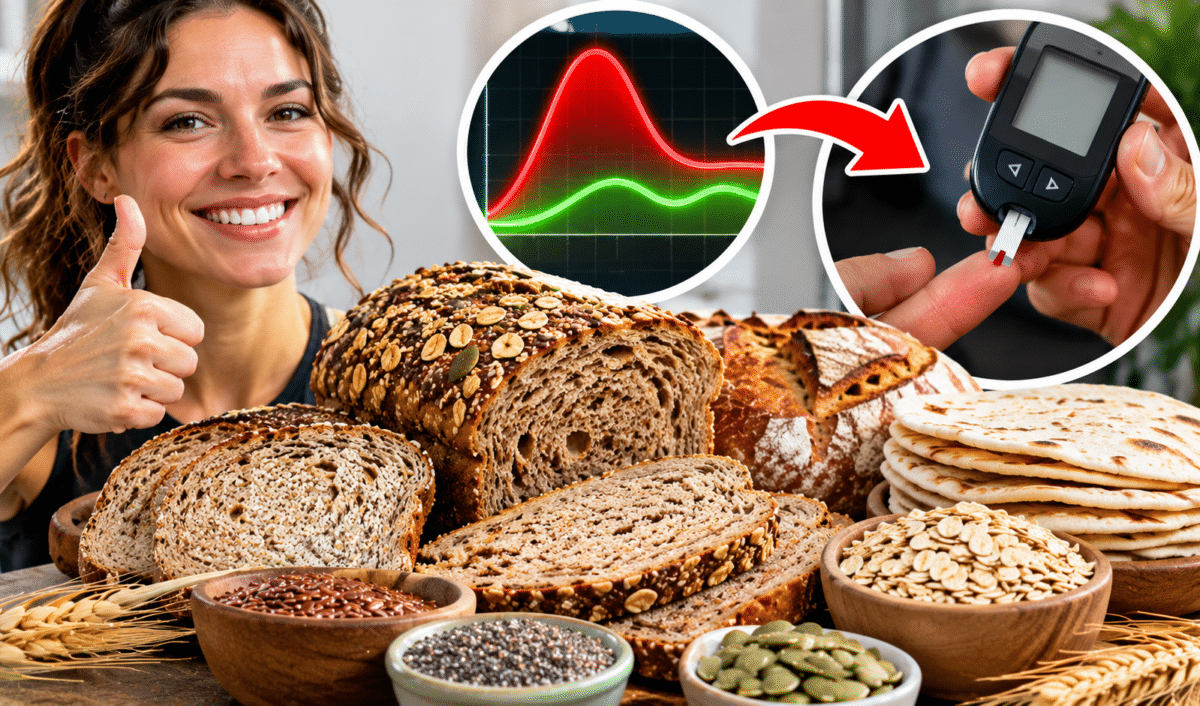
NutritionBlood SugarDietitian Picks
The 5 Best Breads for Blood Sugar, According to Dietitians — and the Label Numbers That Actually Matter
Sprouted grain, 100% whole wheat, traditional sourdough, dense rye and oat or barley breads top dietitians’ lists. Glycemic data show why texture and processing count as much as the word “whole.”
- By the Nutrition Desk
- Checked against peer-reviewed GI studies, CDC data and dietitian guidance
- Updated November 24, 2026
- Scope: U.S. shoppers and supermarket breads
You check your glucose an hour after a turkey sandwich and the number is higher than you hoped. The turkey was not the problem. Two slices of bread carry most of that meal’s carbohydrate, and not all slices behave the same way in your bloodstream.
Registered dietitians are remarkably consistent about which breads tend to work better. An EatingWell roundup reviewed by dietitians names sprouted grain, whole-wheat, sourdough, rye, oat, barley and buckwheat breads as options that support steadier blood sugar. Below are the five categories that show up most often, with the research and the label numbers behind each one.
The answer: The five breads dietitians most often recommend for blood sugar are sprouted whole grain, 100% whole wheat (ideally stone-ground), traditional sourdough (best when whole grain), dense rye or pumpernickel, and oat or barley breads with visible grains. Look for “whole” in the first ingredient and at least 3 grams of fiber per slice. Dense breads with intact grains score lowest: coarse barley bread has a glycemic index of about 34, compared with about 75 for white bread.
- 75Glycemic index of white wheat bread (Harvard Health)
- 34GI of coarse barley bread with 75% to 80% kernels
- 3 g+Fiber per slice dietitians look for
- 115.2MU.S. adults with prediabetes (CDC)
What We Know About Bread and Blood Sugar
These points rest on published glycemic index research, federal data and dietitian guidance.
- White bread is high GI. Harvard Health lists white wheat bread at a glycemic index of 75 and classifies 70 or higher as high.
- “Whole wheat” alone is not enough. Harvard Health lists whole wheat bread at 74, nearly the same as white, while specialty grain bread scores 53.
- Intact grains help most. A 1986 study found whole rye kernels produced about half the glucose response of white bread, while finely milled wholemeal rye bread did not.
- Sprouted grain showed benefits. In a trial of overweight and obese men, sprouted-grain bread lowered the glucose response compared with 11-grain, sourdough and white breads.
- Fiber is the label clue. Dietitians suggest at least 3 grams of fiber per slice and whole grain as the first ingredient.
- Many people need this. The CDC reports 40.1 million Americans have diabetes and 115.2 million adults have prediabetes.
What Is Still Unclear
Glycemic research is solid but messy, and a few gaps matter for shoppers.
- Brand-to-brand variation. GI values are measured for specific products. Two loaves labeled “sourdough” or “rye” can behave very differently.
- Long-term payoff. Lower after-meal spikes are well documented, but research has not shown meaningful improvements in long-term markers like HbA1c from switching breads alone.
- Sourdough’s mixed results. In one trial of overweight and obese men, sourdough’s glucose response was not lower than white bread’s, and it was higher than whole-grain breads when portions were matched by weight.
- Your personal response. People can respond differently to the same food. A glucose meter or CGM is the only way to see your own pattern.
Why a Slice of Bread Can Spike Glucose So Fast
Bread is mostly starch, and starch is glucose molecules strung together. When flour is milled very finely and baked into a fluffy loaf, digestive enzymes reach that starch quickly. The faster the starch breaks down, the faster glucose enters the blood. That speed is what the glycemic index measures, on a scale where pure glucose equals 100.
- 40.1MAmericans with diabetes, about 1 in 8 (CDC)
- 1 in 4People with diabetes who don’t know it
- 115.2MU.S. adults with prediabetes
- 8 in 10Adults with prediabetes who don’t know it
Glycemic index of common breads
Glucose = 100. Low GI is 55 or less; high is 70 or more. Harvard Health table for white, whole wheat and specialty grain bread; other values from the international GI tables as compiled by Spokane Falls Community College. Specific products vary.
The pattern is clear. Ordinary whole wheat sandwich bread sits almost exactly where white bread does, because both are made from finely ground flour. The breads that drop into the low range are the dense ones with visible kernels, coarse grains or traditional processing.
The Five Breads Dietitians Keep Recommending
These are the categories that appear across dietitian roundups and the research. They are listed by how consistently the evidence supports them, not by brand.
- 1
Sprouted whole grain bread
Made from whole grains that have started to germinate, which breaks down some of the starch. In a controlled trial, sprouted-grain bread lowered the glucose response compared with 11-grain, sourdough and white breads in both parts of the study, and raised GLP-1, a hormone tied to fullness.
- 2
100% whole wheat, ideally stone-ground
Whole wheat flour as the first ingredient and at least 3 grams of fiber per slice. Dietitians interviewed by EatingWell suggest stone-ground flour over roller-milled, since coarser flour digests more slowly. Standard soft whole wheat still scores near white bread, so texture matters.
- 3
Traditional sourdough, best when whole grain
Long fermentation produces acids that can slow starch digestion. Results vary: in one trial, store-style sourdough did not beat white bread on glucose. Dietitians favor traditionally made sourdough using whole wheat or rye flour rather than quick “sourdough-flavored” loaves.
- 4
Dense rye and pumpernickel
Dark, heavy rye made from coarsely ground whole rye berries. International GI tables list pumpernickel at about 50. Light “deli rye” is often mostly wheat colored with molasses or cocoa, so the heavier the loaf feels, the better.
- 5
Oat, barley and seeded whole-grain breads
Oats and barley carry beta-glucan, a soluble fiber that forms a gel and slows absorption. Coarse barley bread with 75% to 80% kernels has a GI of about 34. Seeded loaves add fiber and protein; one popular 21-grain loaf lists 5 grams of fiber and 6 grams of protein per slice.
The Grain Structure Test, in Numbers
That older study is one of the clearest demonstrations that processing matters as much as grain type. Groups of people with type 1 and type 2 diabetes ate 50-gram carbohydrate portions of different wheat and rye products.
Blood sugar response relative to white bread
Glycemic index with white bread = 100, in people with diabetes. Jenkins et al., The American Journal of Clinical Nutrition, 1986. Lower is better.
Even “German-style” breads can surprise you
Dense European breads are often assumed to be low GI. A study in the European Journal of Clinical Nutrition tested four German breads and found only the wholemeal rye bread with visible intact grains and sunflower seeds qualified as low GI.
Glycemic index of four German-style breads
Glucose = 100. European Journal of Clinical Nutrition study of breads commonly eaten in Germany. Low GI is 55 or less.
Worked Example: Same Sandwich, Different Bread
Glycemic load combines how fast a food raises blood sugar with how much carbohydrate a serving contains. A glycemic load of 10 or less per serving is generally considered low. Here is how a two-slice sandwich compares, using published values for a 30-gram serving.
Two slices, about 60 grams of bread
- White baguette, GL 15 per 30 gAbout 30
- White wheat flour bread, GL 10 per 30 gAbout 20
- Average whole wheat bread, GL 9 per 30 gAbout 18
- 100% whole grain bread (one brand), GL 7 per 30 gAbout 14
- Coarse barley bread, GL 7 per 30 gAbout 14
- Pumpernickel, GL 6 per 30 gAbout 12
Switching from a white baguette to pumpernickel cuts the sandwich’s glycemic load by roughly 60%, and from standard white bread by about 40%. These figures are indicative: real slice weights vary, and adding protein, fat and vegetables to the sandwich slows absorption further. A label check confirms the carbs: one 100% whole wheat brand lists 21 grams of carbohydrate per slice.
Five Breads at a Glance
Use this decoder to compare the five categories quickly in the bread aisle.
| Bread type | Glycemic evidence | Label clue | Fiber target | Watch out for |
|---|---|---|---|---|
| Sprouted whole grain | Lower glucose than white, sourdough and 11-grain in a trial | “Sprouted” whole grains listed first | 3 g+ per slice | Short shelf life; often frozen |
| 100% whole wheat | GI about 71 to 74 for standard soft loaves | “Whole wheat flour” first, stone-ground a plus | 3 g+ per slice | “Wheat flour” means refined |
| Traditional sourdough | Mixed: not lower than white bread in one trial | Starter or levain; whole grain flour | Varies; often low in white versions | Quick “sourdough-flavored” loaves |
| Dense rye or pumpernickel | GI about 50 for pumpernickel | Whole rye or rye meal first | 3 g+ per slice | Light deli rye made mostly of wheat |
| Oat, barley or seeded | GI 34 for coarse barley bread | Visible kernels, oats or seeds | 3 to 5 g per slice | “Multigrain” made from refined flour |
| White bread (comparison) | GI about 75 | Enriched wheat flour | Usually under 1 g | Fast spikes when eaten alone |
Where Shoppers Get Fooled in the Bread Aisle
Packaging language is designed to sound healthy. Several of the most common terms tell you very little about blood sugar.
Common mistakes, corrected
- “Wheat bread” means whole wheat. If “wheat flour” rather than “whole wheat flour” is first, it is refined flour.
- “Multigrain” means whole grain. Multigrain only means several grains; they can all be refined. Check the first ingredient and fiber.
- Any dark bread is low GI. Some rye and wheat breads are darkened with molasses or cocoa. Density and visible grain are better clues than color.
- Whole wheat solves the spike. Soft whole wheat bread scores 71 to 74 on the GI scale, close to white bread at 75.
- Bread alone determines the spike. What you eat with it matters. Protein, fat and fiber in the meal slow how quickly glucose rises.
A five-step label check
- Step 1Read the first ingredient: it should say whole wheat, whole rye, sprouted whole grains or similar.
- 3 g fiberLook for at least 3 grams of fiber per slice; 5 grams is better.
- CarbsCheck total carbohydrate per slice; many loaves land around 20 to 22 grams.
- Added sugarChoose loaves with little added sugar; several dietitian picks list 0 to 4 grams.
- Squeeze testPick up the loaf. Denser, heavier bread usually digests more slowly.
A Blood-Sugar-Smarter Bread Checklist
These habits combine dietitian advice with what the glycemic research shows.
- Choose one of the five categories: sprouted, 100% whole wheat, sourdough, dense rye or oat and barley.
- Look for 3 g or more of fiber per slice.
- Prefer visible kernels and dense texture over soft, fluffy loaves.
- Pair bread with protein, such as eggs, turkey, tuna or nut butter.
- Add vegetables or healthy fats like avocado to the same meal.
- Keep portions in mind: one slice is often 20 to 22 g of carbohydrate.
- Store sprouted bread in the freezer to prevent spoilage.
- Test your own response with a meter 1 to 2 hours after eating, if your care team advises it.
Frequently Asked Questions
What is the best bread for blood sugar?
Dietitians most often recommend sprouted whole grain bread, 100% whole wheat (ideally stone-ground), traditional whole-grain sourdough, dense rye or pumpernickel, and oat or barley breads. Dense breads with intact grains tend to have the lowest glycemic index.
Is sourdough bread good for diabetics?
It can be, especially traditionally fermented whole-grain sourdough. Research is mixed: in one trial, sourdough’s glucose response was not lower than white bread’s. Whole wheat or rye sourdough is a better pick than white sourdough.
Is whole wheat bread better than white bread for blood sugar?
It has more fiber and nutrients, but standard soft whole wheat bread has a glycemic index of about 71 to 74, close to white bread at 75. Stone-ground or whole-kernel versions perform better.
Does Ezekiel or sprouted bread raise blood sugar?
All bread raises blood sugar to some degree. In a controlled trial, sprouted-grain bread produced a lower glucose response than 11-grain, sourdough and white bread, which is why dietitians often rank it highly.
What is a low glycemic index bread?
A low-GI food scores 55 or less on the glycemic index. Pumpernickel (about 50), specialty grain bread (about 53) and coarse barley bread (about 34) fall in that range in published tables.
How much fiber should bread have for blood sugar?
Dietitians suggest at least 3 grams of fiber per slice, with whole grain listed as the first ingredient. Some seeded whole-grain breads offer 5 grams of fiber per slice.
Is rye bread good for blood sugar?
Dense, dark rye and pumpernickel made from whole rye tend to raise blood sugar more slowly than wheat bread. Light deli rye is often mostly wheat flour, so it may not offer the same benefit.
How many slices of bread can a diabetic eat?
There is no single number. It depends on your total carbohydrate plan, medications and activity. Many slices contain about 20 to 22 grams of carbohydrate, so ask your dietitian or diabetes educator how bread fits your meals.
The Short Version
The five breads dietitians most often recommend for steadier blood sugar are sprouted whole grain, 100% whole wheat, traditional whole-grain sourdough, dense rye or pumpernickel, and oat or barley breads. The research shows that processing matters as much as the grain: soft whole wheat bread scores about 74 on the glycemic index, close to white bread’s 75, while pumpernickel scores about 50 and coarse barley bread about 34. Look for “whole” first on the ingredient list, at least 3 grams of fiber per slice and a dense texture, and pair bread with protein and vegetables.

Omisha is a health writer passionate about turning complex medical research into clear, actionable content readers can trust. She covers everything from nutrition and mental wellness to chronic disease management, always grounding her work in credible science and real-world relevance. When she's not writing, she's usually reading up on the latest health studies or exploring new wellness trends to write about next.